Claim: “You Cannot Support the Burqa and Be a Feminist”
Accuracy Assessment: True
The claim is True. Supporting the burqa as a practice or institution is incompatible with feminist principles — and the counter-arguments that have been deployed to defend it do not survive scrutiny.
The core logic is well-supported: the burqa is a garment that originated in, and is overwhelmingly enforced by, patriarchal religious and cultural systems. Where it exists as a state-imposed mandate — Afghanistan under the Taliban, Iran under theocratic enforcement — it is unambiguously a tool of female oppression. Leading feminist intellectuals across the Muslim world, including Mona Eltahawy and Ayaan Hirsi Ali, explicitly argue it is impossible to reconcile support for the burqa with feminist values.
The “free choice” defence is fatally undermined by documented reality: senior Muslim clerics have explicitly stated that uncovered women invite rape (“uncovered meat”); women are shot dead by the Taliban for appearing without a burqa in public; and honour killings are triggered by refusing to wear the burqa — in the UK as well as in Afghanistan and Pakistan. When non-compliance with a dress code carries consequences ranging from rape-blame to execution, the concept of “free choice” is not merely strained — it is an active lie.
The “she chose it” argument is circular reasoning that produces the same logic used to defend FGM in the 1980s — Germaine Greer called opposition to FGM “an attack on cultural identity” — and is now universally recognised as morally bankrupt. Applied consistently, this logic would oblige feminists to endorse child marriage, foot binding, and sati.
The strongest remaining counter-argument — that banning the burqa infringes bodily autonomy — also fails under its own consistency test. Liberal democracies already ban FGM, domestic violence, and forced marriage despite religious choice defences. Consider the thought experiment: if a religious family wished to apply a painful spiked collar to a woman in public, the bodily autonomy argument would not be invoked to protect the practice — the harm principle that already governs FGM law would apply instead. The burqa’s function as a control mechanism is not negated by the fact that it is made of fabric rather than metal. There is no coherent principle that simultaneously accepts bans on FGM and domestic violence while treating the burqa as beyond scrutiny — only inconsistent special pleading rooted in reluctance to criticise a specific religion.
Key Claims at a Glance
| Claim | Assessment |
|---|---|
| The burqa originated from and enforces patriarchal control of women | ✅ True — documented by historians and Islamic scholars; used as a control mechanism by Taliban and theocratic regimes |
| Feminism’s core goal is dismantling patriarchal oppression of women | ✅ True — definitional consensus across all feminist traditions |
| The burqa is routinely imposed on women by coercion not free choice | ✅ Largely True — compulsory in Afghanistan, Iran, Saudi Arabia; not wearing it used as justification for rape, violence, and honour killings |
| Feminists who “support” the burqa can be consistent with feminist principles via bodily autonomy | ❌ Does not hold — the “she chose it” defence is circular reasoning; the anti-ban argument fails by its own standards since liberal democracies ban FGM and domestic violence despite religious choice defences |
| Prominent feminist Muslims themselves argue the burqa is incompatible with feminism | ✅ True — Mona Eltahawy, Ayaan Hirsi Ali, Ni Putes Ni Soumises, and others explicitly confirm this |
Claim Breakdown
1. The Burqa Originates From and Enforces Patriarchal Control
✅ True
The burqa is not clearly mandated by the Quran. The Wikipedia article on the burqa states: “Face veiling has not been regarded as a religious requirement by most Islamic scholars, either in the past or the present… most contemporary scholars agree that the burqa is not obligatory.” The Quran (24:31, 33:59) prescribes modesty for both sexes but does not specify full face and body covering. The burqa as it exists today is a cultural and patriarchal elaboration, shaped by interpretations that functioned — explicitly — to restrict women’s movement, visibility, and autonomy in public life.
The Newslaundry analysis (2024) documents this clearly:
“The burqa, after all, was originally imposed as a means of controlling women’s bodies and interactions with the outside world. It was justified with arguments such as protecting women from the perverted gaze, which shifts the blame onto victims of sexual violence and away from the perpetrators, reinforcing the notion that women must be controlled to prevent such violations. This approach institutionalised the suppression of women, treating them as possessions of their male guardians.”
Under the Taliban’s first rule of Afghanistan (1996–2001), the burqa was immediately imposed as law. In May 2022 — after their return to power — the Taliban again ordered all women to wear burqas covering the face, and in 2024 issued the Law on the Promotion of Virtue and Prevention of Vice. Human Rights Watch documented a 28% drop in hospital admissions within days of a November 2025 Herat edict requiring burqas to enter healthcare facilities.
The garment functions as what women’s rights campaigners have called a “mobile prison” — restricting sensory input, physical movement, and social interaction. UN experts have described Taliban enforcement of full covering as a system of “gender apartheid”.
Verdict: ✅ True. The burqa’s origins and predominant enforcement are clearly patriarchal, not religious in the Quranic sense.
2. Feminism’s Core Goal Is Challenging Patriarchal Oppression
✅ True
This is definitional across all recognised schools of feminist thought, including liberal, radical, socialist, and intersectional feminism. The UN Women definition states: “Feminism is the belief that everyone, regardless of gender, should have equal rights and opportunities.” The Britannica definition: “At its core, feminism is the belief in full social, economic, and political equality for women.”
All feminist schools — however much they diverge in strategy — share opposition to:
- Patriarchal norms that control women’s bodies
- Systems that treat women as property of male guardians
- Cultural or religious practices that enforce female subservience
The burqa, as documented above, directly embodies all three. The logical tension between supporting the burqa as a practice and being a feminist is therefore not merely rhetorical — it is structural.
Terri Murray, writing in New Humanist (2013), argues:
“The claim that covering yourself up in public is an empowering choice insults the intelligence and dignity of women everywhere, just as the theological claim that the burqa is a necessary defence against predatory male sexuality insults Muslim men… Equating feminine dignity with sexual shame requires us to view women as sexual commodities of men, objects of desire that become impure when seen.”
Verdict: ✅ True. This is not contested within feminist scholarship.
3. The Burqa Is Routinely Imposed, Not Freely Chosen
✅ Largely True
The crucial question is whether the “choice” to wear the burqa is genuinely free. The evidence points overwhelmingly to coercion as the norm:
| Country / Context | Status |
|---|---|
| Afghanistan (Taliban rule) | Legally mandated — women beaten, arrested for non-compliance |
| Iran | Mandatory hijab; face covering enforced in some contexts |
| Saudi Arabia | Full body covering (abaya) legally required until 2019; still cultural norm |
| Pakistan / conservative communities | Strong family and social pressure; girls conditioned from childhood |
| Western diaspora communities | Survey data shows significant family/community coercion |
The Feminist Majority Foundation (2025) on Afghanistan:
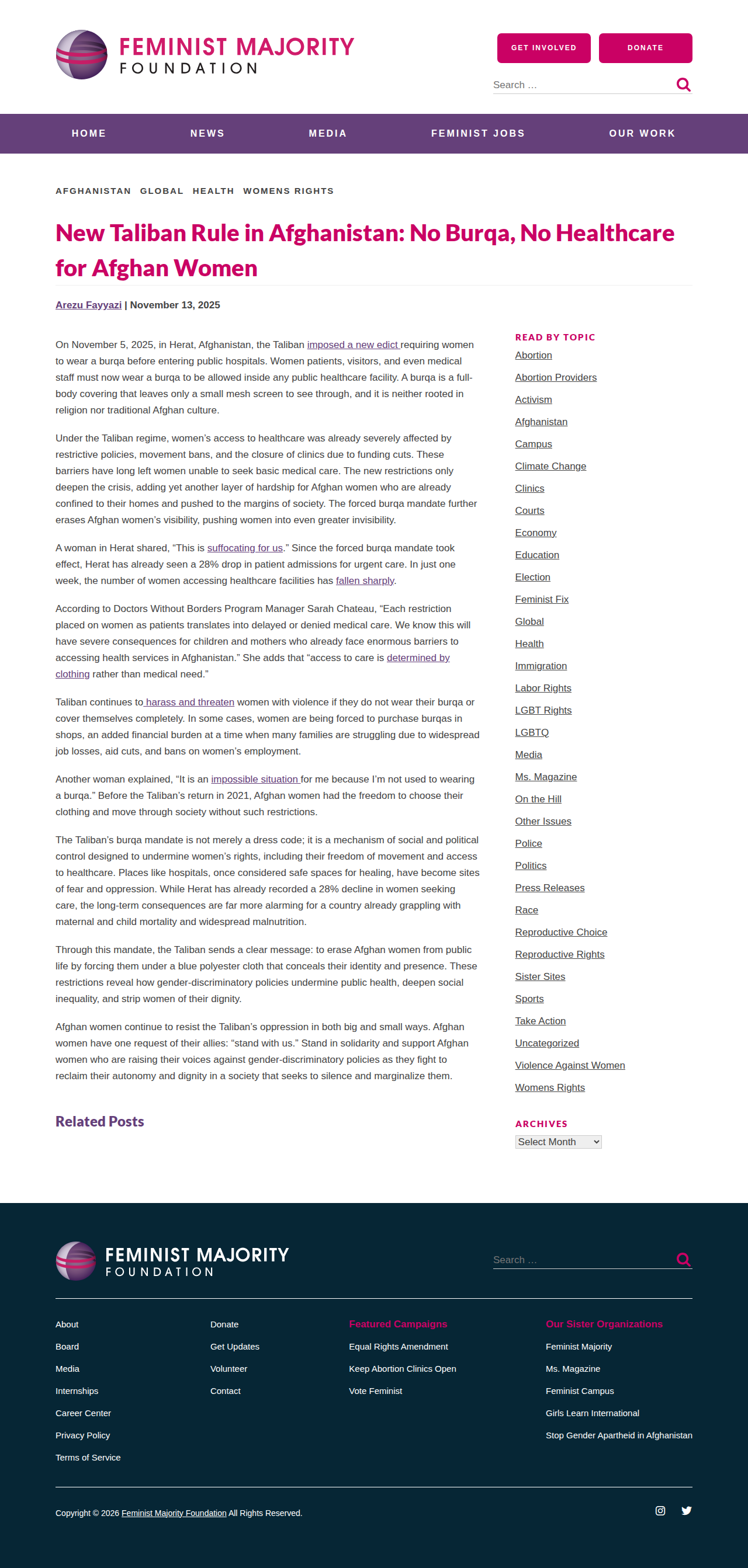
“Taliban continues to harass and threaten women with violence if they do not wear their burqa or cover themselves completely. In some cases, women are being forced to purchase burqas in shops, an added financial burden at a time when many families are struggling.”
A personal testimony published by Newslaundry illustrates ordinary coercion: “My mother was on the brink of marrying my father… he laid down a condition: she must always wear a burqa when leaving the house… My father’s word was final.” This is structural, not individual.
The most significant counterargument here is that in Western liberal democracies, some Muslim women do wear the burqa/niqab voluntarily and identify it as an expression of religious identity. This is real — but it is the exception. A 2016 DW News poll found that one-in-four French Muslims backed the burqa ban — meaning even within the Muslim community there is no consensus on its legitimacy. Reddit data from Muslim women themselves suggests “burqa wearing usually isn’t voluntary” and that “very few actually would [wear it] if they thought their family/community didn’t care.”
The “choice feminism” critique is also relevant here: just as feminism does not endorse cosmetic surgery, pornography, or other activities women may “choose” under patriarchal pressure, it does not automatically validate the burqa because an individual has been conditioned to choose it.
Not Wearing the Burqa Is Used as a Direct Justification for Rape, Violence, and Honour Killings
The idea that “choice” exists in any meaningful sense collapses entirely when one examines what happens to women who do not wear the burqa or hijab. In multiple documented contexts, the absence of full covering is explicitly invoked as a justification — or even a direct cause — of rape, sexual violence, and murder.
The “uncovered meat” sermon: In 2006, Sheikh Taj El-Din Hilaly, Australia’s most senior Muslim cleric at the time, delivered a Ramadan sermon that became internationally notorious. He stated:
“If you take out uncovered meat and place it outside… without cover, and the cats come to eat it… whose fault is it, the cats’ or the uncovered meat’s? The uncovered meat is the problem. If she was in her room, in her home, in her hijab, no problem would have occurred.”
He then referenced gang rapes carried out in Sydney by a group of Lebanese Muslim men, implying the women were partly responsible for not covering themselves. The logic is explicit: an uncovered woman invites rape. By extension, the burqa is not a “choice” but a survival mechanism under a system that blames women for their own assault if they do not wear it. (The Guardian, October 2006)
Taliban execution for not wearing a burqa: In August 2021, on the same day the Taliban held a press conference pledging to “honour women’s rights,” they shot and killed a woman in Takhar province for not wearing a burqa in public. Her body was left in a pool of blood in the street. This was not an aberration — it was policy. The Taliban’s Law on the Promotion of Virtue and Prevention of Vice (2024) formally encodes the dress requirement as morality law, with morality police empowered to detain, beat, and imprison women for non-compliance.
Honour killings triggered by dress code violations: Wikipedia’s entry on honour killings documents explicitly:
“Purdah is a religious and social practice of female seclusion prevalent among some Muslim (especially South Asian) and Hindu communities; it often requires having women stay indoors, the avoiding of socialization between men and women, and full body covering of women, such as burqa and hijab. When these rules are violated, including by dressing in a way deemed inappropriate or displaying behavior seen as disobedient, the family may respond with violence up to honor killings.”
And further:
“Refusing to wear clothes associated with a culture or a religion, such as burqa, or otherwise choosing to wear what is seen as ‘foreign’ or ‘western’ types of clothing can trigger honor killings.”
The UN estimates 5,000 women and girls are murdered each year in so-called honour killings globally. In Pakistan alone, hundreds of women are killed annually, many for “violating conservative norms governing women’s relationships” — including dress. In the UK, young women such as Heshu Yones (murdered in London by her father for being “too westernised”) and Banaz Mahmod were killed for failing to conform to expected female behaviour including dress and religious compliance.
This destroys the premise of free choice entirely. When the penalty for not wearing the burqa ranges from being blamed for your own rape, to being beaten, arrested, or executed — the idea that wearing it is a “free choice” is not simply stretched; it is nonsensical. A woman who wears a burqa under these conditions is not exercising autonomy. She is complying with a threat to her safety or life. Calling this “her choice” is the same logic as saying a hostage who cooperates with their captor does so “voluntarily.”
Verdict: ✅ Largely True. In most contexts where the burqa is worn, coercion — legal, familial, social, or theological — is the operative force, not free choice. Where not wearing the burqa exposes women to sexual violence, honour-based violence, or death, there is no meaningful choice at all.
4. Liberal Feminism’s “Bodily Autonomy” Argument
🟡 Contested
The strongest counter-argument to the claim comes from liberal and intersectional feminism. Human Rights Watch argued in 2009 against state bans:
“The argument that ‘the burqa oppresses all women’ and therefore should be banned by the state implies that it is up to the state to regulate and limit a woman’s choices about how she expresses her religious belief through her outward appearance. This is an outrageous interference that so far from protecting Muslim women, which is presumably the intention, actually further undermines their ability and their right to choose how to lead their lives.”
This position has internal coherence: if feminism is about bodily autonomy, then state-mandated dress codes — even “liberating” ones — violate that principle. A feminist can simultaneously oppose the ideology behind the burqa while defending a woman’s legal right not to be fined or imprisoned for wearing one.
However, this argument has significant limits as a counter to the original claim:
- It conflates “defending the right to wear” with “supporting the burqa” — these are categorically different positions. A feminist can oppose the criminalisation of the burqa without supporting the practice. The claim is about the latter.
- It assumes a freely choosing subject — in most real contexts, as above, the choice is not free. Defending the “right to wear” in a context where wearing is compulsory is perverse.
- The Bustle argument (“If your feminism doesn’t include Muslim women, it’s not feminism”) collapses “supporting Muslim women” with “supporting the burqa” — a category error. Supporting Muslim women means supporting their liberation from coercion, not endorsing the coercive mechanism.
Playwright Stephanie Street, arguing against the French ban in The Guardian (2010), provides the most honest version of the counter-argument: that the state ban singles out a specific religious group and imposes another form of control. At surface level this sounds principled — but it does not survive scrutiny once you apply the same reasoning to other practices that liberal democracies do, in fact, ban.
The Anti-Ban Argument Fails Its Own Legal Consistency Test
The claim that banning the burqa is an illegitimate infringement of bodily autonomy dissolves the moment you ask: why is FGM illegal in the United Kingdom?
Female genital mutilation is a criminal offence in Britain under the Female Genital Mutilation Act 2003. It is performed on girls and women who very frequently have been told since childhood that it is a religious obligation, a cultural necessity, and a mark of purity. Girls subjected to it often say it was their choice. The same “she chose it / it’s her culture” argument was deployed in its defence for decades — and the British legal system ultimately concluded that the harm to women overrides any appeal to religious or cultural preference.
The same principle applies across numerous other areas:
- Domestic violence is illegal regardless of whether the victim expresses that she “chose” to stay or frames the abuse as part of her religious relationship structure
- Child marriage is banned in the UK regardless of whether the girl has been conditioned to believe it is her duty
- Forced marriage is a criminal offence even when the woman has been coerced into appearing to consent
- Rape within marriage is illegal — the “she consented by virtue of being married” argument was rejected by UK law in 1991
In every one of these cases, the state made a determination: some practices cause sufficient harm to women that they cannot be legalised by appeal to consent, culture, or religion. No one argues that criminalising domestic violence is an “illegitimate interference in the choices of women in religious relationships.”
The burqa fails the same test. Consider a thought experiment: if a religious community had a tradition of attaching a spiked metal collar to women when they appeared in public — a painful restraining device justified by theological texts about female modesty and male protection — the bodily autonomy argument would not be invoked to protect it. The harm to women would be the deciding factor, irrespective of cultural or religious framing. The principle that already governs FGM law applies.
The burqa restricts peripheral vision, causes thermal discomfort in warm climates, physically limits movement, and signals to every observer that the woman wearing it cannot be trusted to appear in public without her body being completely hidden from view. That it is made of fabric rather than metal does not change its function as a control mechanism. The argument that the state has no basis to regulate it — while simultaneously accepting the state’s right to ban FGM, forced marriage, and domestic violence — rests on an inconsistency that has never been satisfactorily explained by those who hold it.
The Stephanie Street position is not “principled bodily autonomy feminism.” It is the same selective tolerance of harm that characterised the feminist refusal to condemn FGM in the 1980s — and it deserves the same ultimate judgement: well-meaning, but wrong.
The “Choice” Argument Is Circular Reasoning That Could Justify Any Barbaric Practice
The most fundamental problem with the “she chose it” defence of the burqa is that it is circular reasoning — and when examined logically, it is a form of reasoning that could be used to justify literally any oppressive practice imposed on women by patriarchal systems. Its logic is:
- A woman wears a burqa
- Therefore, she chose to wear it
- Therefore, it is her autonomous choice
- Therefore, it is empowering
- Therefore, supporting it is feminist
The obvious flaw: the more completely a woman is coerced — through childhood conditioning, family enforcement, community pressure, religious instruction, or the threat of rape/violence for non-compliance — the more completely she internalises the practice and the more sincerely she will assert it is her own free choice. The degree of coercion produces the stated preference. The claim that this represents autonomous choice is not just weak — it is logically backwards.
Joan Smith, writing in UnHerd, noted this exact pattern when recounting how 1980s feminists refused to condemn FGM on the grounds that “it’s their culture”:
“In the Eighties, I used to argue with women, some of them feminists, who believed in equal rights but refused to condemn ‘female circumcision’. Their defense of mutilating women’s genitals always started and ended with the same statement: ‘It’s their culture.’ Even Germaine Greer fell for it, describing moves to ban female genital mutilation as ‘an attack on cultural identity’ in her 1999 book The Whole Woman. Now FGM is a criminal offense in Britain, and rightly so.”
The parallel is precise. Exactly the same “choice” logic was applied to FGM as is now applied to the burqa. When applied to FGM, virtually everyone — including mainstream feminists — now recognises it as morally bankrupt reasoning. A girl who has been subjected to FGM, told since birth that it is necessary for her acceptance, marriage prospects, and religious standing, and who sincerely expresses that she supports the practice, has not made a free choice. She has been conditioned. The same is true of a woman who sincerely supports the burqa after a lifetime of being told that her uncovered face invites rape, dishonours her family, or contradicts God’s will.
This “chosen therefore feminist” logic, applied consistently, would require feminists to support:
- FGM, if a woman sincerely says she chose it
- Child marriage, if a teenage girl has been conditioned from birth to see it as her destiny
- Foot binding (China, historically), since women who had undergone it often defended it as a mark of beauty and status
- Sati (widow immolation, India), since some widows reportedly walked voluntarily to the pyre after a lifetime of being told it was their duty
- Any other patriarchal practice, as long as sufficient social conditioning produces a woman willing to endorse it
The absurdity of this conclusion reveals that the argument itself is incoherent as a feminist position. Feminism’s entire purpose is to challenge patriarchal conditioning — not to accept any practice the moment a conditioned woman endorses it. The line between “genuine free choice” and “internalised oppression” is not always clean, but the burqa sits firmly in the latter category given its origins, its enforcement mechanisms, and the documented consequences (including death) for women who refuse it.
The fact that the “choice” defence is enthusiastically used by Western progressive feminists — many of whom live in contexts where they face zero personal consequences for expressing an opinion — to override the voices of Muslim feminists like Mona Eltahawy, Ayaan Hirsi Ali, and Hoda Shaarawi who live or lived within affected communities, is itself a form of cultural arrogance dressed up as solidarity.
Verdict: ❌ Does not hold up under scrutiny. The liberal feminist “right to wear” argument confuses opposing state bans with supporting the burqa — but even the anti-ban position itself fails once you apply it consistently: liberal democracies ban FGM, forced marriage, and domestic violence despite religious choice defences, and there is no coherent principle that exempts the burqa. The “she chose it therefore it’s feminist” version of this argument is circular reasoning that, applied consistently, would require feminists to endorse FGM and any other barbaric practice sufficiently embedded in a culture to generate willing participants.
5. Prominent Feminist Muslims Oppose the Burqa
✅ True
The claim is significantly reinforced by the fact that some of the most prominent feminist voices from within Muslim-majority cultures explicitly reject the burqa as compatible with feminism:
Mona Eltahawy (Egyptian-born feminist columnist): “As a Muslim woman and as a feminist I support banning the face veil, everywhere… It is an ideology that describes women alternately as candy, a diamond ring or a precious stone that needs to be hidden to prove her ‘worth’. That is not a message Muslims learn in our holy book, the Qur’an.” (The Guardian, 2010)
Ayaan Hirsi Ali (Somali-Dutch feminist and human rights activist): Called the burqa a form of “female apartheid” and has repeatedly argued that it is incompatible with women’s equality and Western liberal values.
Ni Putes Ni Soumises (Neither Whores Nor Submissive, France): A prominent feminist organisation founded by French-Arab women, which supported the French burqa ban and explicitly considers the burqa a tool of female oppression.
Fadela Amara (Ni Putes Ni Soumises founder, French politician): Active supporter of burqa restrictions on feminist grounds.
Hoda Shaarawi (pioneering Egyptian feminist, 1923): Famously removed her face veil at a Cairo train station returning from an international women’s conference, declaring it “a thing of the past” — over a century ago.
These are not Western commentators projecting cultural imperialism. They are women from within the affected cultures, with direct knowledge of what the burqa means in practice, who have reached the same conclusion: it is incompatible with feminist principles.
Verdict: ✅ True. Multiple prominent Muslim feminist voices explicitly confirm the incompatibility.
Summary Table
| Sub-claim | Rating | Summary |
|---|---|---|
| Burqa originates from and enforces patriarchal control | ✅ True | Scholarly and historical consensus; not required by the Quran; used as tool of oppression by Taliban and theocratic states |
| Feminism’s core is opposing patriarchal oppression | ✅ True | Definitional — agreed across all feminist traditions |
| Burqa is routinely imposed by coercion not free choice | ✅ Largely True | Compulsory in multiple states; not wearing it is used to justify rape, violence, and honour killings — eliminating the premise of free choice |
| Liberal feminist bodily autonomy argument provides a counter | ❌ Does not hold | The “she chose it” defence is circular reasoning; the anti-ban position fails its own legal consistency test — liberal democracies ban FGM and domestic violence despite religious choice defences, with no coherent principle exempting the burqa |
| Prominent Muslim feminists confirm incompatibility | ✅ True | Eltahawy, Hirsi Ali, Ni Putes Ni Soumises — all explicitly argue burqa is incompatible with feminism |
Overall: ✅ True — The claim is correct. Supporting the burqa as a practice or institution is incompatible with feminist principles. Every counter-argument fails on examination: the “she chose it” defence is circular reasoning that produces exactly the same logic that was used to defend FGM — and which, applied consistently, would oblige feminists to endorse child marriage, foot binding, and sati. The anti-ban “bodily autonomy” position does not survive its own consistency test: liberal democracies ban FGM, forced marriage, and domestic violence despite religious choice defences, and there is no coherent principle that would simultaneously accept those bans while treating the burqa as beyond regulation. The spiked collar analogy is instructive: a painful religious restraint applied to women in public would be banned without hesitation — the fact that the burqa is made of fabric does not change its function as a control mechanism. Non-compliance with the burqa is used to justify rape, triggers family honour killings, and in Afghanistan in 2021 resulted in a woman being shot dead in the street. When Muslim feminists themselves — from Mona Eltahawy to the founders of Ni Putes Ni Soumises to the 1923 actions of Hoda Shaarawi — argue the burqa is incompatible with feminism, and when the bodily autonomy counter-argument collapses under scrutiny, the absolute phrasing of the claim is vindicated.
References
Primary Sources
-
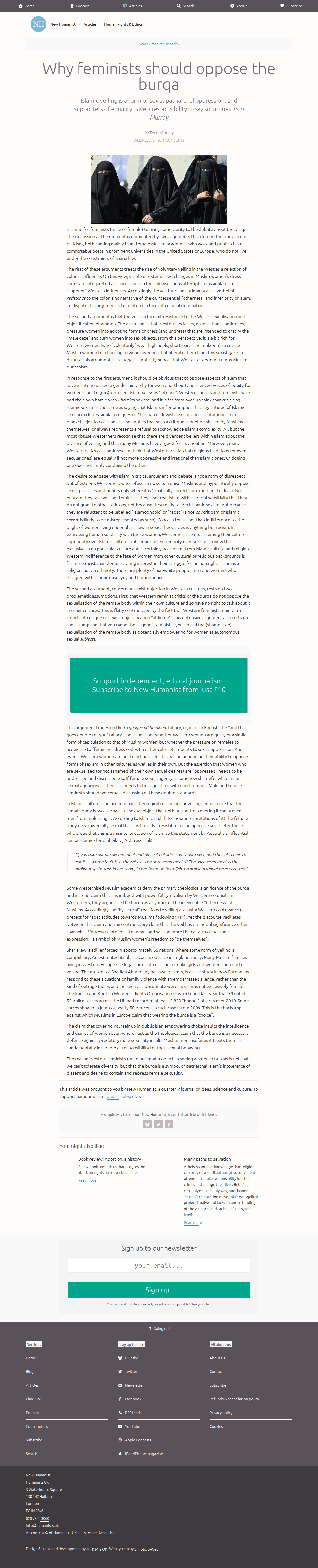
Why feminists should oppose the burqa — Terri Murray, New Humanist Published: June 2013 | Accessed: March 2026 URL: https://newhumanist.org.uk/articles/4199/why-feminists-should-oppose-the-burqa Key finding: Argues the burqa enforces a gender hierarchy rooted in the equation of female dignity with sexual shame, and that Western feminists who refuse to critique it are “fair-weather feminists”.
-
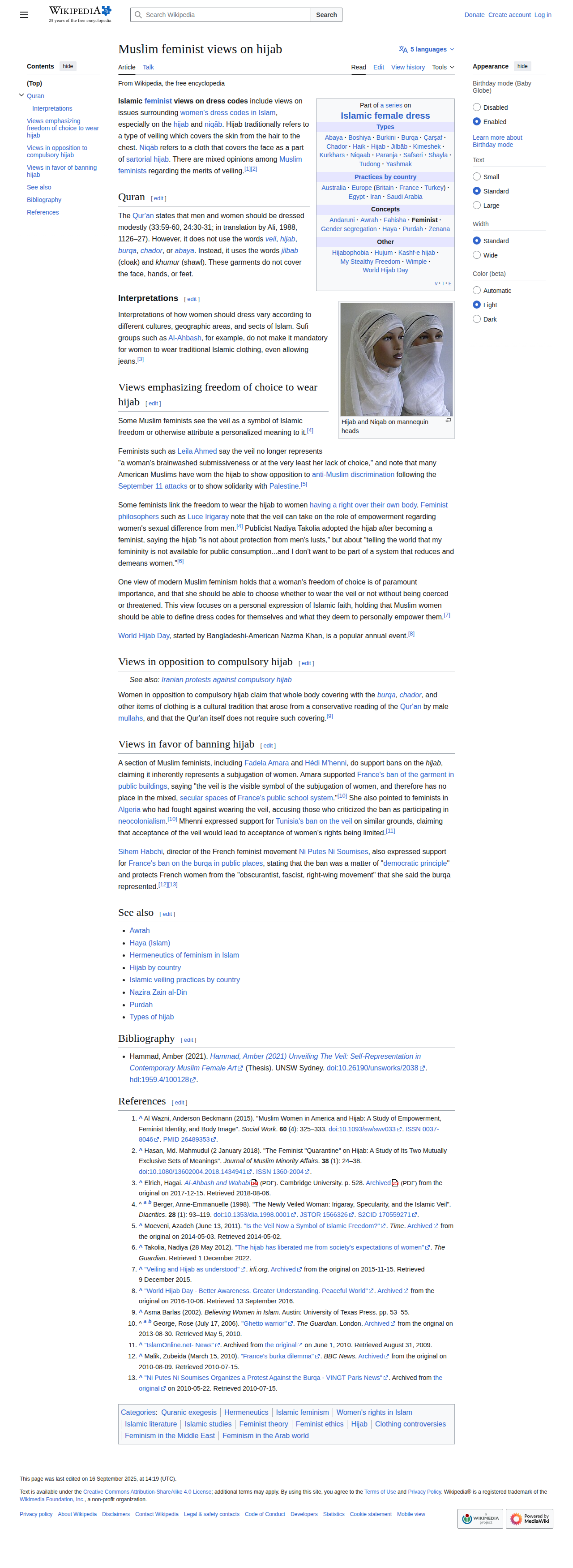
Muslim feminist views on hijab — Wikipedia Accessed: March 2026 URL: https://en.wikipedia.org/wiki/Muslim_feminist_views_on_hijab Key finding: Documents the split between Muslim feminists who support free choice to veil and those (including Fadela Amara) who support bans on grounds that veiling inherently represents female subjugation.
-
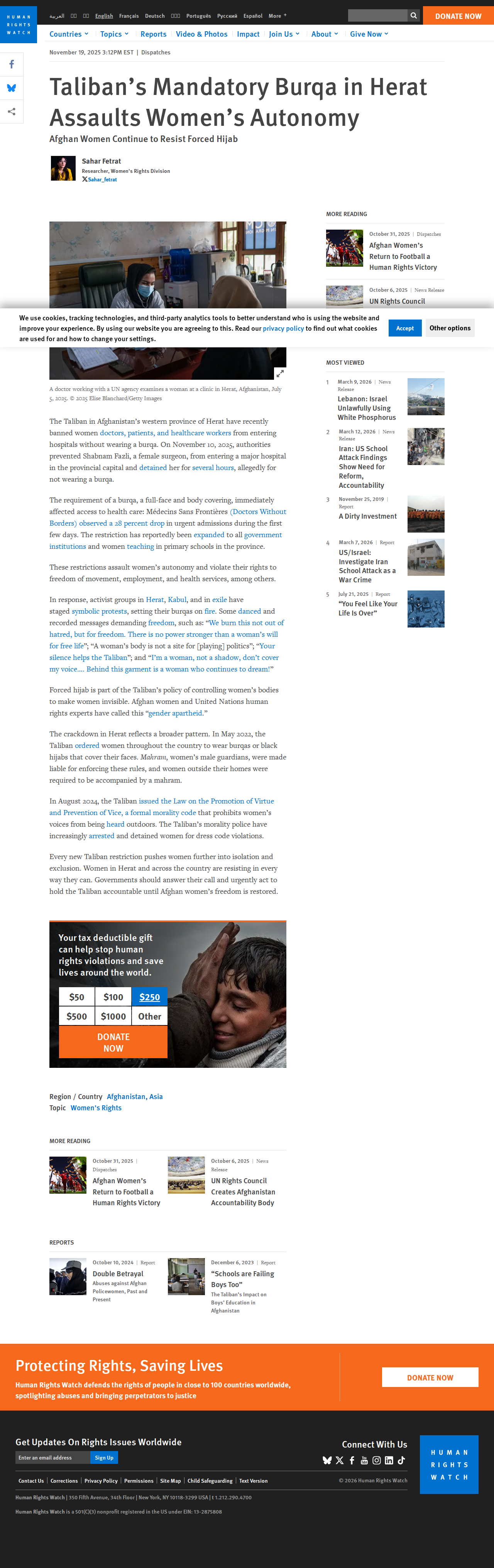
Taliban’s Mandatory Burqa in Herat Assaults Women’s Autonomy — Human Rights Watch Published: November 2025 | Accessed: March 2026 URL: https://www.hrw.org/news/2025/11/19/talibans-mandatory-burqa-in-herat-assaults-womens-autonomy Key finding: Taliban mandated burqa to enter hospitals in Herat, causing 28% drop in admissions; UN experts describe system as “gender apartheid”.
-
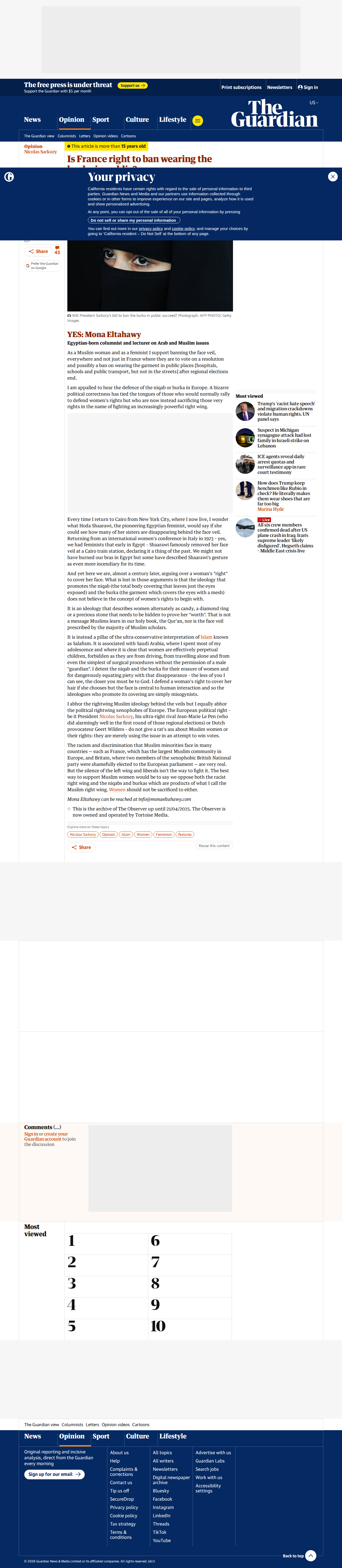
Is France right to ban wearing the burka in public? — Mona Eltahawy & Stephanie Street, The Guardian/Observer Published: March 2010 | Accessed: March 2026 URL: https://www.theguardian.com/theobserver/2010/mar/21/debate-on-french-burka-ban Key finding: Muslim feminist Mona Eltahawy argues “as a Muslim woman and as a feminist I support banning the face veil, everywhere” while the counter-position focuses on state overreach rather than supporting the practice.
-
No feminist should defend the niqab — Joan Smith, UnHerd Accessed: March 2026 URL: https://unherd.com/newsroom/no-feminist-should-defend-the-niqab/ Key finding: Argues that feminists criticising the niqab are attacking the ideology not the women; draws comparison to historical feminist reluctance to oppose FGM as “cultural practice”.
-
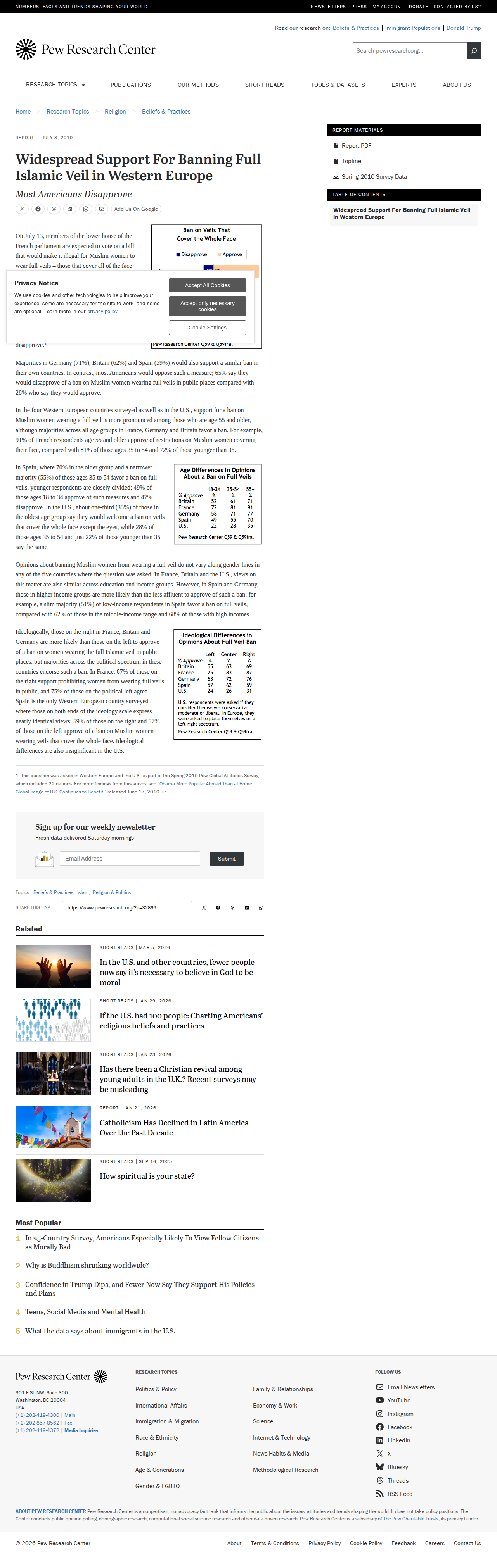
Widespread Support for Banning Full Islamic Veil in Western Europe — Pew Research Center Published: July 2010 | Accessed: March 2026 URL: https://www.pewresearch.org/global/2010/07/08/widespread-support-for-banning-full-islamic-veil-in-western-europe/ Key finding: 82% of French public, 71% Germany, 62% Britain support banning full veils in public; support spans left and right of the political spectrum.
-
The burqa paradox: Feminism’s blind spot amid patriarchal impositions — Newslaundry Published: September 2024 | Accessed: March 2026 URL: https://www.newslaundry.com/2024/09/17/the-burqa-paradox-feminisms-blind-spot-amid-patriarchal-impositions Key finding: Personal account of father imposing burqa on mother as marriage condition; argues the burqa functions as a “mobile prison” and that feminist rallying for “choice” overlooks coercive origins.
-
New Taliban Rule in Afghanistan: No Burqa, No Healthcare for Afghan Women — Feminist Majority Foundation Published: November 2025 | Accessed: March 2026 URL: https://feminist.org/news/new-taliban-rule-in-afghanistan-no-burqa-no-healthcare-for-afghan-women/ Key finding: Taliban edict in Herat denying healthcare to women without burqas; 28% drop in admissions; women quoted: “This is suffocating for us.”
-
Burqa — Wikipedia Accessed: March 2026 URL: https://en.wikipedia.org/wiki/Burqa Key finding: “Face veiling has not been regarded as a religious requirement by most Islamic scholars, either in the past or the present… most contemporary scholars agree that the burqa is not obligatory.”
-
Choice feminism — Wikipedia Accessed: March 2026 URL: https://en.wikipedia.org/wiki/Choice_feminism Key finding: Documents the “choice feminism” critique — that feminist acceptance of any “chosen” practice regardless of its patriarchal origins hollows out the movement’s ability to challenge systemic oppression.
-
Australian Muslim leader compares uncovered women to exposed meat — The Guardian Published: October 2006 | Accessed: March 2026 URL: https://www.theguardian.com/world/2006/oct/26/australia.marktran Key finding: Sheikh Taj El-Din Hilaly, Australia’s most senior Muslim cleric, stated that women without hijab are “uncovered meat” who invite rape — explicitly linking absence of covering to culpability for sexual assault.
-
Hours after vowing to ‘honour women’s rights’, Taliban kill woman in Takhar — Hindustan Times Published: August 2021 | Accessed: March 2026 URL: https://www.hindustantimes.com/world-news/hours-after-vowing-to-honour-women-s-rights-taliban-kill-woman-in-takhar-101629271919184.html Key finding: Taliban shot and killed a woman for not wearing a burqa in public — on the same day they pledged to respect “women’s rights.” Demonstrates that non-compliance with burqa carries lethal consequences.
-
Honor killing — Wikipedia Accessed: March 2026 URL: https://en.wikipedia.org/wiki/Honor_killing Key finding: Documents that refusing to wear a burqa or dressing in “western” clothing is an explicit trigger for honour killings in multiple cultures; purdah (requiring burqa/hijab) is enforced by family violence; UN estimates 5,000 women murdered annually in honour killings.
Evidence Screenshots
New Humanist — "Why feminists should oppose the burqa" (Terri Murray, 2013)
The Guardian — Debate: Mona Eltahawy vs Stephanie Street on French burqa ban (2010)
UnHerd — "No feminist should defend the niqab" (Joan Smith)

Human Rights Watch — Taliban's mandatory burqa assaults women's autonomy (2025)
Pew Research Center — Widespread support for banning full Islamic veil in Western Europe (2010)
Feminist Majority Foundation — Taliban: No burqa, no healthcare (2025)
Newslaundry — The burqa paradox: Feminism's blind spot (2024)

Wikipedia — Muslim feminist views on hijab
The Guardian — Sheikh Hilaly "uncovered meat" sermon justifying rape (2006)

Hindustan Times — Taliban kills woman for not wearing burqa (August 2021)

Wikipedia — Honor killing (dress code violations as trigger)

Evidence PDFs
| Source | |
|---|---|
| New Humanist — Why feminists should oppose the burqa | page.pdf |
| The Guardian — Burqa ban debate | page.pdf |
| UnHerd — No feminist should defend the niqab | page.pdf |
| HRW — Taliban mandatory burqa | page.pdf |
| Pew Research — Veil ban support | page.pdf |
| Feminist Majority Foundation | page.pdf |
| Newslaundry — Burqa paradox | page.pdf |
| Wikipedia — Burqa | page.pdf |
| The Guardian — Sheikh Hilaly “uncovered meat” rape justification | page.pdf |
| Wikipedia — Honor killing | page.pdf |