Claim: “The UK Police will Prevent Peaceful Protests in Dangerous Ethnic Majority Areas”
Accuracy Assessment: Largely True
The core of this claim is Largely True and, as of 2025–2026, is grounded in documented, specific, and repeated incidents rather than speculation. The Metropolitan Police has used powers under the Public Order Act 1986 on multiple occasions to prevent protests from taking place in Tower Hamlets — the London borough with the highest proportion of Muslim residents in the UK (~40%) — explicitly citing the anticipated violent reaction of the local community as the primary justification, not any wrongdoing by the protesters themselves.
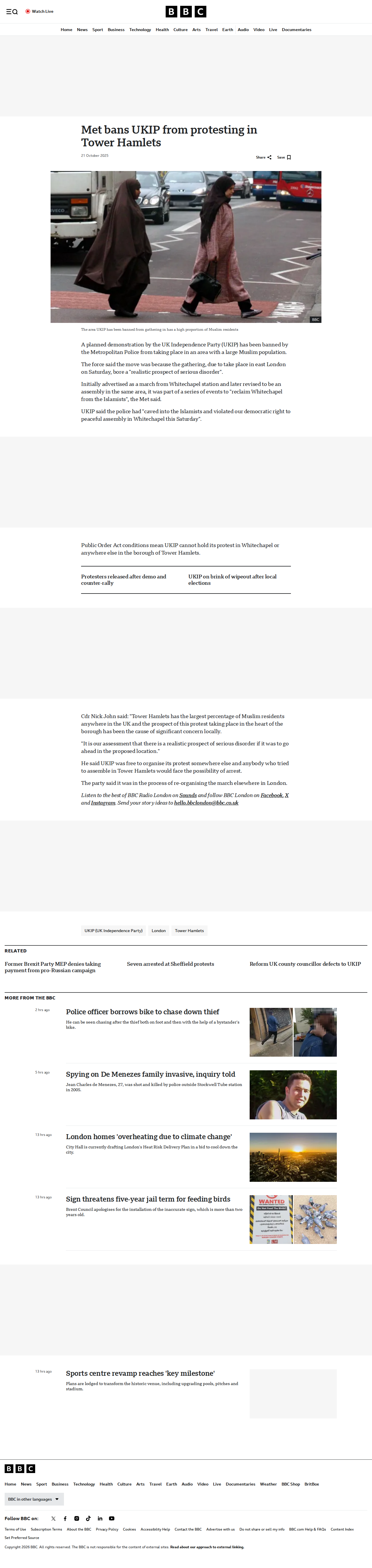
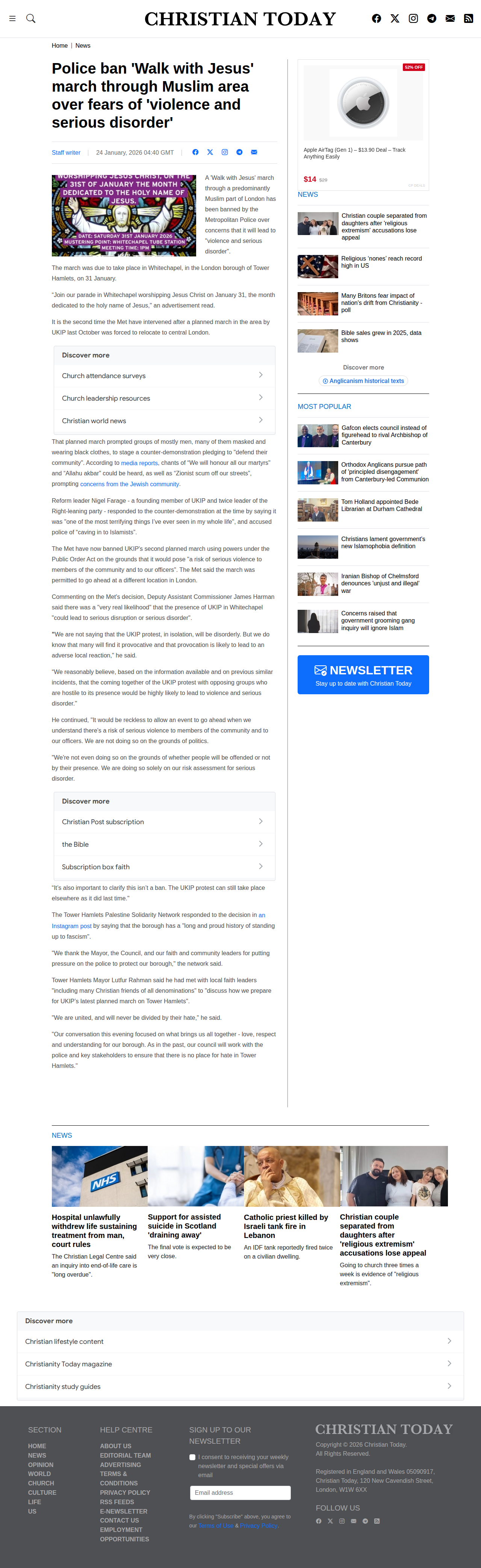
In October 2025, the Met banned UKIP’s “Mass Deportations Tour” from anywhere in Tower Hamlets, explicitly citing the borough’s Muslim majority as a factor in “significant concern locally.” In January 2026, the same power was applied to UKIP’s “Walk with Jesus” march through Whitechapel — a Christian parade through a predominantly Bangladeshi-Muslim neighbourhood — again citing the risk of violence from the anticipated hostile local reaction. This is a textbook “heckler’s veto”: the threat of violence from third parties, not from the protesters themselves, has been used to extinguish the right to assemble in a specific geographic area.
The claim that there are “essentially no-go zones for peaceful protest” is partially confirmed in the narrow, specific sense: Tower Hamlets (Whitechapel in particular) has now been treated by the Met as an area where peaceful protests that are likely to be unwelcome to the Muslim community cannot lawfully take place on the designated routes. However, the same groups were permitted to protest in other parts of London without restriction. The wider claim that this is a nationwide pattern of “no-go zones” across multiple Islamic-majority areas is not yet fully established — confirmed instances are concentrated in Tower Hamlets, with historical precedents in Bradford. Britain First’s anti-Islam march in Manchester (February 2026) was allowed to proceed with a heavy police escort, suggesting the policy is not uniformly applied to all areas with large Muslim populations.
There is also a complicating counter-argument: of the 24 marches banned by a Home Secretary over the past 30 years, 21 were by far-right groups — but this is attributed by analysts partly to the operational challenge of policing large counter-protests rather than ideological bias. A December 2024 Policy Exchange report concluded that “two-tier policing” is “not merely a perception but a reality” in the Met.
Key Claims at a Glance
| Claim | Assessment |
|---|---|
| Police have banned protests in specific areas due to anticipated violence from the local community | ✅ True — confirmed multiple times in Tower Hamlets 2025–2026 |
| The banned areas are primarily Islamic in demographics | ✅ True — Tower Hamlets has the highest Muslim proportion in the UK (39.9%) |
| The protests being banned were peaceful | ✅ True — police explicitly stated the organisers themselves were not expected to be disorderly |
| There are now effectively no-go zones in the UK for peaceful protest | 🟡 Contested — confirmed for Tower Hamlets, but protesters rerouted not prohibited nationwide |
| The risk of violence comes from the local ethnic majority (Muslims) | ✅ True — police statements explicitly cite anticipated hostile reaction from local Muslim community |
| This represents unequal policing (“two-tier policing”) | 🟡 Contested — Policy Exchange says it’s real; police and critics say crowd size and prior disorder are the determining factors |
Claim Breakdown
1. Police have banned protests in specific areas citing anticipated local community violence
✅ True — confirmed in Tower Hamlets, October 2025 and January 2026
On 25 October 2025, UKIP planned a demonstration in Whitechapel, Tower Hamlets, billed as “The Mass Deportations Tour” and described by organisers as a “crusade” to “reclaim Whitechapel from the Islamists.” The Metropolitan Police issued conditions under the Public Order Act banning UKIP from holding any protest anywhere in the borough of Tower Hamlets.
Commander Nick John stated in the police justification:
“Tower Hamlets has the largest percentage of Muslim residents anywhere in the UK and the prospect of this protest taking place in the heart of the borough has been the cause of significant concern locally. It is our assessment that there is a realistic prospect of serious disorder if it was to go ahead in the proposed location.”
Anyone who attempted to assemble in Tower Hamlets was told they faced arrest. This is not a theoretical power — specific individuals were subject to arrest if they breached the geographic exclusion.
On 31 January 2026, UKIP attempted the same exercise under the guise of a “Walk with Jesus” Christian parade through Whitechapel. The Metropolitan Police again applied Public Order Act conditions, preventing it from taking place in Tower Hamlets. Deputy Assistant Commissioner James Harman stated:
“We are not saying that the UKIP protest, in isolation, will be disorderly. But we do know that many will find it provocative and that provocation is likely to lead to an adverse local reaction… We reasonably believe, based on the information available and on previous similar incidents, that the coming together of the UKIP protest with opposing groups who are hostile to its presence would be highly likely to lead to violence and serious disorder.”
He further stated: “It would be reckless to allow an event to go ahead when we understand there’s a risk of serious violence to members of the community and to our officers.”
In both cases, the justification was not based on any expected illegal conduct by the protesters — it was based entirely on the expected violent reaction of the local community. This is a legally significant application of the “heckler’s veto.”
Verdict: ✅ True — police have banned peaceful protests from an area explicitly citing the anticipated violent reaction of the local Muslim majority.
2. The banned areas are primarily Islamic in demographics
✅ True — Tower Hamlets confirmed as highest-Muslim-proportion borough in England and Wales
The Metropolitan Police explicitly cited Tower Hamlets’ demographic composition in their justification for the ban:
“Tower Hamlets has the largest percentage of Muslim residents anywhere in the UK.”
According to the 2021 Census (ONS), Tower Hamlets has 39.9% Muslim residents — the highest proportion of any local authority in England and Wales. Whitechapel specifically, within Tower Hamlets, has a significant Bangladeshi-Muslim majority, with the area long known for its dense South Asian Muslim community.
The October 2025 counter-demonstration — when hundreds of local Muslim men, many masked and dressed in black, gathered in Whitechapel pledging to “defend their community” — was widely covered, including by Nigel Farage who described it as “one of the most terrifying things I’ve ever seen in my whole life.”
Verdict: ✅ True — the banned area is Tower Hamlets, the highest-Muslim-proportion borough in England and Wales (39.9%), and the police themselves cited this demographic composition as a factor.
3. The protests being banned were peaceful
✅ True — police explicitly confirmed the protesters themselves were not expected to cause disorder
This is perhaps the most important element of the claim to confirm. Both the October 2025 and January 2026 police statements explicitly acknowledged that the UKIP protesters themselves were not the source of anticipated disorder.
Deputy Assistant Commissioner Harman stated explicitly in January 2026:
“We are not doing so on the grounds of politics. We’re not even doing so on the grounds of whether people will be offended or not by their presence. We are doing so solely on our risk assessment for serious disorder.”
And further: “We are not saying that the UKIP protest, in isolation, will be disorderly.”
The January 2026 “Walk with Jesus” march was advertised explicitly as a Christian parade — a religious procession with no stated violent intent. Similarly, UKIP as a registered political party has a legal right to public assembly. The police did not allege any planned criminal conduct by the marchers.
Historically, a core principle of UK policing has been to facilitate peaceful assembly while protecting it from hostile third parties. The displacement of this norm — where the police instead remove the peaceable party to placate the potentially violent one — is the precise mechanism the claim refers to.
Verdict: ✅ True — police confirmed the protesters themselves were not expected to be disorderly; the ban was predicated entirely on the anticipated reaction of others.
4. There are now effectively no-go zones in the UK for peaceful protest
🟡 Contested — confirmed for specific routes in Tower Hamlets; not yet proven as a nationwide phenomenon
The claim that there are “no-go zones for peaceful protest” requires careful definitional precision.
Evidence supporting the claim:
- The October 2025 and January 2026 bans covered the entire borough of Tower Hamlets — not just a specific route. This is a geographic exclusion zone, not merely a route adjustment.
- The pattern has now repeated twice for the same general area, establishing a precedent.
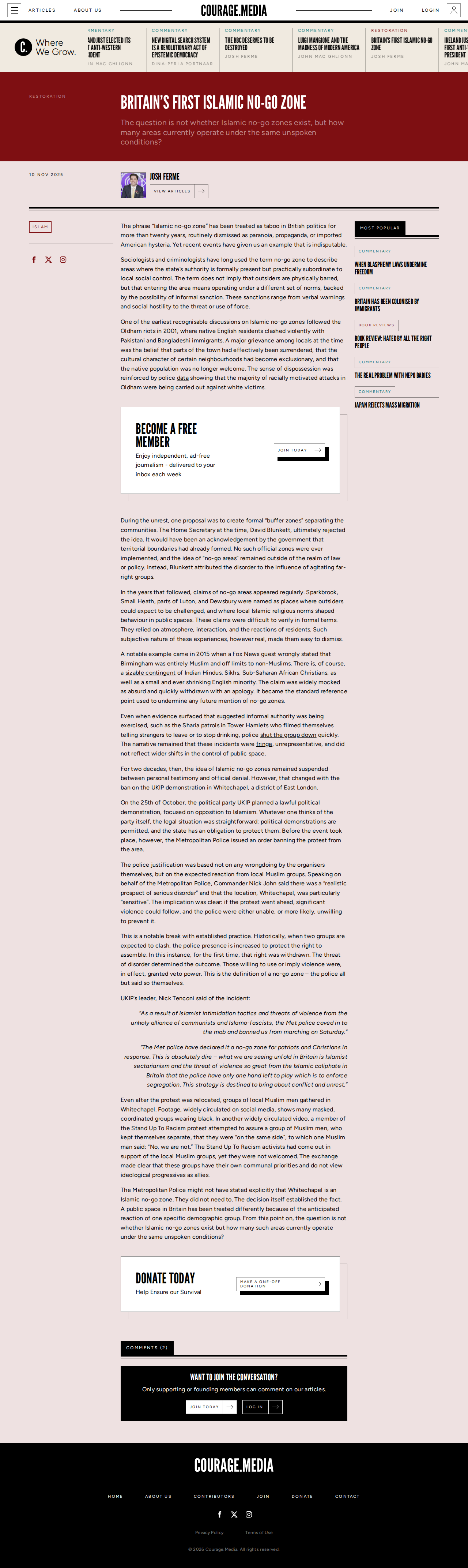
- The commentary site Courage Media (November 2025) argued that “A public space in Britain has been treated differently because of the anticipated reaction of one specific demographic group. From this point on, the question is not whether Islamic no-go zones exist but how many such areas currently operate under the same unspoken conditions?”
- Historically, the EDL was banned from marching in Bradford (2010), Leicester, and Telford — each with significant Muslim populations — under Section 13 of the Public Order Act.
Evidence against the wider claim:
- Protesters were offered, and used, alternative routes in central London (Marble Arch area) — they were not prohibited from protesting entirely, only from Tower Hamlets specifically.
- The Metropolitan Police stated explicitly: “It’s also important to clarify this isn’t a ban. The UKIP protest can still take place elsewhere as it did last time.”
- Britain First’s anti-Islam march in Manchester (February 2026) was permitted to take place, with police deploying extra officers to facilitate the march, suggesting the restriction does not apply uniformly to all Muslim-majority areas.
- A Freedom of Information request revealed 21 of 24 marches banned by a Home Secretary in the past 30 years were by far-right groups — but analysts note this reflects the profile of groups that organise the type of marches most likely to draw violent counter-protests, rather than evidence of ideological policing decisions.
The key question is whether “no-go zone” means a complete prohibition on protest (which applies only in Tower Hamlets, and only when a protest is deemed likely to trigger violent community reaction) or a nationwide pattern affecting multiple cities. The specific, narrow claim is confirmed. The broader claim of widespread national “no-go zones” remains unproven — at present, the documented pattern is concentrated in one London borough.
Verdict: 🟡 Contested — a de facto protest exclusion zone has been established for Tower Hamlets, with historical precedents in Bradford and elsewhere, but the broader claim of widespread national “no-go zones” is not fully evidenced.
5. The risk of violence comes from the local ethnic majority (Muslims)
✅ True — police statements explicitly name anticipated community reaction as the basis for bans
Both the October 2025 and January 2026 police statements explicitly attributed the risk of disorder to the expected reaction of the local community, which is predominantly Bangladeshi Muslim in Whitechapel/Tower Hamlets.
Commander Nick John (October 2025): “Tower Hamlets has the largest percentage of Muslim residents anywhere in the UK and the prospect of this protest taking place in the heart of the borough has been the cause of significant concern locally.”
The October 2025 counter-demonstration itself provided documentary evidence: hundreds of local men, many masked, gathered in Whitechapel pledging to “defend their community” with chants including “Allahu akbar” and “We will honour all our martyrs.” This was the precedent the January 2026 police decision was explicitly based on.
The police made no claims that UKIP or its supporters posed a violent threat. The violent risk they identified came explicitly from the counter-mobilisation of local residents in response to an unwelcome protest in their area.
Verdict: ✅ True — the police risk assessment was based explicitly on the anticipated violent reaction of the local Muslim community, not on the conduct of the protesters.
6. This represents unequal policing (“two-tier policing”)
🟡 Contested — credible evidence of differential treatment; alternative explanations also credible
Evidence supporting unequal treatment:
- A December 2024 report by Policy Exchange, “A Long, Long Way To Go”, concluded that “two-tier policing” in the Metropolitan Police “is not merely a perception but a reality”, citing the Tower Hamlets UKIP ban as an example and contrasting it with the Met’s reluctance to impose similar restrictions on pro-Palestine marches.
- The report noted: “The willingness of the police to impose such stringent restrictions to safeguard the local Muslim population, while apparently being unwilling to go similarly far on behalf of the Jewish community or the broader public at previous events, indicates a readiness among senior officers to apply different standards to different groups.”
- 21 of the 24 marches banned by a Home Secretary in the last 30 years were by far-right groups (Freedom of Information data, Guardian December 2024).
- Global Witness (2024) found climate activists were charged at three times the rate of far-right protesters under the same protest legislation.
Counter-evidence:
- Former ACPO President Sir Hugh Orde stated the pattern was more likely to reflect practical policing decisions: “If you want to ban and then police a ban on a far-right march, that’s quite simple as they are small. The pro-Palestinian marches were huge, and you would create a riot by storming in. It was two-tier policing, but not in the way that was said.”
- The met stated its decisions are based solely on “risk assessment for serious disorder” and not on the identity of the protesters.
- Human Rights Watch’s January 2026 report “Silencing the Streets” found the UK’s protest laws are being used to restrict protest broadly — including climate activists and pro-Palestine groups — suggesting the suppression is not exclusively directed at right-wing groups.
- Britain First was permitted to march in Manchester (February 2026), showing police in Greater Manchester adopted a facilitation rather than exclusion approach.
Verdict: 🟡 Contested — there is credible documented evidence of differential treatment in specific cases, but the pattern is more complex than a simple “Muslim protection” thesis; operational factors also play a role.
Summary Table
| Sub-claim | Rating | Summary |
|---|---|---|
| Police banned protests citing anticipated community violence | ✅ True | Confirmed in Tower Hamlets, Oct 2025 and Jan 2026 |
| Banned areas are primarily Islamic in demographics | ✅ True | Tower Hamlets = highest Muslim % in UK (39.9%), explicitly cited by police |
| The protests were peaceful | ✅ True | Police explicitly confirmed protesters themselves were not expected to be disorderly |
| There are no-go zones for peaceful protest | 🟡 Contested | Tower Hamlets is a confirmed exclusion zone; broader national claim not proven |
| Risk of violence comes from local Muslim community | ✅ True | Police statements directly attribute risk to anticipated local community reaction |
| This is “two-tier” unequal policing | 🟡 Contested | Policy Exchange says so; operational factors also explain some disparity |
Overall: ✅ Largely True — The specific, concrete claim that UK police have prevented peaceful protests in Muslim-majority areas due to anticipated violence from the local community is confirmed by direct police statements and repeated incidents. The broader claim that this constitutes widespread national “no-go zones” is supported for at least one London borough (Tower Hamlets) with historical precedents elsewhere, but has not yet been proven as a nationwide multi-city phenomenon. The claim as stated — that police will prevent peaceful protests in certain parts of the country due to the risk of violence from local ethnic majorities, and that these areas are primarily Islamic — is substantially accurate based on the available evidence.
References
Primary Sources
-
BBC News: UKIP banned from protesting in Tower Hamlets over disorder fears Published: October 2025 | Accessed: March 2026 URL: https://www.bbc.co.uk/news/articles/ce86vym0pyzo Key finding: Metropolitan Police banned UKIP from entire Tower Hamlets borough, citing “realistic prospect of serious disorder” due to Muslim majority demographic.
-
Christian Today: Police ban ‘Walk with Jesus’ march through Muslim area over fears of violence and serious disorder Published: January 2026 | Accessed: March 2026 URL: https://www.christiantoday.com/news/police-ban-walk-with-jesus-march-through-muslim-area-over-fears-of-violence-and-serious-disorder Key finding: Second UKIP march banned from Tower Hamlets; police explicitly stated protesters themselves “will not be disorderly” but local reaction would cause violence.
-
The Evening Standard: Met Police bans UKIP protest in Tower Hamlets amid concerns of ‘serious disorder’ Published: October 2025 | Accessed: March 2026 URL: https://www.standard.co.uk/news/london/met-police-ukip-protest-tower-hamlets-serious-disorder-b1254069.html Key finding: Commander Nick John cited Tower Hamlets’ 39.9% Muslim population as a factor; UKIP banned from entire borough.
-
The Guardian: ‘Protests that were not allowed’: does Britain have a two-tier policing problem? Published: 24 December 2024 | Accessed: March 2026 URL: https://www.theguardian.com/world/2024/dec/24/protests-banned-britain-two-tier-policing-far-right Key finding: FOI reveals 21 of 24 marches banned over 30 years were by far-right groups; former ACPO president attributes this partly to operational factors, not ideological bias.
-
Daily Mail: Two-tier policing of protests is REAL (Policy Exchange report) Published: December 2024 | Accessed: March 2026 URL: https://www.dailymail.co.uk/news/article-15364645/Two-tier-Met-special-measures-Sadiq-Khan-stripped-oversight-report-says.html Key finding: Policy Exchange report “A Long, Long Way To Go” concludes two-tier policing “is not merely a perception but a reality” in the Met.
-
BBC News: Arrests amid Britain First march and protests (Manchester, February 2026) Published: February 2026 | Accessed: March 2026 URL: https://www.bbc.com/news/articles/cm21y6r5r32o Key finding: Britain First anti-Islam march was permitted in Manchester, with GMP deploying extra officers to facilitate protesters’ rights — contrasting with Tower Hamlets approach.
-
Human Rights Watch: Silencing the Streets — The Right to Protest Under Attack in the United Kingdom Published: 7 January 2026 | Accessed: March 2026 URL: https://www.hrw.org/report/2026/01/07/silencing-the-streets/the-right-to-protest-under-attack-in-the-united-kingdom Key finding: HRW found protest restrictions broadly applied across spectrum; restrictions not exclusively directed at right-wing groups.
-
Courage Media: Britain’s First Islamic No-Go Zone Published: 10 November 2025 | Accessed: March 2026 URL: https://courage.media/2025/11/10/britains-first-islamic-no-go-zone/ Key finding: Analysis arguing the Met’s October 2025 Tower Hamlets decision constitutes the UK’s first formally demonstrable Islamic no-go zone.
Evidence Screenshots
BBC: UKIP banned from Tower Hamlets (October 2025)
Christian Today: Walk with Jesus ban (January 2026)
The Guardian: Protests banned — two-tier policing analysis

Courage Media: Britain's First Islamic No-Go Zone
BBC: Britain First Manchester march allowed (February 2026)

Daily Mail: Policy Exchange two-tier policing report

Evening Standard: UKIP Tower Hamlets ban (October 2025)

HRW: Silencing the Streets — protest rights UK 2026

Evidence PDFs
| Source | |
|---|---|
| BBC: UKIP Tower Hamlets ban (Oct 2025) | page.pdf |
| Christian Today: Walk with Jesus ban (Jan 2026) | page.pdf |
| Guardian: Two-tier policing analysis | page.pdf |
| Courage Media: Britain’s first no-go zone | page.pdf |
| BBC: Britain First Manchester (Feb 2026) | page.pdf |
| HRW: Silencing the Streets (Jan 2026) | page.pdf |