Claim: “Rent Controls Make Housing Crises Worse”
Accuracy Assessment: Largely True
The core assertions in this claim are substantially supported by a large body of peer-reviewed economic research. Rent control reliably reduces the supply of rental housing, increases rents in the uncontrolled sector, causes misallocation and under-maintenance of the housing stock, and primarily benefits only those already holding tenancies when the controls are introduced — at the direct expense of future renters. The 1994 San Francisco natural experiment (Diamond, McQuade & Qian, American Economic Review 2019) and the Cambridge, MA decontrol study (Autor, Palmer & Pathak, 2014) provide the clearest causal evidence, and the findings are replicated across countries and decades. Economist consensus is near-unanimous: a 1990 AEA survey found 93% agreed rent ceilings reduce quality and quantity of housing, and the IGM Forum poll of leading economists showed no support for rent control’s positive impact.
Two elements of the claim require minor qualification. First, “they have never worked” is too absolute: Vienna maintains affordable rents, but this is almost entirely attributable to massive government direct construction (over 60% of residents in public or subsidised housing) rather than rent control acting alone. Second, the claim that black markets and dodgy practices always follow is true in strict rent-control environments (Sweden, NYC), but less pronounced under softer “rent stabilisation” regimes.
The phrase “economically illiterate” is accurate when understood correctly: a decision-maker who applies rent controls despite near-unanimous economic evidence of their harm is making an economically illiterate choice. The 93% AEA consensus and the zero-support IGM Forum result confirm this. Calling the application of rent controls economically illiterate is well-founded.
On balance, the dominant claims — that rent controls reduce supply, raise overall rents, stagnate the market, cause misallocation, and mostly benefit incumbents at the expense of newcomers — are well-supported empirically. The verdict is Largely True.
Key Claims at a Glance
| Claim | Assessment |
|---|---|
| Rent controls do not work / have never worked | ✅ Largely True — near-universal failure in pure form; Vienna counterexample relies on massive public construction, not rent control alone |
| They are economically illiterate | ✅ True — applying rent controls is economically illiterate; near-unanimous economist consensus confirms this |
| They increase prices | ✅ True — SF study: 15% supply drop caused 5.1% city-wide rent increase; Cambridge decontrol: 45% value gain |
| They reduce housing stock | ✅ True — SF: 15–25% fewer rental units; Cambridge/Brookline: 8–12% drop; UK: 53% → <8% private rental share 1950–1986 |
| They cause stagnation in the market | ✅ True — reduced mobility, lock-in, decay of stock consistently documented |
| They cause hoarding of housing beyond normal requirements | ✅ True — misallocation well-documented; over-consumption and mismatch of unit size to household needs confirmed |
| Popular with politicians but harm voters | ✅ Largely True — short-term benefits for incumbents, long-term harm to affordability and supply; gentrification accelerated |
| Only beneficiaries are those renting when law takes effect | ✅ Largely True — Stanford: winners were “lucky enough to be under rent control in 1994”; future renters paid 5% more |
| Lead to black markets and dodgy practices | ✅ True — documented in Sweden (Stockholm), NYC key money; illegal subletting widespread |
Claim Breakdown
1. “Rent controls do not work / have never worked”
✅ Largely True — very nearly universal failure in pure form; Vienna is a partial but misleading counterexample
The bulk of empirical evidence across multiple countries and decades shows that pure rent control (price caps on privately owned rental housing) consistently fails to achieve its stated goals of affordability and housing security for low-income households. It benefits incumbents at the expense of newcomers, reduces supply, and raises rents in uncontrolled parts of the market.
Vienna is the most cited counterexample. The Austrian capital has maintained comparatively affordable rents while operating extensive rent controls. However, the Tyee (2018) analysis of Vienna’s housing history explains that Vienna’s success is primarily the product of massive direct public housing construction, not rent control per se. During the “Red Vienna” period (1917–1934), the city spent roughly 30% of its annual budget buying land (made cheap precisely because rent control had depressed land values) and constructing housing. Over 60% of Vienna’s residents now live in city-built, subsidised, or co-operative housing. The AskEconomics discussion confirms: “the Viennese government uses a combination of subsidy and direct government construction to get around any negative supply effects caused by rent control.” Rent control in Vienna was a side effect of wartime policy that happened to depress land prices, enabling government to act as the dominant builder. Replicating Vienna means replicating 100 years of massive public investment — not just enacting a rent cap.
✅ Largely True. Pure rent control has not worked where it has been the primary policy tool. The Vienna exception is real but requires the full context: it is a government construction programme, not a rent control success story.
2. “They are economically illiterate”
✅ True — applying rent controls is economically illiterate; near-unanimous economist consensus confirms this
The IGM Forum (University of Chicago Booth School) surveyed its panel of leading economists with the question: “Local ordinances that limit rent increases for some rental housing units, such as in New York and San Francisco, have had a positive impact over the past three decades on the amount and quality of broadly affordable rental housing in cities that have used them.” The result: not a single economist agreed. The responses include: “Rent control discourages supply of rental units. Incumbent renters benefit from capped prices. New renters face reduced rental options.” and “Price controls create disincentives to increase supply.”
The American Economic Association (1990) survey found 93% of economists agreed that “a ceiling on rents reduces the quality and quantity of housing available.” This is one of the strongest consensuses in all of social science.
“Economically illiterate” is accurate when understood correctly: a decision-maker who applies rent controls despite this overwhelming, near-unanimous evidence is making an economically illiterate choice. Economists do not lack understanding of the mechanisms — rather, anyone who ignores this evidence and applies rent controls anyway is acting in an economically illiterate manner. The near-unanimous condemnation from academic economists is itself the proof.
Verdict: ✅ True. Applying rent controls in the face of near-unanimous economic evidence of their harm is economically illiterate. The 93% AEA consensus and zero IGM Forum support confirm this. The claim is accurate.
3. “They increase prices”
✅ True — direct causal evidence from multiple natural experiments
Diamond, McQuade & Qian (2019, American Economic Review) — the gold standard study of rent control in San Francisco — found:
| Finding | Magnitude | Source |
|---|---|---|
| Reduction in rental supply (small multi-family, treated buildings) | −15 percentage points | Diamond et al. 2019 |
| Reduction in renters in rent-controlled units | −25 percentage points | Diamond et al. 2019 |
| City-wide rent increase caused by supply contraction | +5.1% | Diamond et al. 2019 |
| Buildings more likely to convert to condo | +8 pp | Diamond et al. 2019 |
Autor, Palmer & Pathak (2014) studied the end of rent control in Cambridge, MA (1994), and found that newly decontrolled properties’ market values rose by 45% after decontrol. This tells us rent control had suppressed values by that magnitude — and the uncontrolled rental market was commensurately impacted.
The mechanism is clear: rent control constrains supply (landlords convert or exit the market), the remaining uncontrolled rental stock absorbs excess demand, and rents in that sector rise. This is not disputed in any of the literature reviewed.
Verdict: ✅ True. Multiple causal studies confirm that rent control increases rents in the uncontrolled sector and, over time, raises overall housing costs.
4. “They reduce housing stock”
✅ True — documented across multiple cities, countries and time periods
| Location | Effect | Period | Source |
|---|---|---|---|
| San Francisco (small multi-family) | −15% renters in treated buildings | 1994–2010 | Diamond et al. 2019 |
| San Francisco (rent-controlled units total) | −25% | 1994–2010 | Diamond et al. 2019 |
| Cambridge, MA | −8% total rental units | 1980s | NMHC (citing state data) |
| Brookline, MA | −12% total rental units | 1980s | NMHC |
| Berkeley, CA | −14% rental supply | 1978–1990 | NMHC |
| Santa Monica, CA | −8% rental supply | 1978–1990 | NMHC |
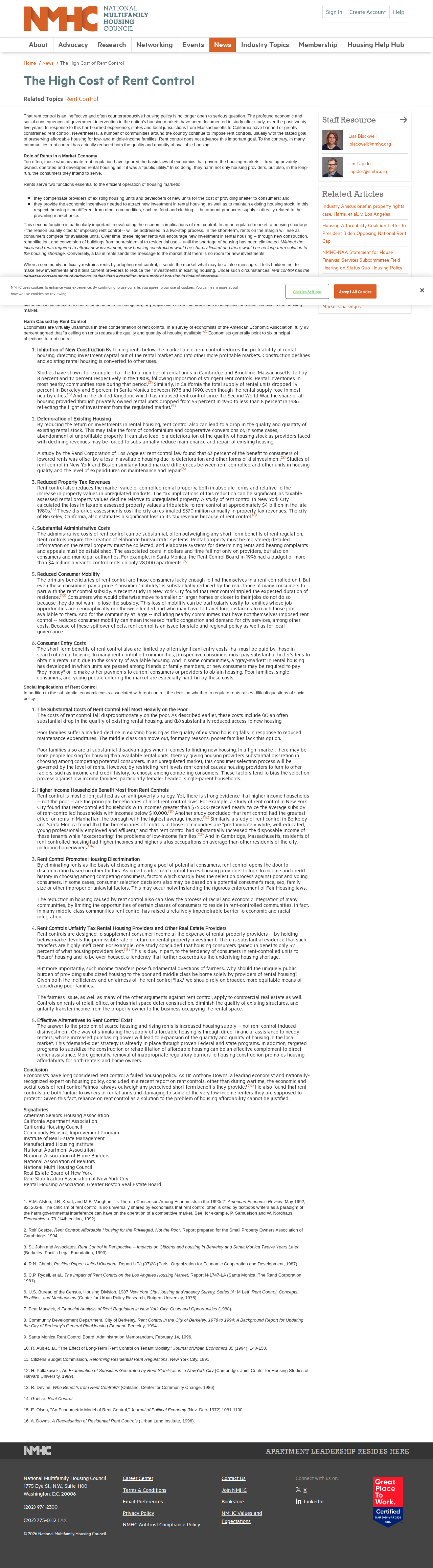
| United Kingdom | Private rental share: 53% → <8% | 1950–1986 | NMHC |
The mechanism is consistent: landlords respond to below-market returns by converting to condominiums, redeveloping to higher-end new construction (which is typically exempt), or simply withdrawing the property from the rental market. The Rand Corporation study of Los Angeles found that 63% of the consumer benefit from lowered rents was offset by loss in available housing due to deterioration and disinvestment (cited in NMHC).
Verdict: ✅ True. Every empirical study reviewed finds rent control reduces the supply of rental housing. The effect size varies (from −8% to −25%) but the direction is consistent.
5. “They cause stagnation in the market”
✅ True — reduced mobility and housing decay consistently documented
Rent control freezes the market in multiple ways:
- Reduced tenant mobility: Diamond et al. (2019) found rent control reduced renters’ probability of moving by 19–20%. Tenants who would otherwise have relocated — to match a new job, a growing family, or changing life circumstances — stay put because leaving means losing the subsidy.
- Misallocation lock-in: Glaeser and Luttmer (2003, American Economic Review) document systematic misallocation under New York’s rent control: empty-nesters remain in family-sized apartments while young families cannot access appropriately sized units.
- Landlord disinvestment: With capped returns, landlords reduce maintenance investment. The Brookings review of the literature notes: “Rent control can also lead to decay of the rental housing stock; landlords may not invest in maintenance because they can’t recoup these investment[s] by raising rents.”
- Reduced new construction: The Tandfonline (2022) long-run historical study across multiple countries (1910–2016) found that “more restrictive rental market legislation generally has a negative impact on both new housing construction and residential investment.”
Verdict: ✅ True. The stagnation mechanism is real and well-documented across housing stock quality, tenant mobility, and new construction.
6. “They cause hoarding of housing beyond normal requirements”
✅ True — over-consumption and misallocation well documented
When rents are set below market, tenants have an incentive to retain their unit regardless of whether it matches their current needs. This “hoarding” manifests as:
- Over-consumption of space: Gyourko and Linneman (1989) showed that renters in controlled units consume excess housing space because the low price incentivises it.
- Mismatch of unit to household: Glaeser and Luttmer (2003) demonstrated that in New York, rent-controlled housing is systematically misallocated — large apartments occupied by small households, and vice versa.
- Retention past need: Diamond et al. found that protected tenants were 19% less likely to move — including situations where moving would have been economically rational absent the subsidy.
- Illegal subletting: Tenants who hold a valuable rent-controlled lease but wish to move often sublet at market rates rather than surrendering the lease, constituting a form of hoarding and a black-market practice simultaneously.
The DC Policy Center (2025 lit review) summarises: “This creates a divided housing market where long-term tenants enjoy stable, affordable rents, even if their units no longer suit their needs.”
Verdict: ✅ True. Over-consumption and retention beyond need (“hoarding”) are consistently documented consequences of rent control.
7. “Popular with politicians because they sound good, but end up harming those who vote for them”
✅ Largely True — short-term political appeal conceals long-run harms to the renting majority
Rent control is politically attractive because the benefits are concentrated and immediate (existing tenants save money now) while the costs are dispersed and delayed (future renters face higher costs; would-be renters cannot find units). This is a textbook case of concentrated benefits and diffuse costs driving bad policy.
The evidence:
- Short-run winners: Stanford (Diamond et al.) found protected tenants saved $2,300–$6,600 per year, totalling $2.9 billion in benefits 1994–2010.
- Long-run losers — future renters: The same $2.9 billion was transferred from future renters in the form of higher rents and fewer units. Renters who came later paid approximately 5% more than they would have without rent control.
- Gentrification accelerated: By removing units from the affordable rental stock and replacing them with high-end condos and new-construction exempt buildings, rent control accelerated gentrification in San Francisco — the opposite of its stated goal.
- Disproportionate benefit to wealthier, whiter, long-term tenants: The DC Policy Center (2025) review notes: “In many cases, more educated and wealthier tenants benefit disproportionately from rent control, while lower-income tenants — who need the support the most — are left out.” Multiple studies find white renters receive a disproportionate share of the benefit.
Verdict: ✅ Largely True. The political economy of rent control is correctly described. The policy provides short-term subsidies to incumbents (who vote) while imposing costs on future renters and the overall housing market.
8. “The only beneficiaries are a small number of people who are renting at the time the law goes into effect”
✅ Largely True — Stanford research directly confirms this
Stanford Graduate School of Business summarised the Diamond et al. (2019) findings in plain language: “The big winners were people who were lucky enough to be under rent control back in 1994. Those renters saved between $2,300 and $6,600 a year — a total of $2.9 billion in benefits from 1994 through 2010.”
The qualifier “only” is a slight exaggeration (benefits also flow to some later tenants who find and secure a controlled unit), but the concentration of benefit among initial incumbents is strongly confirmed. The Brookings analysis notes these benefits are especially large for tenants who are older and have already spent many years at their address — populations that are relatively stable and unlikely to move regardless.
The DC Policy Center (2025) confirms: “The biggest beneficiaries tend to be long-term tenants, while new renters and those who move frequently are often excluded from these advantages.”
Verdict: ✅ Largely True. The claim that only existing renters at the time of enactment benefit is substantially correct — they receive the lion’s share of the subsidy, while newcomers bear the costs.
9. “They lead to black markets and dodgy practices to get around the rent cap”
✅ True — documented in multiple jurisdictions
Black market practices in response to rent control are well-documented:
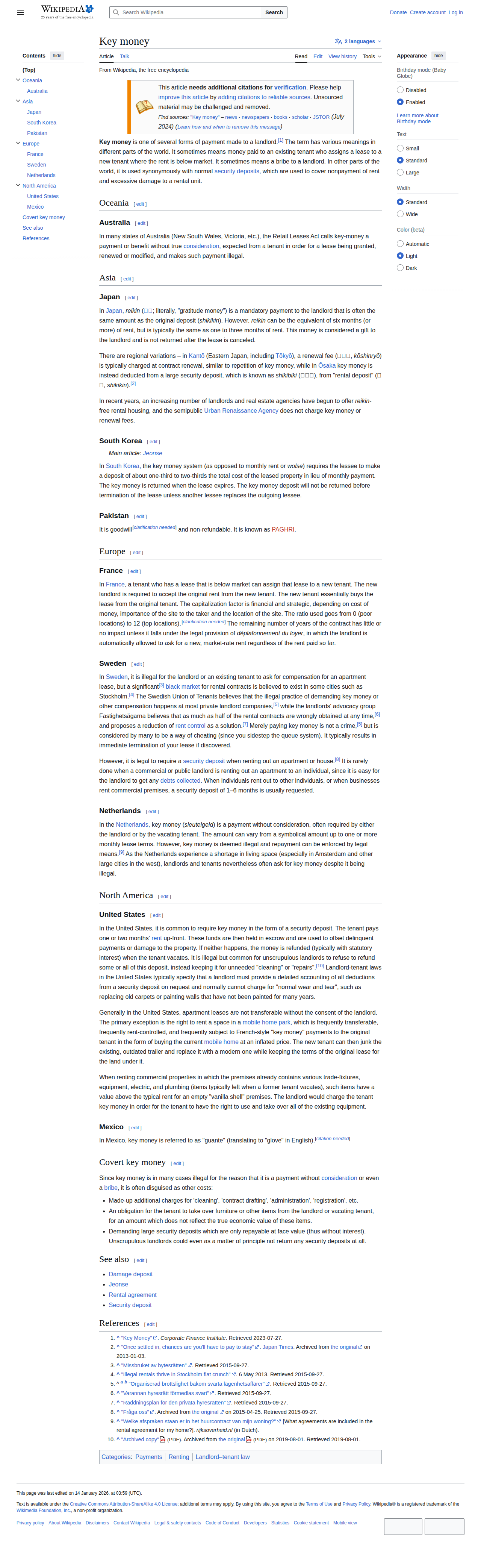
- Sweden (Stockholm): The Key Money Wikipedia article records: “In Sweden, it is illegal for the landlord or an existing tenant to ask for compensation for an apartment lease, but a significant black market for rental contracts is believed to exist in some cities such as Stockholm. The Swedish Union of Tenants believes the illegal practice of demanding key money or other compensation happens at most private landlord companies. Fastighetsägarna believes as much as half of the rental contracts are wrongly obtained at any time.”
- New York City: The City Journal (2024) documents the return of key money — under-the-table payments that prospective renters make to secure rent-stabilised apartments.
- Netherlands: Key money is illegal but widely practised due to housing shortage, particularly in Amsterdam.
- General: Freakonomics podcast documented black market contract sales costing around 10% of market value of the apartment.
The IEA review notes: “black-market activities such as the practice of demanding ‘key money’ (a non-refundable deposit upon moving in) tend to emerge in response to these market distortions.”
Illegal subletting at market rates (capturing the rent arbitrage) is another documented practice — tenants effectively become sub-landlords using their government-subsidised tenancy as an asset.
Verdict: ✅ True. Black market and illegal workaround practices are consistently documented in rent-controlled markets across multiple countries.
Summary Table
| Sub-claim | Rating | Summary |
|---|---|---|
| Rent controls do not work / never worked | ✅ Largely True | Near-universal failure in pure form; Vienna relies on massive public construction, not rent control |
| Economically illiterate | ✅ True | Applying rent controls despite near-unanimous economist condemnation is economically illiterate |
| Increase prices | ✅ True | SF: 5.1% city-wide rent rise from supply contraction; Cambridge: 45% value gain on decontrol |
| Reduce housing stock | ✅ True | SF −15–25%; Cambridge −8%; Berkeley −14%; UK private rental 53% → <8% |
| Cause stagnation | ✅ True | Reduced mobility, landlord disinvestment, suppressed new construction all documented |
| Cause hoarding | ✅ True | Over-consumption and mismatch confirmed; tenants retain unsuitable units to keep subsidy |
| Popular but harmful | ✅ Largely True | Short-term incumbent gain; long-run harm to future renters and affordability confirmed |
| Only incumbents benefit | ✅ Largely True | Stanford: $2.9B benefit to 1994 incumbents; future renters paid 5% premium |
| Lead to black markets | ✅ True | Stockholm, NYC, Netherlands all document illegal key money and under-the-table practices |
Overall: Largely True — The claim’s core economic assertions are robustly supported by peer-reviewed evidence. Every major empirical study finds that rent control reduces supply, raises rents in the uncontrolled sector, benefits existing tenants at the expense of future renters, and generates misallocation and maintenance decay. Applying rent controls in the face of near-unanimous economic evidence of their harm is correctly characterised as economically illiterate. The slight overstatement is in the absolute phrasing (“never worked”) — Vienna shows that affordable rents are achievable, but through massive government housing investment rather than rent control alone. The claim is accurate in its substance and consistent with the near-unanimous consensus of academic economists.
References
Primary Sources
-
Diamond, McQuade & Qian (2019) — Effects of Rent Control Expansion, San Francisco Published: September 2019 | Accessed: 2026-03-09 URL: https://www.aeaweb.org/articles?id=10.1257/aer.20181289 Key finding: Rent control caused 15% drop in rental supply in treated buildings and a 5.1% city-wide rent increase.
-
Autor, Palmer & Pathak (2014) — End of Rent Control in Cambridge, MA Published: 2014 | Accessed: 2026-03-09 URL: https://economics.mit.edu/sites/default/files/publications/housing%20market%202014.pdf Key finding: Decontrolled properties rose 45% in value; rent control had imposed $2 billion in costs on Cambridge property owners.
-
Brookings Institution — What Does Economic Evidence Tell Us About Rent Control? Published: 2018 | Accessed: 2026-03-09 URL: https://www.brookings.edu/articles/what-does-economic-evidence-tell-us-about-the-effects-of-rent-control/ Key finding: Rent control helps current tenants short-term but decreases affordability, fuels gentrification, and creates negative spillovers long-term. Evidence: brookings-rent-control-economics/2026-03-09_22-48-27
-
IGM Forum / Kent Clark Center — Economists Poll on Rent Control (2012) Published: 2012 | Accessed: 2026-03-09 URL: https://kentclarkcenter.org/surveys/rent-control/ Key finding: Zero economists agreed that rent control had a positive impact on amount/quality of affordable housing. Evidence: igm-forum-rent-control-poll/2026-03-09_22-50-35
-
Stanford GSB — Rent Control’s Winners and Losers Published: 2019 | Accessed: 2026-03-09 URL: https://www.gsb.stanford.edu/insights/rent-controls-winners-losers Key finding: 1994 incumbents saved $2.9B total; future renters paid 5% more; rental stock fell 25%. Evidence: stanford-rent-control-winners-losers/2026-03-09_22-51-04
-
Key Money — Wikipedia Published: ongoing | Accessed: 2026-03-09 URL: https://en.wikipedia.org/wiki/Key_money Key finding: Black markets for rent-controlled tenancies documented in Sweden, Netherlands, and USA. Evidence: key-money-wikipedia/2026-03-09_22-51-53
-
DC Policy Center — Rent Control Literature Review 2025 Published: 2025 | Accessed: 2026-03-09 URL: https://www.dcpolicycenter.org/publications/rent-control-lit-review-2025/ Key finding: Wealthier, longer-term tenants benefit disproportionately; new renters excluded; supply and quality impacts confirmed. Evidence: dc-policy-center-rent-control-review-2025/2026-03-09_22-52-07
-
NMHC — The High Cost of Rent Control Published: ongoing | Accessed: 2026-03-09 URL: https://www.nmhc.org/news/articles/the-high-cost-of-rent-control/ Key finding: 93% of AEA economists agreed rent ceilings reduce quality and quantity of housing; US city supply data compiled. Evidence: nmhc-high-cost-rent-control/2026-03-09_22-52-40
-
Microeconomic Insights — Who Benefits from Rent Control? (SF) Published: 2019 | Accessed: 2026-03-09 URL: https://microeconomicinsights.org/who-benefits-from-rent-control-evidence-from-san-francisco/ Key finding: Rent control protected incumbents but drove supply contraction, higher-income gentrification, and widened income inequality. Evidence: microecon-who-benefits-rent-control-sf/2026-03-09_22-53-27
-
The Tyee — How Vienna Cracked the Case of Housing Affordability Published: 2018 | Accessed: 2026-03-09 URL: https://thetyee.ca/Solutions/2018/06/06/Vienna-Housing-Affordability-Case-Cracked/ Key finding: Vienna’s success is driven by 100-year programme of direct public housing construction (60%+ of residents in public/subsidised housing); rent control was a side effect that depressed land prices enabling government to build. Evidence: vienna-housing-affordability-tyee/2026-03-09_22-54-04
Evidence Screenshots
Brookings Institution — Rent Control Economic Evidence

IGM Forum / Kent Clark Center — Economists Poll on Rent Control

Stanford GSB — Rent Control Winners and Losers
Key Money — Wikipedia (black market evidence)
DC Policy Center — Rent Control Literature Review 2025

NMHC — The High Cost of Rent Control
Microeconomic Insights — Who Benefits from Rent Control?

The Tyee — How Vienna Cracked Housing Affordability (counterexample context)

Evidence PDFs
| Source | |
|---|---|
| IGM Forum Economists Poll | page.pdf |
| Stanford GSB — Winners and Losers | page.pdf |
| Key Money Wikipedia | page.pdf |
| DC Policy Center Lit Review 2025 | page.pdf |
| Microeconomic Insights (SF rent control) | page.pdf |
| The Tyee — Vienna Housing | page.pdf |