Claim: “Current immigration is a net negative to the UK”
Accuracy Assessment: Largely True
The strongest evidence supports a Largely True assessment. The current UK migration mix contains routes with short-run fiscal gains but shows clear medium/long-run pressures once settlement is reached, especially where employment and earnings are lower and benefit eligibility rises after ILR12.
The evidence also supports significant non-fiscal costs: large and rapid demographic change, measurable trust/cohesion risks in the literature, and substantial remittance outflows from the UK economy345. The key caveat is that impacts are heterogeneous by route and migrant characteristics; high-earning skilled migration can be strongly positive while several other cohorts are not32.
Key Claims at a Glance
Overall claim rating: ✅ Largely True
| Statement | Verdict |
|---|---|
| Short-term fiscal gains happen, but mainly because rules delay benefit access before settlement31 | ✅ Largely True |
| After settlement (ILR), fiscal pressure rises for some groups16 | ✅ True |
| Family partner migration is net negative over a lifetime in MAC modelling (about -£109,000 each)2 | ✅ True |
| Some migrant groups have lower employment and lower pay, which weakens fiscal outcomes2 | ✅ True |
| Recent migration mix raises risk of weaker average labour participation37 | ✅ Largely True |
| Demographic change in England and Wales has been large and fast4 | ✅ True |
| London and other major cities changed faster than the national average (english-ethnic-cleansing-claim.md) | ✅ Largely True |
| Cultural value gaps are a real integration risk in some source-country populations5 | ✅ Largely True |
| Voting patterns and campaign strategy can follow ethnic or language blocs in some places (english-ethnic-cleansing-claim.md, govt-misogyny-training-ignores-islam.md) | 🟡 Mixed |
| Crime data quality limits make broad immigration-cause claims less certain (police-arrest-stats-unreliable.md, criminality-causes-culture-upbringing-intelligence.md) | 🟡 Mixed |
| Most projected UK population growth is linked to net migration, adding housing pressure (english-ethnic-cleansing-claim.md) | ✅ Largely True |
| NHS and human-capital effects vary by route and are not all one-way (islam-uk-privilege.md) | 🟡 Mixed |
| Remittances are large and persistent outflows from the UK economy8 | ✅ True |
| Job competition effects are strongest in lower-wage segments32 | ✅ Largely True |
Claim Breakdown
1. “Short-run fiscal gains are real but depend heavily on NRPF and time horizon”
✅ True — explicitly supported by official UK sources
The Migration Observatory summary states OBR generally finds higher net migration lowers deficits/debt, but also explains the method sensitivity and the importance of migrant characteristics3. It also notes NRPF is designed to suppress welfare-cost exposure before settlement3.
Verdict: ✅ True. The short-run positive headline exists, but it is structurally conditional.
2. “Post-ILR fiscal profile worsens for key cohorts”
✅ True — directly stated by OBR and MAC
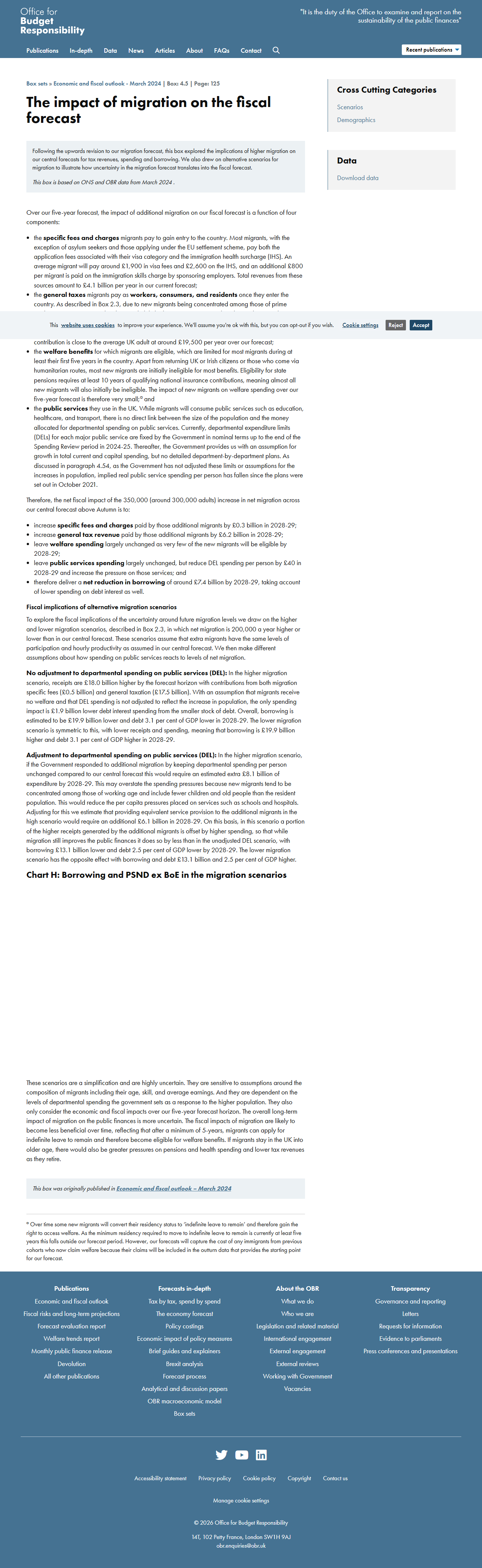
OBR states fiscal effects are likely to become less beneficial over time because migrants can become eligible for welfare after at least five years and because ageing increases pension/health costs1.
MAC 2025 lifetime modelling similarly finds that after ILR, access to benefits and loss of visa-fee/IHS contributions worsen fiscal outcomes for Family Partner cohorts, producing a negative lifetime net present value on average2.
Fiscal Contributions and Long-term Costs
The fiscal evidence is sensitive to route mix, earnings, settlement rates, and time horizon.
- Composition has shifted, affecting expected fiscal profile: post-Brexit inflows are more non-EEA and include larger shares of groups with historically lower participation (for example students and dependants), while policy design continues to use salary thresholds to raise expected tax yield among workers37.
- Short-run gains are structurally front-loaded: OBR and Migration Observatory both describe why near-term estimates can look positive when migrants are younger, paying visa/IHS fees, and largely ineligible for most benefits under NRPF before ILR31.
- Settlement transition matters for fiscal modelling: Home Office Migrant Journey outcomes show route-specific progression to ILR at five years (around 14% overall, about 20% for work routes, and over 50% for family routes), which changes expected benefit eligibility and therefore long-run net contribution6.
- Family-route lifetime modelling is negative in MAC 2025: MAC estimates the 2022/23 Partner cohort at -£5.6bn NPV (around -£109,000 per applicant), with low initial employment (49%) and mean earnings around £21,000, and notes fiscal deterioration after ILR as benefit eligibility expands2.
- Dependants and employment differentials are material drivers: fiscal outcomes vary by migrant type and labour-market attachment, with weaker employment outcomes in some humanitarian/asylum-linked cohorts and stronger outcomes in high-earning skilled cohorts329.
Taken together, these findings support using long-horizon, route-specific fiscal analysis rather than relying only on short-horizon snapshots for cohorts that have not yet reached settlement/benefit-eligibility stages. Migration Observatory also cites OECD cross-country evidence that age profile, employment, and skill level are primary determinants of fiscal contribution differences3.
Verdict: ✅ True. Long-run impacts are weaker than short-run snapshots for several settlement-heavy routes.
3. “A sizeable pre-ILR migrant caseload already receives UC through lawful routes/exceptions”
✅ True — confirmed by DWP immigration-status breakdowns
DWP UC statistics show immigration-status shares including Refugee (1.5%), Limited Leave incl. family reunion (1.0%), and Humanitarian (0.7%) in June 20259. At a 7.9 million UC caseload, this corresponds to a material absolute claimant count.
This does not imply widespread fraud; it reflects route rules and lawful exceptions.
Verdict: ✅ True. Pre-ILR benefit exposure is empirically real and policy-mediated.
4. “Demographic change is large and fast in England and Wales”
✅ True — official census data is unambiguous
Ethnicity Facts & Figures (2021 Census) reports White British at 74.4% in England and Wales, down from 80.5% in 2011 and 87.5% in 20014.
The claim “rapid demographic change” is therefore straightforwardly supported on official data.
Verdict: ✅ True. The change is large in magnitude and occurred within one generation.
5. “Value divergence risks are non-trivial in major source regions”
✅ Largely True — strong directional support
Pew’s multi-country Muslim attitudes survey finds very high support in many countries for making Sharia official law, including high medians in South Asia and MENA regions5.
This does not prove identical preferences among all UK migrants from those countries, but it does support a non-trivial integration risk when migration is large and sustained.
Verdict: ✅ Largely True. Directional risk is robust; exact UK magnitudes vary by cohort and generation.
6. “Remittances are large enough to be macro-relevant outflows”
✅ True — direct World Bank data confirms billions in annual outflow
World Bank indicator BM.TRF.PWKR.CD.DT for GBR shows personal remittances paid around US$12.27bn (2024), US$11.57bn (2023), and US$10.92bn (2022)8.
These are material outflows that are not spent in the domestic consumer economy.
Verdict: ✅ True. Remittances are economically meaningful and persistent.
Summary Table
| Statement | Verdict |
|---|---|
| Short-term fiscal gains depend on temporary policy conditions | ✅ True |
| Fiscal pressure rises after settlement for some groups | ✅ True |
| A meaningful pre-ILR UC caseload exists through lawful routes | ✅ True |
| Demographic change has been large and fast | ✅ True |
| Cultural value-gap risk exists, but varies by cohort | ✅ Largely True |
| Remittance outflow from the UK is large and persistent | ✅ True |
Overall: ✅ Largely True — The available evidence supports the claim that the current mix of UK immigration produces net-negative outcomes on several high-weight dimensions (long-run fiscal pressure, social/institutional strain, and outflow leakage), while preserving the caveat that some routes and cohorts remain net-positive.
References
Migration Observatory fiscal briefing (screenshot)

OBR migration fiscal box (screenshot)
MAC annual report 2025 (screenshot)

DWP UC immigration status bulletin (screenshot)

Ethnicity facts and figures population page (screenshot)

World Bank remittances API capture (screenshot)

-
Office for Budget Responsibility — The impact of migration on the fiscal forecast
-
Published: 2024 box release Accessed: 18 Mar 2026 -
page.txt screenshot.png page.html - Key finding: OBR states impacts become less beneficial over time as migrants gain ILR/welfare eligibility and age.
-
-
Migration Advisory Committee — Annual Report 2025
-
Published: 2025 Accessed: 18 Mar 2026 -
page.txt screenshot.png page.html - Key finding: Partner-route lifetime model estimates net negative NPV and explains ILR/benefit-access deterioration mechanism.
-
-
Migration Observatory (Oxford) — The Fiscal Impact of Immigration in the UK
-
Published: 25 Oct 2024 Accessed: 18 Mar 2026 -
page.txt screenshot.png page.html - Key finding: Fiscal estimates are method-sensitive; OBR short-run improvements coexist with NRPF/time-horizon caveats.
-
-
Ethnicity Facts and Figures — Population of England and Wales
-
Published: 2021 Census dataset update Accessed: 18 Mar 2026 -
page.txt screenshot.png page.html - Key finding: White British share fell from 87.5% (2001) to 74.4% (2021).
-
-
Pew Research Center — The World’s Muslims: Religion, Politics and Society (Overview/Beliefs About Sharia)
-
Published: 30 Apr 2013 Accessed: 18 Mar 2026 -
page.txt screenshot.png page.html - Key finding: Strong support in multiple countries for making Sharia official law.
-
-
Home Office — Migrant journey: 2023 report
-
Published: 23 May 2024 Accessed: 18 Mar 2026 -
page.txt screenshot.png page.html - Key finding: Settlement progression is highly route-dependent, with materially higher ILR transition on family than study/work pathways.
-
-
Office for Budget Responsibility — Economic and fiscal outlook (March 2024)
-
Published: Mar 2024 Accessed: 18 Mar 2026 -
page.txt screenshot.png page.html - Key finding: Post-Brexit migration composition shifted toward groups with historically lower participation, while policy changes targeted dependant and salary-threshold channels.
-
-
World Bank API — Personal remittances, paid (current US$), GBR
-
Last updated: 24 Feb 2026 Accessed: 18 Mar 2026 -
page.txt screenshot.png page.html - Key finding: UK personal remittances paid are >US$10bn annually in recent years.
-
-
DWP — Universal Credit statistics (to 12 June 2025)
-
Published: 2025 Accessed: 18 Mar 2026 -
page.txt screenshot.png page.html - Key finding: UC caseload includes Refugee, Humanitarian, and Limited Leave categories at published shares.
-