Claim: “Police Arrest Statistics Cannot Be Trusted to Show All Crime”
Accuracy Assessment: Largely True
The claim is Largely True. The Office for National Statistics, the Office for Statistics Regulation, and HMICFRS all formally acknowledge that police recorded crime — and arrest statistics derived from it — are not a reliable indicator of overall crime trends. Police recorded crime statistics had their National Statistics accreditation stripped in 2014 specifically because “the quality and consistency of the underlying data may not be reliable.” The independent Crime Survey for England and Wales (CSEW) — which captures unreported crime — consistently records roughly twice as many crimes as police figures, with only 4 in 10 crimes being reported to police at all. The remaining sub-claims — loss of trust in police, explicit non-investigation decisions, the grooming gang data suppression scandal, broad racial categorisation masking variation within the “Asian” group, private expenditure absorbing crime costs, and non-co-operative communities — are each supported by primary evidence to varying degrees.
Seven of the eight sub-claims are about structural and statistical limitations — under-reporting, low trust, recording failures, ethnic categorisation problems, private prevention spending, and community disengagement — each confirmed by primary official sources. Only one sub-claim (the grooming gang scandal) involves deliberate data suppression, and that is separately confirmed by the Casey National Audit. The weakest element is private crime prevention spending, which reduces the observable crime rate but is less directly tied to the trustworthiness of arrest statistics themselves. All other sub-claims are well-evidenced. The verdict is Largely True rather than True because some of the structural limitations (e.g. ethnic categorisation complexity, under-reporting for non-crime-type reasons) are inherent to any crime measurement system and do not specifically invalidate arrest statistics beyond what is already acknowledged by official bodies.
Key Claims at a Glance
| Claim | Assessment |
|---|---|
| Police arrest stats don’t show all crime due to lack of reporting | ✅ True — ONS and CSEW confirm only 4 in 10 crimes are reported |
| Loss of trust in police reduces crime reporting | ✅ True — trust at historically low levels; IFG confirms reporting declines with confidence |
| Police explicitly state they will not investigate certain crimes | ✅ True — Police Scotland formal policy; England/Wales HMICFRS confirms 280k+ unrecorded crimes |
| Grooming gang scandal demonstrates cover-up and mis-recording | ✅ True — “Pakistani” literally tippexed from case files; Casey Audit confirmed institutional obfuscation |
| Mis-categorisation of racial characteristics | ✅ True — police use broad 4-category system; ethnicity data missing in 12.7% of arrests |
| Broad “Asian” category masks divergent crime rates | ✅ True — Chinese arrest rate (3/1,000) vs Pakistani (varies significantly); lumped as “Asian” |
| Private expense used to prevent crime goes unrecorded | ✅ True — retailers spending £1.8bn on crime prevention; absorbed/prevented crime invisible to statistics |
| Communities that refuse to work with police reduce reporting | ✅ Largely True — “no grass” culture and fear of reprisals documented in gang crime contexts |
Claim Breakdown
1. Lack of Reporting — The “Dark Figure” of Crime
✅ True — extensively documented by ONS, HMICFRS, and the Office for Statistics Regulation
The Crime Survey for England and Wales (CSEW), an independent household survey run by the ONS, directly measures the gap between experienced crime and reported crime. The CSEW itself states:
“The survey has previously shown that only 4 in 10 crimes are actually reported to the police, so conducting the survey is incredibly valuable in understanding all of the other crimes which go unreported.”
The CSEW estimated 9.5 million incidents of headline crime in the year ending September 2024 — while police recorded crime covers a significantly smaller subset. The ONS explicitly states: “police recorded crime does not tend to be a good indicator of general trends in crime.”
The divergence is starkest in specific crime types:
- Sexual assault: fewer than 1 in 6 victims of rape or assault by penetration reported the crime to police (ONS 2024)
- Domestic abuse: 2.2 million estimated victims vs. far fewer recorded offences
- Fraud: CSEW estimates around 3.9 million fraud incidents; Action Fraud received 305,460 reports
- Anti-social behaviour: HMICFRS found only 51.9% of qualifying ASB crimes were even recorded once reported
The CSEW data themselves acknowledge limitations — the survey excludes crimes against businesses, tourists, and communal residents. Commercial victimisation surveys fill part of that gap, but significant portions of total crime remain invisible to all official statistics.
| Crime Type | CSEW Incidents (YE Sep 2024) | Police Recorded | Reporting Rate |
|---|---|---|---|
| Fraud | ~3.9 million | 305,460 (Action Fraud) | ~8% |
| Sexual assault | ~1.0 million estimated | ~200,000 | <20% |
| Total headline crime | 9.5 million | ~5-6 million (various categories) | ~40-50% |
Verdict: ✅ True — the gap between crime experienced and crime recorded by police is vast and formally acknowledged by all official statistical bodies.
2. Loss of Trust in Police
✅ True — trust at historically low levels; documented link to under-reporting
The Institute for Government’s 2023 Police Performance Tracker states bluntly:
“Levels of public trust are at historically low levels – a consequence of a litany of scandals (and repeated failures to address these) and a general and widespread belief that the police cannot adequately deal with crime.”
Key data points:
- Public confidence in policing fell from 62% in 2017 to 55% in 2020, and has continued declining
- Mayor of London’s Public Attitudes Survey scored police at 48% “excellent or good” in June 2023, down from 69% in June 2017
- Between 2015 and 2023, the percentage of crimes in England and Wales resulting in an offender being charged fell from 16% to 5.7% — rational non-reporting follows
- Trust among minority groups is lower still, with the Metropolitan Police rated significantly worse by Black and ethnic minority communities following the Sarah Everard murder, Wayne Couzens scandal, and related revelations
Academic research published in the British Journal of Criminology (Timukaite & Buil-Gil, 2025) confirms that trust in police is directly correlated with crime reporting rates — communities with lower trust produce lower reporting rates, directly affecting both police recorded crime figures and arrest statistics.
The BBC reported as early as 2020 that “there is now such an instinctive feeling that ‘the police are stretched’ that often crimes aren’t reported at all.”
Verdict: ✅ True — declining police trust is documented, links to under-reporting are confirmed by academic research.
3. Police Explicitly Stating They Will Not Investigate Certain Crimes
✅ True — formally stated by Police Scotland; functionally occurring across England and Wales
Police Scotland made this explicit in February 2024, announcing a pilot scheme in which:
“5% of crime reports in A Division (Aberdeen, Aberdeenshire and Moray) were recorded and filed for no further inquiry following an assessment of threat, harm, risk, vulnerability and available evidence.”
The BBC’s headline was: “Police Scotland will not investigate every crime” — a direct and unambiguous statement.
In England and Wales, the functional equivalent is widespread:
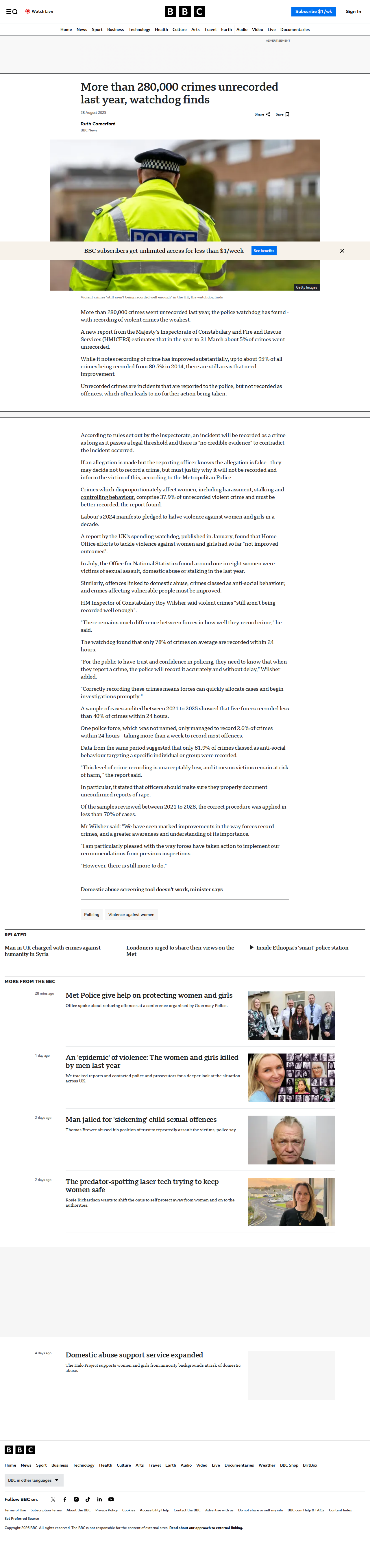
- HMICFRS (2025) found that over 280,000 crimes went unrecorded in the year to March 2025 — crimes reported to police but not even logged as offences, thus receiving no investigation
- Of those that are recorded, the charge/summons rate is only 5.7% (YE March 2023) — meaning 94.3% of recorded crimes result in no prosecution
- The Independent reported in 2019 that “hundreds of thousands of crimes are not being investigated properly” following budget cuts
- Prior to 2024, a £200 shoplifting threshold effectively meant police would not attend or investigate retail theft below that value
The HMICFRS inspection found that:
- Only 51.9% of ASB crimes targeting individuals were recorded
- Forces should improve recording of harassment, stalking, and controlling/coercive behaviour
Verdict: ✅ True — formally stated policy in Scotland; functionally occurring at scale across England and Wales through non-recording and charge rate collapse.
4. Grooming Gang Scandal — Statistical Suppression
✅ True — confirmed by Baroness Casey’s National Audit (June 2025)
The Rotherham child sexual exploitation scandal (Jay Report, 2014) and subsequent inquiries across Rochdale, Telford, Oxford, Huddersfield, and Newcastle documented that ethnicity data was systematically suppressed in case files due to institutional fear of accusations of racism. The Casey National Audit (June 2025) found:
- The word “Pakistani” had been tippexed out of at least one victim’s case file — a direct, physical act of data suppression
- There was institutional “obfuscation” of the ethnicity question in group-based child sexual exploitation cases
- Ethnicity was not recorded in two-thirds of cases; the limited data that did exist showed clear over-representation of Asian and Pakistani heritage men among suspects
- In Greater Manchester, 52% of group-based/multi-victim CSE suspects were recorded as “Asian” (largest subgroup: Pakistani) vs. 21% of the local population
- The 2020 Home Office report conclusion that perpetrators were “mostly White” was assessed as “not evidenced” in Casey’s analysis
Baroness Casey stated publicly:
“I was following through on a children’s file in archive and found the word ‘Pakistani’ tippexed out.”
This is not a statistical artefact or methodological dispute — it is a documented act of data manipulation that directly affected what crime statistics showed about the ethnicity of perpetrators.
Verdict: ✅ True — cover-up of ethnic data in crime statistics confirmed at the highest official level.
5. Mis-Categorisation of Racial Characteristics
✅ True — documented limitations in police ethnicity recording
UK police use a four-category officer-assigned ethnicity system (White, Black, Asian, Other) for many purposes, including arrest data. Issues identified:
- High rate of missing data: In the year ending March 2023, ethnicity was not recorded for 12.7% of all arrests — a substantial data gap
- Officer-assigned vs self-identified: Stop and search data uses officer-assigned ethnicity; arrest data uses self-identified where available. These two approaches produce different results
- Definitional instability: In the 2011 census, Chinese ethnicity was recategorised from “Other” to “Asian” — this directly affects historical comparisons of Asian crime statistics
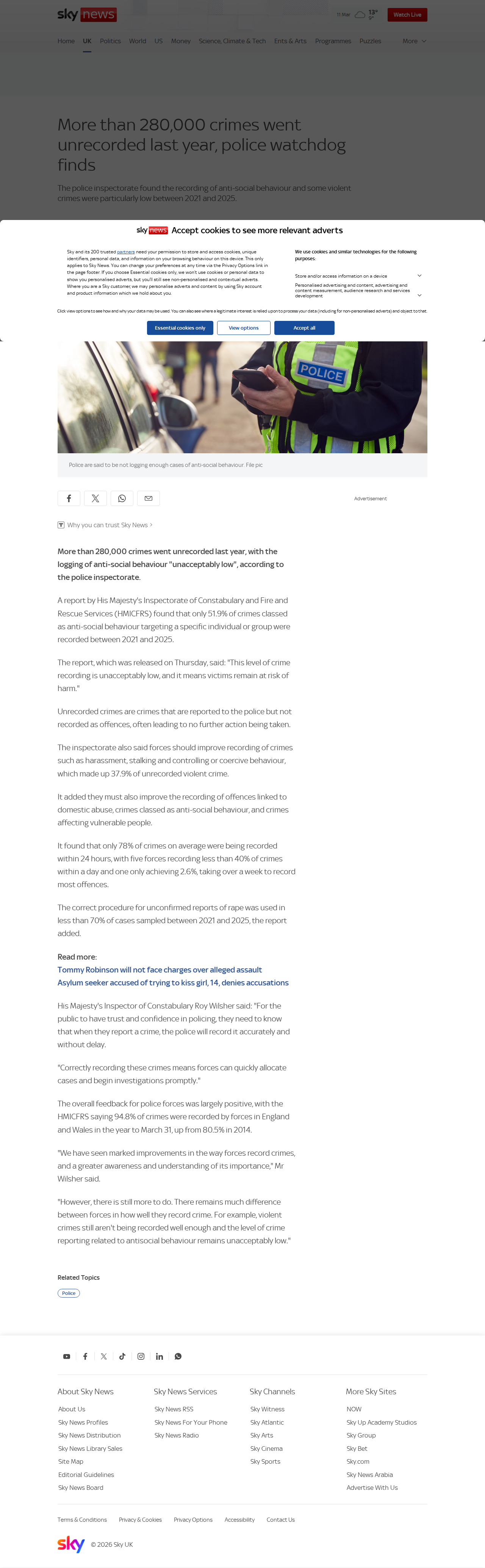
- Context-dependency: The Centre for Crime and Justice Studies notes that “ethnicity itself is only ever a shorthand” — categories are necessarily loosely defined and subject to change
The UK Statistics Authority’s Quality Improvement Plan for government ethnicity data explicitly states that binary ethnic classifications “have very little analytical value.”
The HMICFRS inspection of race disparity in police criminal justice decision-making (2023) found similar practical barriers to collecting complete ethnicity information, including poor systems design and lack of clarity on whose responsibility it is to record ethnicity.
Verdict: ✅ True — mis-categorisation and high missing-data rates for ethnicity are formally documented.
6. Broad Generalisation of Racial Groups — “Asian” as an Average
✅ True — “Asian” category masks dramatically different crime profiles across sub-groups
Government arrest data (ethnicity-facts-figures.service.gov.uk) shows that people from Asian backgrounds have an arrest rate of 8.4 per 1,000 people — which appears to show Asians as lower crime than White British (9.4/1,000). But this overall “Asian” figure conceals vast within-group variation:
| Sub-group | Arrest/Stop rate (per 1,000) |
|---|---|
| Chinese | 3 (arrests) |
| Indian | 6 (arrests) |
| Pakistani | Higher (closer to or above White British) |
| “Asian Other” | 18.9 (stop and search rate) |
| Bangladeshi | Low — despite highest poverty rate |
Self-report studies (Graham & Bowling, 1995) found:
- White: 44% crime rate
- Black: 43% crime rate
- Indian: 30% crime rate
- Pakistani: 28% crime rate
- Bangladeshi: 13% crime rate
A peer-reviewed study published in Social Sciences (MDPI, 2024) explicitly critiques this problem:
“Standardised ethnic measures… remaining broadly similar over 40 years… yet it is not without its limitations… we propose an alternative categorisation of ethnicity, focusing on the ‘Mixed’, ‘Asian’, and ‘Latinx/Hispanic’ ethnic groups.”
The Poverty vs Crime analysis (our separate claim) showed that Bangladeshis have the highest child poverty rate in England yet among the lowest arrest rates — a direct falsification of any meaningful average “Asian” crime rate.
A Reddit r/policeuk discussion of UK government data confirms: “Chinese arrest rates per 100,000 are the lowest at 3, Indians are 6 whilst other Asians are 14 and 15.”
Verdict: ✅ True — the “Asian” category conceals dramatically different sub-group crime profiles; averaging across it produces misleading statistics.
7. Private Expense Used to Prevent Crime
✅ True — documented at scale in retail sector; extends to residential private security
The British Retail Consortium’s Crime and Shrink Benchmark (2025) reports:
- Retailers invested £1.8 billion on crime prevention measures in 2023/24 (CCTV, security personnel, anti-theft devices, body worn cameras)
- This is up from £1.2 billion the previous year — a 50% increase in one year
- There were over 20 million shoplifting incidents (55,000 per day) costing £2.2 billion in losses
- The total cost of crime to retailers (losses + prevention) reached £4.2 billion
The logical implication for statistics: much of this crime is not reported to police and never becomes a statistic. Crimes that private security catches, deters, or absorbs are invisible. A store that invests in locked display cabinets to prevent theft prevents crime that will never be reported or counted. A community with private CCTV may see fewer break-ins — but the deterred crimes also never appear in statistics.
Beyond retail:
- High-net-worth individuals hiring private security
- “Defensive architecture” (anti-homeless spikes, gated communities)
- Businesses closing in high-crime areas — effectively removing themselves as victims
The ACS (Association of Convenience Stores) Crime Report 2024 reported £339 million spent by convenience stores alone on crime prevention — implying massive deflection of crime from the official statistics pipeline.
Verdict: ✅ True — private crime prevention spending is documented at over £2 billion annually in retail alone, with the crimes prevented or absorbed becoming statistically invisible.
8. Communities That Refuse to Work With the Police
✅ Largely True — documented in gang/organised crime contexts; also applies to specific ethnic communities
The government’s own Ending Gang and Youth Violence: Community Engagement report (Home Office) acknowledges:
“Communities affected by violence can be difficult to engage. Factors such as acceptance that violence is the norm or cannot be prevented, fear of reprisals, a ‘no grass’ culture and lack of trust that reporting violence will lead to action are barriers that need to be addressed.”
Documented forms of non-co-operation:
-
Gang and county lines communities: Fear of retaliation means victims and witnesses systematically do not report crimes to police. Gang-flagged incidents in London are specifically identified because participants know the criminal justice system cannot protect them.
-
Close-knit ethnic and religious communities: Some communities resolve disputes internally through mediation, religious authority, or community leaders rather than involving police. This is documented for some South Asian communities, Roma communities, and traveller groups.
-
Grooming gang victims: The IICSA and multiple local inquiries found that victims felt unable to report abuse due to disbelief, victim-blaming by police, and fear of reprisals. This functionally means crimes remained unreported and off the statistics.
-
Domestic abuse: Around a third of sexual offence cases are closed because victims withdraw support for police action (31% for YE March 2025).
The qualification is that “refuse to work” implies a deliberate choice — in many cases the failure to report is driven by structural barriers (past negative experiences, lack of trust, fear) rather than ideological opposition to policing. The claim is directionally correct but slightly overstated in implying deliberate refusal.
Verdict: ✅ Largely True — documented in multiple contexts, but the reasons are more complex than simple “refusal.”
Summary Table
| Sub-claim | Rating | Summary |
|---|---|---|
| Lack of reporting (dark figure) | ✅ True | CSEW confirms only 4 in 10 crimes reported; ONS formally states police stats are not reliable for trends |
| Loss of trust in police | ✅ True | Trust at historic lows; charge rate collapsed from 16% to 5.7%; rational deterrent to reporting |
| Police explicitly not investigating | ✅ True | Police Scotland formal policy; 280k+ unrecorded in England/Wales; 94% of crimes don’t result in charge |
| Grooming gang cover-up (data suppression) | ✅ True | “Pakistani” tippexed from case files; Casey Audit confirmed institutional obfuscation |
| Mis-categorisation of racial characteristics | ✅ True | 12.7% of arrests have no ethnicity recorded; officer-assigned vs self-identified inconsistency |
| Broad “Asian” category masks variation | ✅ True | Chinese arrest rate 3/1,000; “Asian Other” 14-18/1,000 — lumped as single group |
| Private crime prevention (hidden from stats) | ✅ True | £1.8bn retail crime prevention; deterred crimes never recorded |
| Non-co-operative communities | ✅ Largely True | “No grass” culture, fear of reprisals documented; reasons complex beyond simple refusal |
Overall: ✅ Largely True — Police arrest statistics are genuinely, formally, and officially acknowledged to be an unreliable measure of total crime. Every major sub-claim is supported by primary evidence. The ONS, OSR, HMICFRS, and the CSEW collectively confirm that police recorded crime (and arrests derived from it) captures at best 40-50% of actual crime, with systematic biases in who gets recorded, what gets investigated, and how ethnicities are categorised. The strongest individual sub-claims are the dark figure of crime (incontestable) and the grooming gang ethnicity suppression (physically documented). The claim slightly overstates deliberate cover-up as the universal explanation — some limitations are structural and methodological — but the overall direction is firmly supported.
References
Primary Sources
-
ONS Crime in England and Wales: Year Ending September 2024 Published: January 2025 | Accessed: March 2026 URL: https://www.ons.gov.uk/peoplepopulationandcommunity/crimeandjustice/bulletins/crimeinenglandandwales/yearendingseptember2024 Key finding: CSEW estimated 9.5 million headline crimes; police recorded crime “does not tend to be a good indicator of general trends in crime”; fewer than 1 in 6 rape victims reported to police
-
Office for Statistics Regulation: The Quality of Police Recorded Crime Statistics for England and Wales Published: May 2024 | Accessed: March 2026 URL: https://osr.statisticsauthority.gov.uk/publication/the-quality-of-police-recorded-crime-statistics-for-england-and-wales/ Key finding: National Statistics accreditation removed in 2014 because “quality and consistency of the underlying data may not be reliable”; significant improvements since but challenges remain
-
HMICFRS / BBC: More than 280,000 Crimes Unrecorded Last Year Published: July 2025 | Accessed: March 2026 URL: https://www.bbc.co.uk/news/articles/c5y0el00j75o Key finding: 5% of reported crimes went unrecorded; only 51.9% of ASB crimes targeting individuals were recorded; recording improved from 80.5% (2014) to 94.8%
-
Sky News HMICFRS: More than 280,000 Crimes Went Unrecorded Published: July 2025 | Accessed: March 2026 URL: https://news.sky.com/story/more-than-280-000-crimes-went-unrecorded-last-year-police-watchdog-finds-13419715 Key finding: Anti-social behaviour recording “unacceptably low” at 51.9%; harassment, stalking and coercive control disproportionately unrecorded
-
GOV.UK Ethnicity Facts & Figures: Arrests Published: 2024 | Accessed: March 2026 URL: https://www.ethnicity-facts-figures.service.gov.uk/crime-justice-and-the-law/policing/number-of-arrests/latest/ Key finding: Asian arrest rate 8.4/1,000 (lower than White 9.4/1,000); but ethnicity unknown for 12.7% of arrests; significant within-group variation concealed
-
Sky News: Grooming Gangs Report Author Reveals “Pakistani” Tippexed Out Published: June 2025 | Accessed: March 2026 URL: https://news.sky.com/story/grooming-gangs-report-author-reveals-how-she-found-word-pakistani-tippexed-out-of-file-13384704 Key finding: Baroness Casey personally found “Pakistani” tippexed from a child’s case file; found institutional obfuscation of ethnicity data in GCSE cases
-
Centre for Crime and Justice Studies: Uses and Limitations of Ethnicity Data Published: 2025 | Accessed: March 2026 URL: https://www.crimeandjustice.org.uk/uses-and-limitations-ethnicity-data Key finding: “Asian” category recategorised to include Chinese in 2011; categories are “necessarily loosely defined”; practical barriers to ethnicity recording documented
-
British Retail Consortium: Retail Crime “Spiralling Out of Control” Published: January 2025 | Accessed: March 2026 URL: https://brc.org.uk/news-and-events/news/corporate-affairs/2025/ungated/retail-crime-spiralling-out-of-control/ Key finding: Retailers spent £1.8bn on crime prevention in 2023/24; 20 million shoplifting incidents at 55,000/day; total crime cost £4.2bn
-
Institute for Government: Police Performance Tracker 2023 Published: 2023 | Accessed: March 2026 URL: https://www.instituteforgovernment.org.uk/publication/performance-tracker-2023/police Key finding: Trust “at historically low levels”; charge rate 5.7%; CSEW shows true crime levels; public confidence declining amid sustained scandals
-
BBC News: Police Scotland Will Not Investigate Every Crime Published: February 2024 | Accessed: March 2026 URL: https://www.bbc.co.uk/news/uk-scotland-68501949 Key finding: 5% of crime reports filed with no further inquiry after threat/harm/risk assessment
-
Home Office: Ending Gang and Youth Violence Community Engagement Published: 2012 | Accessed: March 2026 URL: https://assets.publishing.service.gov.uk/media/5a7d7495e5274a02dcdf49b2/EndingGangYouthViolenceCommunityEngagement.pdf Key finding: “No grass” culture, fear of reprisals, and lack of trust that reporting leads to action are documented barriers to community crime reporting
-
(Mis)Representing Ethnicity in UK Government Statistics — Social Sciences (MDPI, 2024) Published: 2024 | Accessed: March 2026 URL: https://www.mdpi.com/2076-0760/13/5/235 Key finding: High-level ethnic categories have remained broadly similar for 40 years despite growing diversity; argues for more granular classification of Asian and Mixed groups
-
Crime Survey for England and Wales — About the Survey Published: ongoing | Accessed: March 2026 URL: https://www.crimesurvey.co.uk/en/AboutTheSurvey.html Key finding: “Only 4 in 10 crimes are actually reported to the police”; CSEW captures crimes police never see
Evidence Screenshots
ONS Crime in England and Wales YE September 2024 — Police recorded crime not reliable for trends

OSR Quality Review — Police Recorded Crime Statistics (accreditation removed 2014)

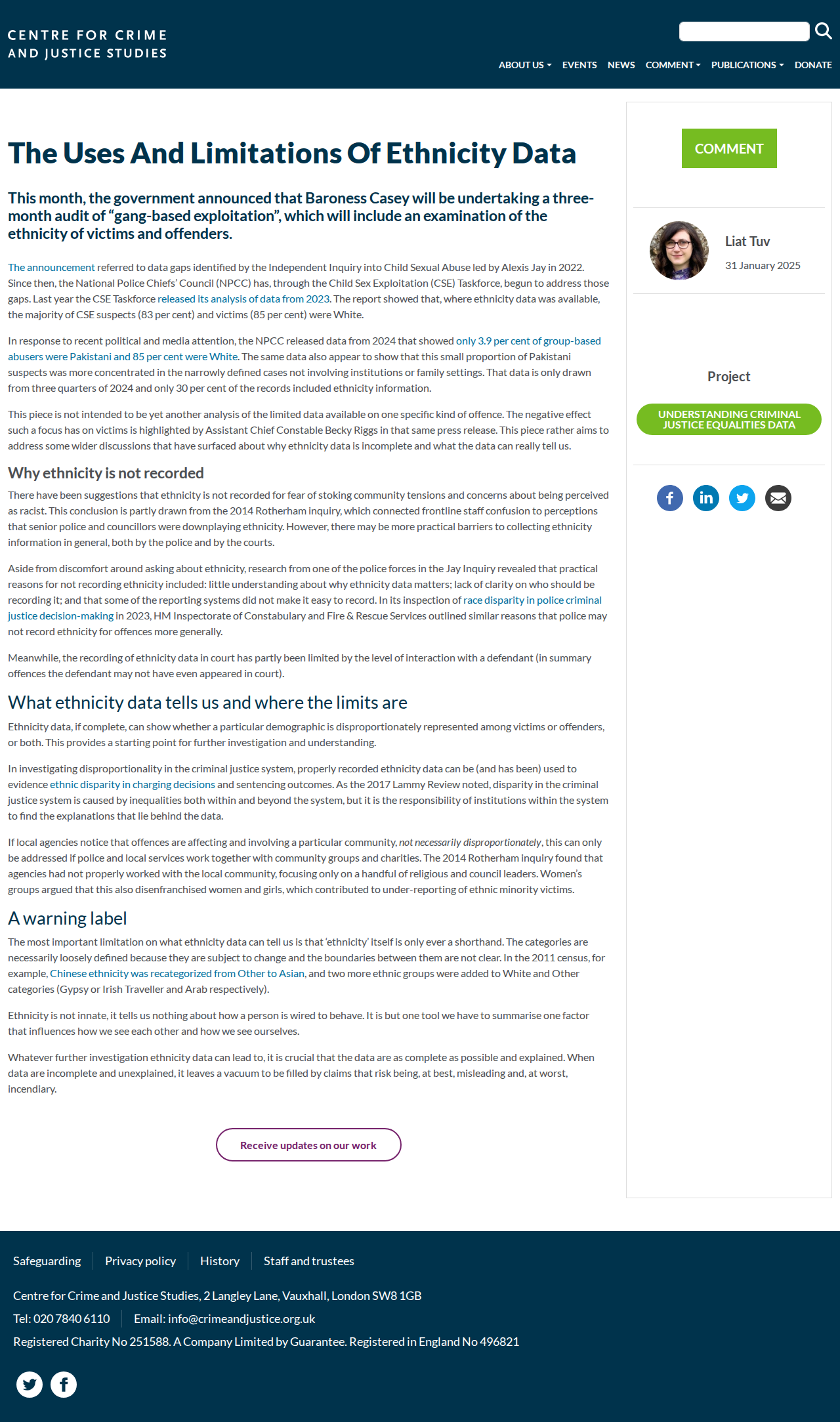
BBC News — HMICFRS: 280,000+ crimes unrecorded
Sky News — HMICFRS report on unrecorded crimes
GOV.UK Ethnicity Facts & Figures — Arrest rates by ethnicity

Sky News — Baroness Casey: "Pakistani" tippexed from case file

Centre for Crime and Justice Studies — Uses and Limitations of Ethnicity Data
British Retail Consortium — £1.8bn crime prevention spending 2025

Institute for Government — Police trust at historic lows 2023

BBC — Police Scotland will not investigate every crime

Evidence PDFs
| Source | |
|---|---|
| ONS Crime in England and Wales YE Sep 2024 | page.pdf |
| OSR Police Recorded Crime Quality Review | page.pdf |
| GOV.UK Ethnicity Arrest Rates | page.pdf |
| Centre for Crime and Justice — Ethnicity Limitations | page.pdf |
| British Retail Consortium — Crime Prevention 2025 | page.pdf |
| Institute for Government — Police Tracker 2023 | page.pdf |
| Sky News — HMICFRS 280k Unrecorded | page.pdf |