Is Equity Harmful to Society?
Equity is a term often conflated with equality, but it is a distinct concept. Equity has been interpreted to mean equality of outcomes over equality of opportunity1.
As always please read the Bias Busting guide if you have not already done so.
Argument
I will argue:
Equity based hiring policies are harmful to society, and hence morally wrong.
Definitions
It will be beneficial to explicitly define what I am referring to in the arguments.
Harm
Harm is defined according to the framework (harm based consequentialism). Opposite of the moral good. Reducing the total well-being of society on average compared to alternative policies.
Merit
Merit is a fairly nebulous term to define. I think it’s important to narrow the scope to allow the argument to be made.
Looking at definitions online as a base we see:
the quality of being good and deserving praise
quality of person’s character or conduct deserving of reward or punishment
These definitions beg the questions:
- What is good?
- What is deserving?
In-line with the framework, I will use this definition that is grounded in something we can measure and compare more reliably.
The sum of individual’s performance, capability, or output, relative to any particular societal role.2
No characteristic of their involuntary identity is considered in merit (e.g. race, sex, etc).
No knowledge of their personal history is required beyond their past achievements and labours (no disabilities, no past discrimination, no past childhood trauma etc).
Equality
For this argument I will take this general definition of equality taken from Britannica
Generally, an ideal of uniformity in treatment or status by those in a position to affect either.
The end goal of equality would be equal opportunity for all. No biases to involuntary, or immutable attributes that would affect someone’s life. That may include Race, Sex, Sexuality, Appearance, Height, Age, Gender, Weight.
Allowing a person’s merit be the sole determinant of their success.
Defined as a function Deserved success = Merit.
Equity
The top definition for equity returned by Google (Oxford Languages) is:
The quality of being fair and just, especially in a way that takes account of and seeks to address existing inequalities.
Again this begs the questions:
- What is it to be fair?
- What is it to be just?
I will use this definition which I think narrows the scope sufficiently while retaining the underlying goal:
Equity is the pursuit of balancing outcomes by taking into consideration a person’s personal circumstances and history and adjusting accordingly.
Defined as a function Deserved success = Merit + Disadvantage coefficient.
Outcomes
I will use outcomes in the common sense of the word. For example:
- Income
- Wealth
- Educational attainment
- Employment status
- Job seniority or role responsibility
- Career progression rate
- Access to scarce resources (housing, healthcare availability, childcare)
- Social or institutional status
- Legal outcomes (sentencing length, conviction rates)
- Health outcomes (life expectancy, disability-adjusted life years)
- Exposure to risk (dangerous work, crime rates)
- Quality-of-life indicators (leisure time, job satisfaction, stress levels)
These are fairly easy to conceptualise and compare between people and groups.
Success
Success is simply defined the sum total of positive outcomes. E.g. increases in income, reduction in negative health outcomes etc.
Equality vs Equity
The difference between equity and equality is often presented with the simplistic example of boxes or ladders. I will use “Ladders” instead of boxes to allow for further arguments below, the concept remains unchanged.
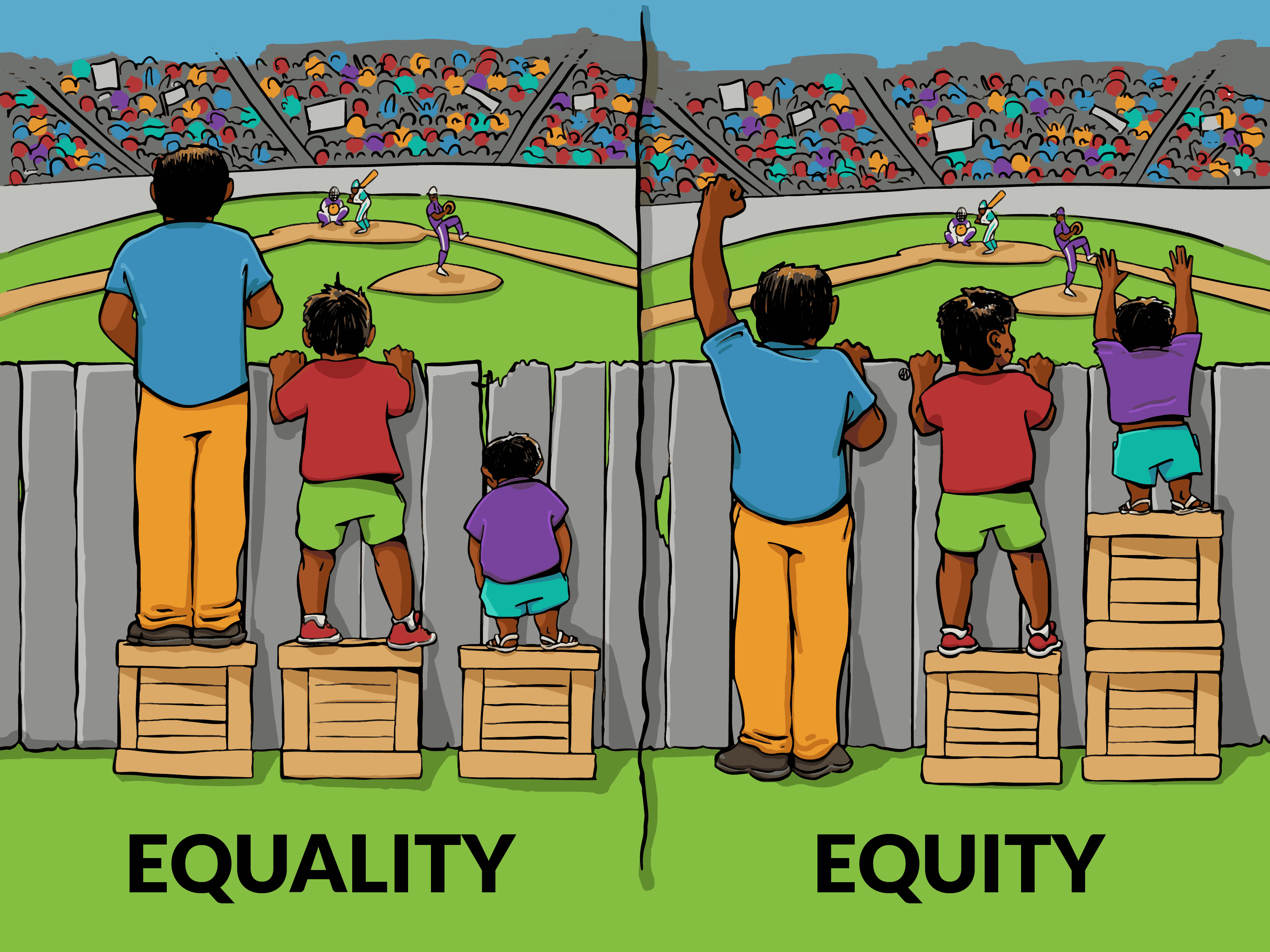 (source)
Equality states that everyone is treated fairly and equally by being issued the same size ladder.
Equity states that the outcome is unfair because the shorter person was disadvantaged at birth. The shorter person is therefore given a larger (more expensive) ladder to compensate for this disadvantage.
Why this example fails
This analogy is used so ubiquitously to explain equity that it is worth analysing it briefly here.
Simplistic
Firstly, it has a single variable to determine the relative disadvantage between people, which just so happens to be easily measurable, objective, linear, and with no room for debate. If you are in doubt about relative height based disadvantage you simply get out a ruler and measure the person yourself.
Disadvantage = Average height - Actual height
It also has an extremely simple solution. Add ladder height to match disadvantage.
Success (Ladder ownership) = Merit (Actual Height) + Disadvantage
It’s hard to imagine a more contrived example than this. I will explore why reality is far more complicated than this below.
Lack of scarce resources
The ladders in this example are always assumed to be an abundant resource. There are always just the right number of resources available for all involved, it’s simply a matter of distribution. This is almost never what happens in reality.
If I go for a job interview against another candidate, their win is my loss. Only one of us can get the job. This is a zero-sum outcome. Put in terms of ladders - there is no way to give someone else a ladder without taking that ladder from me.
Imagine the above scenario, but now we only have 1 ladder. The choice is no longer so immediately obvious. Should the short man get the ladder simply because he is short? Is life that simplistic? We will explore this in much greater detail below.
Lack of comparable outputs
The equity example above is often framed in the context of bystanders looking at a sports game over a fence. In this case the productive output could be thought of as “personal enjoyment”.
Under the framework, there is no way to attribute value to any one person being deserving of more “personal enjoyment”. There is just no difference under the framework between John experiencing 1 unit of joy vs Jim. This makes it hard to see why we can justify choosing one person over another.
In the contrived example of viewing a game, the consequences are therefore mostly irrelevant. In reality however, the consequences are decidedly not irrelevant. If one person gets the job and the other does not, that person likely continues to be unemployed, possibly in poverty. If one person gets a life-saving vaccine or organ transplant, the other person could very well simply die.
Let’s see how this plays out in reality. We will look at a similar scenario that is also often used to explain and advocate for equity.
Apple picking
Two people are trying to pick apples. One is short and one is tall. The tall man can pick many more apples than the short man. Is it fair that they both get one equal height ladder?

Proponents of equity will argue the shorter man should be compensated for his disadvantage by receiving a double height ladder. Now the two men can pick an equal number of apples each. The outcomes have been equalised.
The primary issue, is that the overall productivity of the orchard has gone down.
To illustrate this more clearly, imagine you are the orchard owner, you only have enough money to buy two ladders.
SP = Short person
AP = Average person
TP = Tall person
| Staff | Resources used | Apples picked |
|---|---|---|
| AP + SP | 🪜🪜 | 30 |
| AP + AP | 🪜🪜 | 50 |
| TP + AP | 🪜🪜 | 60 |
| TP + TP | 🪜🪜 | 70 |
In all of the above hiring combinations, the scarce resources used (ladders) are the same, but the output dramatically changes based on who we hire.
Apple picking is best suited to the tallest in society. Their merit in this role is proportional to their height3. When aligning our hiring decisions with merit and merit alone, the people chosen for the job generate the highest productive output for society.
🏛️ Pillar
Society is better off when it utilises those people who have the highest merit for the role in question.
Non-linear effects
It may appear that by simply giving the shorter person the two ladders, we have reduced the capability of one worker to the gain of the other. One worker’s life is less efficient, but it’s worth it to correct for past disadvantage.
While this might resonate emotionally, it ignores the non-linear effects that can result from the inefficient use of scarce resources. That orchard might have been responsible for stemming famine for the local town.
By aiming to achieve equity we could have inadvertently caused a 50% reduction in the food supply. In the worst cases this could lead to starvation for the entire town, this is the non-linear effect of the reduction in productivity due to one hiring decision.
This is a simple example, but when scaled up to positions of power, the effects can be devastating. The outcome is not zero-sum as you might imagine either. It is not that we have disadvantaged the short person for the benefit of society as a whole. The short person benefits from not starving, just as the rest of the town does.
You can extend this example to absurdum by imagining a workforce of wheelchair bound apple pickers. The famine would cause the complete death of the town. It is imaginable that under equity policies someone is so disadvantaged by life that their near complete inability to carry out the role is irrelevant to the hiring decision.
You may think that we have destined the short person to a life of destitution and poverty in the pursuit of higher productivity. This is not the case. The short person is still able, just as all others are, to seek employment elsewhere, where it is possible his merit for a role may be the optimum for society.
In addition, whatever negative outcome you wish to prevent applying to the short man does not go away. Employment, just like a ladder, is a scarce resource. We have simply shifted those negative outcomes to another individual.
🏛️ Pillar
Hiring based on anything but merit reduces societal productivity (and therefore wellbeing), and can reduce it in non-linear ways.
Case study
You might argue that my example is contrived and unrealistic. Unfortunately, many real world instances of this exact phenomenon exist through history. I’ll cover one fairly illustrative one here.
During China’s “Great Leap Forward” (1958–1962), Mao Zedong encouraged farmers to plant crops extremely close together. Mao Zedong was not an expert in agriculture or biology, he had no experience in farming. He forced this policy upon actual farmers, and ignored all who raised legitimate objections. The outcome of the inevitable crop failure was the death of between 15 and 45 million people.4.
This is not to say that Mao achieved power through some equitable hiring policy gone awry. It’s an example that shows the dramatic, non-linear effects that a single human in the wrong position can have. Whether that person is in the wrong position due to political reasons or due to an equity decision is of little consequence to the outcomes.
- Intentions don’t matter.
- Confidence doesn’t matter.
- Moral certainty doesn’t matter.
Arbitrary attribute discrimination
In most roles in society, many of the attributes that equity seeks to control for have no bearing on merit, however there are some edge cases where this is simply not the case. There are particular jobs where some of those attributes are critical to the fulfilling of the role. In these roles we can put a number on the diminished or improved output as a result of the characteristic. This in turn can be used to make choices around merit.
An obese firefighter cannot perform as well as physically fitter firefighter. In the case of a sumo wrestler, it may be the exact opposite. The role or function being fulfilled determines the merit of an individual. A paraplegic cannot be a front-line police officer. This is not discrimination, this is an objective assessment of capability.
Like-wise, in a role that requires long distance running, those from the Nilotic groups might be particularly over-represented. Assuming that genetic differences lead to a higher increase in merit for these roles.5 It is logical that they would be chosen in fair and equal recruitment processes above other candidates.

.jpg)
There is no hypocrisy under merit and equality, for one race to be over-represented in any particular industry, when the driving force is merit. In other words even if every competitor in an Olympic sport is Nilotic, this is not racial discrimination. The outcomes only appear on the surface to be racial discrimination. This is not the same thing.
Race based discrimination requires choices that are unduly influenced by race. Sex based discrimination requires choices to be unduly influenced by sex.
Inequality could be represented by the function Success = Merit - Discrimination
If discrimination is 0 then you simply have meritocracy.
🏛️ Pillar
Over-representation can have other explanations beyond discrimination.
Hurting those you want to help
There are many often forgotten drawbacks to “helping” those you deem to be disadvantaged into positions beyond their natural merit.
A side effect of tipping the scales in hiring, is that we may end up hurting those whom we aim to help. Working a job for which you aren’t capable is a demoralising experience. Imagine being the only employee that is physically incapable of keeping up with your teammates, while being paid the same wage as them. This is a recipe to breed resentment. There is no way to get around this fact, human moral intuition is extremely sensitive to unequal work receiving the same levels of reward.6
This is made worse in environments where competition is used to incentivise performance. There is no way that you will be able to compete with those who were hired on merit alone. You will be constantly reminded that you aren’t there by your own efforts. You may encounter immense stress, anxiety, and shame around your performance.
You might not even know if you were selected, in part, due to factors beyond your control. For many, this is in fact a very negative outcome. You may take pride in achieving what you have, through hard fought effort and rightful reward, and the existence of the equity policy puts that into question.
The longer you stay in the industry you aren’t suited for, the more opportunity cost you are racking up. Experience you could be acquiring in another industry that you would have been more adept at slips further away as you sink more time into a path that doesn’t align with your strengths.
Any chance at course correcting your career choices have been summarily taken from you at the best possible time in your life for that correction to occur. The earlier you realise you aren’t suited for the role the earlier you can make adjustments.
Taking the objective evaluation of someone’s experience is a cruel thing to do in any situation. Think of the high-school mean girls trope, who dress up the nerd in the ugliest clothes and tell her she looks beautiful as a sadistic prank. We know that this form of gaslighting is cruel when the intentions are bad in and of themselves, but what about when the intentions are good?
🏛️ Pillar
Equity policies can harm those they intend to help, sometimes in insidious ways
Ignoring common experience
We all understand the consequences of appointing people based on factors other than merit and the disastrous outcomes that can occur as a result. If we simply invert the proposition, most can relate.
Imagine a manager at the company you work for hires their son to work on a team with you. What are you initial thoughts when you imagine that son’s performance? Do you think the son would be as qualified as the next available candidate could have been?
The reason we dislike nepotism is that an outside influence has adjusted the merit required to work in your team. We not only find this intuitively unfair, we also know that the team will not be as efficient as it could be as a result.
Nepotism like an equity policy that promotes people based on their immutable characteristics, takes us further away from meritocracy. The action and outcome is the same, yet some are unable to see them as parallel. The idea that the motivation behind the policy somehow improves its moral worth is invalid within the framework. A harmful outcome achieved with the best intentions, is still morally wrong.
Fairness
A lot of proponents of equity policies believe they are acting in the interest of fairness. It’s often also stated that those advocating against them are promoting unfairness. Rather than disagreeing about the means by which we achieve fairness in society, the proponents often fall back on mind reading, and dismiss arguments outright as having malicious intent.
This is why it is so critical to be clear about what is being discussed and to try to ground our analyses in verifiable chains of reasoning.
We need to understand why things feel unfair, and determine what actually is unfair.
What about those who produce nothing?
Some people achieve far more success than it seems they rightly deserve.
This is a key distinction that must be made. Merit is not always equal to success in our world. The society we live in is not a meritocracy (nor is any). It is important that we do not conflate the value of meritocracy with the value of something that claims to be meritocracy. The fact merit is not the only factor that goes into success in any particular example, does not mean that the concept of merit itself is not objective.
You may be asking this question because you don’t believe those people deserve the success they have attained relative to their merit. This shows you that you have an intuitive idea of what merit is and that it is distinct from the outcomes an individual experiences.
What is it to deserve success?
The key point to clarify here is how one defines the word “deserve”. How is a supermodel deserving of fame and riches, simply for existing with a body fitting a particular set of dimensions?
We have an intuition of fairness that drives our judgment of what each person deserves. This does loosely align with a merit based approach. Most people would not dissagree that those who provide the most benefit to society deserve the highest rewards. But this intuitive merit function starts to break down when you leave the individual and small group setting.
Our moral intuitions evolved long before even the most basic societies existed, as described in the framework, we cannot trust these intuitions to design policy that maximises societal benefit as a whole.
We tend to value specific classes of profession far higher than more modern ones that involve intangible knowledge work. It is no coincidence that these are the roles that humans would be carrying out for one another when our brains evolved.
- Reduce death (Doctors, Surgeons, Midwives)
- Heal illness & injury (Physicians, Nurses, Healers)
- Protect the group (Soldiers, Firefighters, Rescue Workers)
- Enforce fairness & order (Judges, Arbitrators, Elders)
- Transmit knowledge (Teachers, Professors, Mentors)
- Provide food security (Farmers, Fishers, Food Producers)
- Build durable infrastructure (Engineers, Architects, Master Craftspeople)
- Lead through responsibility (Competent Leaders, Commanders, Chiefs)
- Create shared meaning (Artists, Storytellers, Philosophers, Spiritual Leaders)
Many negative feelings stem from a collision between the complexity of all modern societies, and our moral intuitions.
Scale and our moral intuitions
Imagine a man owns a company that manufactures widgets. He mostly works by hand producing around 100 widgets per day, and sells them for around £1 per widget.
This scenario very easy for us to hold in our minds, we can imagine carrying out 100 tasks in a day, we often do this in our own lives.
It seems fair that he earns the money he earns for the work he did. He produced a hundred pounds of value and earned every pound of it.
Now imagine he is the owner of a company that produces 1 million widgets a day for the same price. This is where the moral intuition starts to fail, because we can’t imagine someone working hard enough to deserve 1 million pounds a day.
This moral incongruence exists because our intuitions aren’t designed to handle scale of this magnitude. It’s possible that society is so much better off because this man produces 1 million widgets per day that he deserves mathematically the payment he receives.
The nature of the man’s work also compounds this effect. Previously his work involved physical action. In the larger business it necessarily involves mostly knowledge work; work that is merely of words and decisions.
How to resolve this moral incongruence?
Similar to the moral foundation described in the framework, when evaluating a person’s merit, we must develop an objective mathematical function to calculate their merit.
In this sense we might be able to more objectively base our judgments about the business owner’s value by what he produces.
Let’s consider two scenarios.
Drug king pin The widgets in the above scenario are packets of heroin. Heroin is well known to cause immense harm to society. There is no disputing that producing packets of heroin is a morally negative action.
By this logic we can calculate that his contribution to society is less than 0.
Cancer researcher The widgets are now pills that cure cancer. The man discovered the cure for cancer and charges £1 per pill. Cancer causes immense damage to society, so we can attribute a positive moral value to each output e.g. +1. By this logic he produces 1 million units of societal improvement per day.
Both jobs are exactly the same. The man is carrying out exactly the same “work” to “earn” his one million pounds a day. Yet the second scenario is much more clearly positive.
🏛️ Pillar
A person's merit should be determined by their net positive contribution to society.
What about human potential?
A concept that is often spoken of in schools, is the idea of “potential”. Potential has a net-zero value to society.
If we put the smartest man on earth in an empty white room for his entire life, the man would produce exactly zero benefit to society.
If the smartest man on earth was also born without empathy, and decided that the best course of action for himself was to live a life of crime, he would produce a net negative value to society.
The fact the man in both scenarios had more potential than any other human on earth is completely irrelevant to the merit of the individual.
🏛️ Pillar
A person's "potential" has no bearing on their contribution to society, and hence no bearing on their merit.
Meritocracy
In a human world, a true meritocracy can never exist. There are too many random elements that mean those with the most merit cannot always get the success they deserve due to effects outside societal control.
Think of
- Bad actors
- Natural human biases and irrational thinking
- Systemic design flaws
- Bad luck
The world and humans aren’t compatible with a true meritocracy, however, we should not allow perfection to be the enemy of the good. Our goal (according to the framework) is to maximise the positive outcomes for society. We will never reach the theoretical peak an omniscient being could achieve. With this in mind, we need to evaluate if meritocracy (or rather the pursuit of it) will actually produce the best outcomes in society.
🏛️ Pillar
We can pursue meritocracy even knowing we will never achieve perfection.
Human coordination systems
Often people advocating against meritocracy or capitalism try to compare [current societal system] to an imaginary utopia, and pointing out all the places where the current system comes up short. This is a false comparison. Your options are not utopia or some other inferior system. Your options are the available systems that can be implemented in any particular place.
Even among the societal systems we know of, not all can just be plugged into a society at will. The humans within the group you are trying to organise must be compatible with the system. The cultural values of a group must align with the coordination system you are trying to implement.
Capitalism
We can look at capitalism as an example of a societal system that has strict requirements. Capitalism is the most effective system of advancing society humanity has ever conceived of, but capitalism breaks down if the society does not have the infrastructure available to support it.
Capitalism requires7
- Rule of Law
- Protection of Property Rights
- A stable currency
- A government capable of enforcing the above8
If a business owner can simply set fire to their competitors, capitalism cannot exist. If the government only allows one single business to produce televisions, the price of televisions can be set at whatever that business wants. This is a monopoly which must be prevented for capitalism to work.
Democracy
Democracy has a different set of requirements to be in place before it could be established.
- Freedom of speech
- Uncorrupted electoral processes
- Rule of law
If the currently elected leaders can simply give money in exchange for votes, democracy would readily devolve into authoritarianism. There are numerous other avenues that bad actors can corrupt the system and cause it to devolve into authoritarianism. The people within the society must also support and respect democracy for it to work effectively, if fair elections result in riots or even civil war then you can’t have democracy.
Meritocracy’s requirements
It’s clear that meritocracy requires very specific human infrastructure to work effectively
- The ability to assess merit
- An environment that rewards merit
- Low corruption
- Cultural acceptance of unequal outcomes tied to performance
Meritocracy frequently fails in implementation due to human factors like prejudice, bias, and nepotism among others. Anything that adjusts the outcome using variables besides merit, takes us further away from the most positive outcomes.
Given humans are born with involuntary biases, and nepotism is almost entirely unavoidable, how can we ever have meritocracy?
Just as with capitalism, to achieve the beneficial outcomes of the system, we must put safeguards in place to minimise these deleterious influences.
🏛️ Pillar
Like all society management systems, meritocracy needs strict guard rails to remain effective.
Why would we want to adopt meritocracy?
Meritocracy, when perfectly implemented, is the fastest way to achieve the goals of any particular society. Importantly this does not state anything about the moral direction of the society. Purely that in whatever the direction society is headed, meritocracy will allow it get there faster.
If the goal of a society is to destroy as many rival groups as possible, meritocracy will achieve the most destructive weapons, as quickly as possible. If the goal is to accumulate as much wealth by taking advantage of all others, meritocracy will extract wealth faster than any other system.
🏛️ Pillar
Meritocracy does not infer any moral direction, merely the most efficient way to achieve an end goal.
Alignment with intuitive morality
One of the benefits of meritocracy is that it aligns fairly well with our intuitive moral judgments. We see it as fair that people are rewarded based on the value they bring. We see it as unfair when certain people are rewarded arbitrarily more for the same societal contribution.
What problems do we need to solve for meritocracy?
With an understanding of the meritocratic system, we can now see why we need to have some kind of controls in order to compensate for human failings in the implementation.
There are two classes of problems that we may want to correct for:
- Human biases
- Lack of objective assessments of merit
Human biases
Humans are riddled with biases; we are completely unable to think objectively about pretty much anything. A true meritocracy requires objective standards and objective measures of merit.
Cheating the system by hiring an unqualified friend for a position in a business you work for reduces efficiency dramatically.
Appointing people to positions of authority by excluding particular races or sexes reduces efficiency of the system.
Effective controls
Controls must be implemented to prevent biases reducing the accuracy of the merit assessment. Here are some examples of controls that increase the likelihood that merit is used as the deciding factor.
- Blind hiring processes
- Standardized evaluation criteria and scoring rubrics
- Structured interviews with predetermined questions
- Independent review or audit of decisions
- Clear documentation and justification requirements for decisions
- Separation of decision-making authority (no single gatekeeper)
- Rotation of evaluators to prevent entrenched favoritism
- Use of objective performance metrics
An important consideration is that the administration of these controls detracts from the efficiency of the society. A balancing calculation must be considered to assure that the cost of the controls does not exceed the productivity gained.
The above controls align fairly well with our moral intuitions. They are seen as fair because we intuitively believe people should be judged in a uniform way.6
These controls are generally uncontroversial because they are simply tools to help determine more accurately who is most deserving of success by trying to increase accuracy on their merit measurement.
🏛️ Pillar
Controls can be implemented to improve merit assessment accuracy.
Ineffective controls
Some controls that are commonly implemented that do not move us closer to meritocracy, they have either no effect, or simply skew results towards one group or another. These controls move us further away from meritocracy by trying to adjust for assumed biases, or by increasing pressure on the hiring staff to push through candidates that help to meet the quota.
- Diverse hiring and promotion panels
- Bias-awareness and calibration training
- Equality monitoring (relative percentages of immutable characteristics)
- Guaranteed interview schemes
- Bias audits of hiring outcomes
- Gender pay gap reporting
- Mandatory diversity targets or quotas
- Post-hoc demographic reweighting of outcomes
- Veto power granted to non-evaluating stakeholders
- Appeals processes based solely on demographic disparity
The problem with many of these is that they assume bias or discrimination as the default cause of any disparity in representation. This necessarily leads to “corrective” action being taken to increase representation based on immutable characteristics. This takes us further from meritocracy.
Lack of objective assessments of merit
This is a genuine and difficult problem in hiring. We don’t know in all cases how to assess merit. Many modern professions rely on intelligence as the driving force that determines someone’s suitability to a particular role. It is likely we would need to focus on improving our ability to assess merit objectively through the development of ever increasingly accurate tools. We already do this to a large extent within psychology. Tools are often developed to more objectively determine if someone is suffering from a particular mental disorder vs any other disorder. While imperfect, this iterative improvement over time is the approach that will be required to achieve higher accuracy.
Adjusting outcomes based on immutable or other non merit characteristics does not attempt to solve this problem. Posing it as a solution is invalid.
How would an equity based hiring policy work?
Generally the implementation of equity involves trying to offset the merit calculations to include several other non merit factors. The goal is to start with meritocracy, then modify the merit by some sort of disadvantage coefficient. Most equity systems you’ll likely find right now would consider all the following factors:
- Race (usually white vs non-white)
- Immigration status
- Gender expression (usually cis vs non-cis)
- Biological Sex
- Sexuality (usually straight vs non-straight)
- Disability
From the perspective of the equity advocate, they are trying to improve perceived fairness overall by paying off the debt of past bad luck or injustice inflicted upon a person.
Here is an example scenario on how we might do a merit analysis while attempting to use the history of the individual to compensate for historic inequality.
| Measurement | Person A | Person B |
|---|---|---|
| Race | 4 | 1 |
| Immigration status | 1 | 0 |
| Gender expression | 3 | 1 |
| Biological sex | 2 | 1 |
| Sexuality | 3 | 1 |
| Person | Merit Score | Equity Burden Total | Equity Adjustment (÷10) | Final Adjusted Score |
|---|---|---|---|---|
| Person A | 10 | 13 | +1.3 | 11.3 |
| Person B | 10 | 4 | +0.4 | 10.4 |
This type of analysis is used to override outcomes that would normally be based on merit alone. It also applies to situations where there is no natural priority system (similar to random allocation). This could be:
- Hiring and promotion decisions
- School and university admissions
- Scholarships, grants, and financial aid allocation
- Internship and apprenticeship selection
- Layoff and workforce reduction decisions
- Performance evaluations and advancement timelines
- Public housing placement and wait-list prioritization
- Healthcare triage and preventative care access
- Disability accommodations and workplace flexibility
- Childcare subsidies and family support programs
- Criminal justice decisions (diversion programs, sentencing alternatives)
- Parole, probation, and reentry support eligibility
- Allocation of social services and case-management resources
- Disaster relief and recovery assistance
- Small business loans, grants, and procurement access
- Government contracting and supplier diversity programs
- Zoning, infrastructure investment, and urban planning
- Access to legal aid and public defenders
- Immigration relief programs and integration services
Bad luck
Bad luck can be used as a blanket term for any aspect of your life you had no conscious control over. This sounds like a reasonable definition, but it has serious flaws I will get into further on. Factors generally included in the bad luck category are:
- Race
- Sex
- Ethnicity
- Nationality or country of birth
- Family socioeconomic status at birth
- Parental education level
- Neighbourhood you grew up in
- Access to early childhood education
- Quality of primary and secondary schooling
- Health conditions present at birth
- Physical or cognitive disabilities
- Early-life trauma or instability
Necessary loss of efficiency
As we saw in the apple orchard example, we are exchanging society level efficiency for a perceived sense of fairness. The questions that advocates of equity need to answer are:
- Is the loss of societal progress and efficiency worth the gain in fairness.
- By what metric do we judge fairness?
- Who determines what factors are included?
- Sweeping generalizations based on intrinsic attributes necessarily create unfairness TODO
- How long until the disadvantage is compensated for?
- Could we compensate in other ways?
It is not that in all cases the equity decision will be guaranteed to be the less optimal choice for the job role. It is simply that statistically it is far more likely that the aggregate effect is that more often than not the less optimal person for the role will be hired or promoted vs using merit. Even if the accuracy of the merit assessment is not as high as we would like, any improvement in accuracy above random chance would lead to an average increase in productivity.
Calculating the disadvantage coefficient
Let’s assume for now that these were the only factors that could possibly disadvantage a person, for the sake of simplicity. We need to determine if these could ever be implemented fairly.
Race
To apply the race coefficient we have to determine the disadvantage for each particular race and then calculate the offset. Necessarily the race coefficient is the definition of racist stereotyping.
A stereotype is a generalized belief about a particular category of people Wikipedia
Even when used for theoretically noble ends, stereotyping is stereotyping. The purpose for which you are stereotyping does not change any of the flawed reasoning around stereotyping.
If you want to know the problems with racist stereotyping, simply google it and you find a litany of problems. I will not re-iterate that here. I will simply discuss some logistical questions for anyone attempting to apply such rules.
Which races?
Generally these policies are often implemented by creating two categories:
- White
- Non-white
This is due to a political assumption that everyone non-white is equally disadvantaged by racism. This is simply not true.
Not only are there specific non-white racial groups that are clearly not affected by racism to anywhere near the same level as other non-white groups.9
Even groups with the same skin colour have wildly varying levels of success.10
Individuals exist
The problem with generalising on simplistic categories like race and sex is that there is always larger variability between individuals in a group, than between groups.11
Put another way, there could be the most disadvantaged white man, born in the poorest most abusive environment. Compared with a black woman born into immense family wealth, never experiencing racism or sexism in her life.
Even if the group as a whole experienced one or more average disadvantages, the individual details are far more important when making individual decisions. This is precisely the reason it’s considered harmful to use racist stereotypes to make decisions in life.
How do we objectively calculate disadvantage?
If we assume that there are no individual experiences, and we can simply stereotype for the sake of argument. We have to then calculate the biases for each specific group. We would generally turn to scientists and statisticians to figure it all out.
This is where things start to get messy. When we actually look at statistical analyses on race based outcomes it is far from a simple white vs non-white dichotomy.
Finds that second-generation Nigerian Americans have especially high educational attainment compared with other second-generation Black groups in the U.S.12
Pew Research Center: Black immigrants vs U.S.-born Black Americans (descriptive, high-quality) Reports higher median household income for Black immigrant-headed households than U.S.-born Black households (2019)13
This is just one example that shows a theoretical blanket race based coefficient is simply inadequate. We would need to have a race discrimination rank table to make a fair assessment.
| Group | Coefficient |
|---|---|
| Black American (African American) | 8.0 |
| Black Caribbean (e.g., Jamaican, Haitian) | 7.5 |
| Black African Immigrant (e.g., Nigerian, Ghanaian) | 7.0 |
| Afro-Latino / Afro-Hispanic | 7.0 |
| Native American / Alaska Native | 6.5 |
| Hispanic / Latino (overall) | 5.5 |
| Asian American (overall) | 5.0 |
| Middle Eastern / North African (MENA) | 4.8 |
| White Hispanic | 3.5 |
| White (non-Hispanic) | 2.0 |
Country or area
Some areas have a racial split completely reversed to the majority in a particular country. In these areas the white individuals are the minority. If we apply a country level coefficient this will necessarily lead to racist discrimination of white people.
To those individual whites in their area, their (accurate) perception is that they are subject to systemic racial discrimination.
The question then becomes, how do we define “area”. If a white man is in a town that is 90% black, with town level policies that disadvantage him, is that fair? What if he resides in a majority white state, but majority black city? Majority black school? What if the state is 50% black but the elected government for the district is 70% black?
So now we see we need try to factor all this elements as geographic data into our coefficient map.
| Area (example) | Level | White | Black | Hispanic/Latino | Asian |
|---|---|---|---|---|---|
| United States (national baseline) | Country | 2.0 | 8.0 | 5.5 | 5.0 |
| State X (overall) | State | 2.5 | 7.5 | 5.8 | 4.7 |
| Metro A (diverse, mixed power) | County/Metro | 3.0 | 6.5 | 5.5 | 5.2 |
| Town B (90% Black; local disadvantage for White) | Municipality | 6.5 | 4.5 | 5.0 | 4.8 |
| Town C (80% White; exclusionary local effects) | Municipality | 2.0 | 8.5 | 7.0 | 5.5 |
| Neighborhood D (gentrifying; enforcement-driven) | Census tract | 3.5 | 7.8 | 7.2 | 5.6 |
| Neighborhood E (affluent enclave; access barriers) | Census tract | 2.0 | 8.0 | 7.5 | 4.8 |
| Campus / Tech zone F (network-driven bias) | District | 2.8 | 5.8 | 5.0 | 6.2 |
What is discrimination?
Now the task is becoming more and more complex, we still have the uncertainty of actually being able to measure any particular individual’s rate of discrimination.
Scientists use several techniques to try to determine levels of discrimination. One such technique is to simply ask the individual if they think they have experienced racial discrimination.
These polls are then often used to claim bold conclusions about the rates of discrimination across a particular country.
The fundamental problem is that it has been shown that those who are told they can expect to be discriminated against, perceive discrimination where there is none.14
There are outcome based statistical analyses that are used to determine if discrimination exists, but these are often done in aggregate at country level, and don’t take into account sub-cultural effects that might influence results. If one culture values education more than another, is it fair to claim that outcome differences are due to systemic racism?
🏛️ Pillar
Measuring discrimination is hard at best.
Intersectionality
Intersectionality is the idea that many different disadvantaging characteristics come together to dramatically increase a person’s overall disadvantage coefficient. This could be more than simple addition would imply. For example, it may be that being a woman & black leads to a higher coefficient than the individual disadvantages of being a woman or black summed together.
| Characteristic | Coefficient |
|---|---|
| Neither woman nor Black | 2.0 |
| Woman only | 4.0 |
| Black only | 8.0 |
| Woman & Black | 18.0 |
So now we need to consider all the permutations of disadvantage sources and determine coefficents for each permutation.
For example gay black disabled woman from poor background.
Comparative disadvantage
Before we can generate our coefficient tables to compensate for intersectionality, we need to figure out how to compare oranges to apples. How disadvantaging is being disabled to being of a minority race? If I am missing an arm, is that equivalent to being black in a majority white country? What about two arms? Who decides this?
What objective data could we use to make this determination?
At some point we start to enter the disadvantage olympics.
🏛️ Pillar
Comparing disadvantage categories is hard at best.
The magnitude of the problem
The gargantuan task is beginning to unfold. This was an exploration of 3 factors, sex, race, disability.
!conclusion I hope that it is clear by now that we can never hope to generate sufficiently complex or accurate enough coefficient tables to come anywhere close to being fair. Let alone the fact that the majority of these systems are applied without any consideration to the local demographics involved.
This generally leads to systemic discrimination of large swathes of people. This is both unfair and detrimental to the societal efficiency. We will compound our efficiency losses, while at the same time reducing the overall fairness.
💡 Conclusion
Coefficient tables could never come close to being fair, even with simplistic categories.
Bad metrics regardless
Even if we were to tolerate the trade-offs in equity for the perceived fairness of those that the system benefits, the metrics used frequently are poor metrics to use in any case. Almost always the biggest predictor of poor outcomes in future, are the class of the individual being predicted for. A scientifically applied equity policy would primarily use factors that prevent class mobility as the driving force, rather than an assumed all encompassing systemic racial bias.15
It is clear that deriving hypotheses based on political ideology is not the most accurate way to develop a system that will benefit most with the fewest tradeoffs possible.
Perverse incentives
An interesting phenomenon starts to occur once you begin applying disadvantage coefficients. Everyone suddenly starts getting a lot more disadvantaged. This is known as a perverse incentive.
Working for merit alone is actually really hard. This is why many criminals simply choose to commit crime, crime is a shortcut to getting success without merit.
If an opportunity to gain success without having to increase one’s merit exists, individuals seeking to increase their own wellbeing will take it.
Within a meritocracy however, the incentives are aligned. An increase in merit by definition means an increase in societal value.
🏛️ Pillar
If you provide another way that does not align with the goals of society, some (eventually all) people will maximise their own success to the detriment of society.
Self evaluation
Any disadvantage metric used that relies on self evaluation is open to manipulation. Any self evaluation metric relies on trusting the individual not to simply lie about their disadvantage.
Lying isn’t the only avenue for self evaluation to breakdown. As mentioned previously, telling people they are disadvantaged can lead them to believing they are disadvantaged. In these cases the individual is actually telling what they believe to be the truth. It’s just that their truth doesn’t align with reality.
The flaw with psychological diagnosing
The science of psychology has limited ways of detecting malingering. We simply don’t have the technology to read someone’s mind to determine if they are telling the truth or not.16
For any diagnosis of mental illness we often just rely on the patient declaring their symptoms or past behaviour, and then applying diagnostic criteria to this data.
This fundamental limitation means that anyone capable of researching a condition to a sufficient degree is capable of being falsely diagnosed with said condition.
Any attempt to use mental illness as a disadvantage coefficient is doomed to cause an inflation in the number of diagnosis of that condition.
Diagnoses as a means to improve outcomes
Bokhari and Schneider (2011) found that children in states with more stringent school accountability laws were more likely to be diagnosed with ADHD and prescribed psychostimulants. This occurred because schools received financial incentives to improve student performance, creating a perverse incentive for ADHD diagnosis and medication.
These examples show how financial incentives can lead to significant increases in diagnoses, even when the underlying condition prevalence may not have changed.
It’s easy to imagine how easy it would be to for a school to state that a child demonstrated particular symptoms if it meant receiving additional funding or benefits. Why would we assume that adults seeking to improve their own personal outcomes would not execute similar schemes?
Childhood factors
Childhood disadvantages are also a problem. If I tell you that I had an abusive childhood, how are you going to refute my declaration?
Assuming the parent has no criminal record associated with the abuse, how will you know what is real and what is not?
Again using any unfalsifiable self declarations are doomed to spiral into absurd inflation in the number of claims made for this factor.
Other forms of bad luck
In addition to the above commonly used classifications, there are many serious detriments to success that don’t factor in to anyone’s idea of equity. The primary criteria for choosing the disadvantage characteristics is mostly political.
Assuming for now, we could achieve a 100% fair coefficient map, that takes into consideration intersectionality. We have to still come to an agreement about what factors actually go into the map.
So if we were to design a fair coefficient map what else might we include?
Race is not actually useful factor to consider at all. Race is used as a blunt shortcut for discrimination. By using race we assume a level of discrimination that applied to everyone of that race. Rather than stereotyping an entire race of peoples experience in life, we can choose the first metric to be discrimination. This obviously begs the question we saw above, how do we measure descrimination (short answer its hard to impossible).
Attractiveness
Attractiveness is a factor that impacts every single person’s life in myriad ways. It has been demonstrated over and over that the more attractive you are, the more positive your outcomes will be in nearly all aspects of your life.17
I have never heard of a single instance of an ugliness measurement being used in any equity program, but why shouldnt it be? We have concrete evidence of the negative effects of ugliness, it’s systemic to the human brain, you cant get much more systemic than that. It affects all races. Its a genetic factor you have no control over.
It seems only fair that we allow for the ugliness disadvantage to push people up.
-
The Annie E. Casey Foundation. (2021). “Equity vs. Equality: Differences & Examples.” Retrieved from https://www.aecf.org/blog/equity-vs-equality. “Equality means providing equal support for everyone, whereas equity adjusts support based on need.” ↩
-
Merriam-Webster Dictionary. “Meritocracy Definition & Meaning.” Retrieved from https://www.merriam-webster.com/dictionary/meritocracy. “A system, organization, or society in which people are chosen and moved into positions of success, power, and influence on the basis of their demonstrated abilities and merit.” ↩
-
Assuming other factors like work ethic, etc are all equal for the example. ↩
-
Dikötter, F. (2010). “Mao’s Great Famine: The History of China’s Most Devastating Catastrophe, 1958-1962.” Walker & Company. Also supported by multiple scholarly sources that estimate deaths ranging from 15-55 million, with most recent research converging on 30-45 million deaths resulting from agricultural policies during this period. ↩
-
Wilber, R. L., & Pitsiladis, Y. P. (2012). “Kenyan and Ethiopian distance runners: what makes them so good?” International Journal of Sports Physiology and Performance, 7(2), 92-102. This research discusses genetic factors among East African runners, particularly those from Nilotic ethnic groups, that may contribute to their success in long-distance running events. ↩
-
Fehr, E., & Schmidt, K. M. (1999). “A Theory of Fairness, Competition, and Cooperation.” The Quarterly Journal of Economics, 114(3), 817-868. This research demonstrates that humans have a strong aversion to inequitable outcomes and prefer uniform treatment when evaluating fairness. ↩ ↩2
-
There are many more requirements these are just as an illustrative example of the point. ↩
-
Acemoglu, D., & Robinson, J. A. (2012). “Why Nations Fail: The Origins of Power, Prosperity, and Poverty.” Crown Business. This seminal work identifies institutional requirements for functioning market economies, including property rights protection and rule of law as essential foundations for capitalism to function effectively. ↩
-
Sakamoto, A., Amaral, E. F. L., Wang, S. X., & Nelson, C. (2021). “The Socioeconomic Attainments of Second-Generation Nigerian and Other Black Americans: Evidence from the Current Population Survey, 2009 to 2019.” Socius: Sociological Research for a Dynamic World, 7. https://journals.sagepub.com/doi/10.1177/23780231211001971 ↩
-
Pew Research Center. (2019). “Black immigrants have higher median household income than U.S.-born Black households.” This research demonstrates significant variation in outcomes within racial categories. ↩
-
Jussim, L., Crawford, J. T., & Rubinstein, R. S. (2015). “Stereotype (In)Accuracy in Perceptions of Groups and Individuals.” Current Directions in Psychological Science, 24(6), 490-497. This research demonstrates that within-group variability typically exceeds between-group differences, making generalizations based on group membership problematic for individual assessment. ↩
-
Sakamoto, A., Amaral, E. F. L., Wang, S. X., & Nelson, C. (2021). “The Socioeconomic Attainments of Second-Generation Nigerian and Other Black Americans: Evidence from the Current Population Survey, 2009 to 2019.” Socius: Sociological Research for a Dynamic World, 7. This study found that second-generation Nigerian Americans have significantly higher educational attainment and occupational status compared to other second-generation Black groups. ↩
-
Pew Research Center. (2019). “Key findings about black immigrants in the U.S.” Retrieved from https://www.pewresearch.org/short-reads/2022/01/27/key-findings-about-black-immigrants-in-the-u-s/. The report states that “Black immigrant households have higher median income than U.S.-born Black households” based on analysis of U.S. Census Bureau data. ↩
-
Feldman Barrett, L., & Swim, J. K. (1998). “Appraisals of prejudice and discrimination.” In J. K. Swim & C. Stangor (Eds.), Prejudice: The target’s perspective (pp. 11–36). Academic Press. Also referenced in Feldman Barrett, L., & Swim, J. K. (1998). “Perceived and Actual Social Discrimination: The Case of Overweight and Social Inclusion.” Frontiers in Psychology. This research demonstrates that “former experience of discrimination leads to expectations of future discrimination” and can influence perception of ambiguous situations. ↩
-
Reardon, S. F. (2011). “The Widening Academic Achievement Gap Between the Rich and the Poor: New Evidence and Possible Explanations.” In G. J. Duncan & R. J. Murnane (Eds.), Whither Opportunity? Rising Inequality, Schools, and Children’s Life Chances (pp. 91-116). Russell Sage Foundation. Reardon’s research demonstrates that “family income is now nearly twice as strong as race in predicting student achievement,” and that “the income achievement gap has grown by about 40 percent since the 1960s, while the black-white achievement gap has declined.” ↩
-
Rogers, S. L., & Bender, S. D. (2018). “Clinical Assessment of Malingering and Deception.” The Guilford Press. Research shows that even trained clinicians achieve only modest accuracy rates (around 60-70%) in detecting malingering, with studies demonstrating that “classification accuracy based on subjective impressions is markedly low” compared to chance levels. ↩
-
Premuzic, T. (2019). “It’s Time To Expose The Attractiveness Bias At Work.” Forbes. Retrieved from https://www.forbes.com/sites/tomaspremuzic/2019/07/17/its-time-to-expose-the-attractiveness-bias-at-work/. Research shows that “less attractive individuals are more likely to get fired, even though they are also less likely to be hired in the first place.” ↩