Claim: “Wealth Taxes Produce Net Negative Returns”
Accuracy Assessment: Largely True
The three sub-claims — that wealth taxes produce net negative returns, that they expand to cover more than “the rich” they are originally sold on, and that they raise relatively little revenue — are substantially supported by the empirical record across Europe, with important qualifications.
Net negative returns: The most directly documented case is France’s ISF, where economist Eric Pichet estimated the tax caused an annual fiscal shortfall of approximately €7 billion — roughly twice what it yielded in direct revenue — once capital flight and lost income/VAT revenues from departing taxpayers were factored in. Norway’s 2022 wealth tax increase is another clean natural experiment: the increase was projected to raise $146 million, but instead triggered an exodus of $54 billion in wealth, producing a $448 million net loss relative to the prior revenue baseline. These are not isolated anecdotes — 14 European OECD countries have trialled broad wealth taxes and most abandoned them citing exactly these dynamics. However, “net negative” is not a universal truth: Switzerland maintains a wealth tax that raises ~1.2% of GDP at the cantonal level, and Norway’s aggregate wealth tax revenue has still grown (due to its unusually broad base), even though the 2022 increase was net negative. The net negative outcome is well-evidenced but design- and context-dependent.
Scope expansion beyond “the rich”: This sub-claim is well-supported. France’s ISF threshold was not adjusted for inflation between 1998 and 2004, creating a fiscal drag that pulled in people who were “capital rich but income poor” — by 2016, 20% of ISF taxpayers had annual incomes below €49,000 and 10% below €33,000. Norway’s wealth tax threshold (equivalent to ~$150,000–$264,000 in net worth) now catches roughly 720,000 people — about 20% of the adult population. The OECD documents that wealth taxes have routinely been “levied on relatively low levels of wealth,” affecting the middle class in several countries. The CalMatters research confirms European wealth taxes currently kick in at as little as $200,000 net worth.
Low revenue relative to expectation: This claim is well-supported. Across OECD countries with wealth taxes, revenues average around 0.2% of GDP — “one-fiftieth of what the United States raises in federal income taxes.” Most European nations raised less than 1% of total tax revenue from wealth taxes. Germany’s wealth tax collected just 0.3% of total tax revenue (0.1% of GDP) before being declared unconstitutional. The small pool of ultra-high-net-worth individuals does mean that even modest flight has outsized revenue impacts.
Overall the claims are well-evidenced in their dominant thrust, though somewhat overstated as absolute universals. The verdict is Largely True.
Key Claims at a Glance
| Claim | Assessment |
|---|---|
| Wealth taxes produce net negative returns | ✅ Largely True — documented in France (twice as much lost as raised) and Norway’s 2022 increase ($448M net loss); not universal but well-evidenced |
| They expand to cover more than “the rich” they are sold on | ✅ True — France’s ISF caught low-income property owners; Norway covers 20% of adults; OECD confirms pattern |
| They produce relatively little revenue due to small number of individuals | ✅ True — average 0.2% of GDP in Europe; most raise <1% of total tax revenue; 14 of 17 OECD wealth-tax countries abandoned them |
| Taking 100% of UK billionaire wealth would not fund UK for a single year | ✅ True — UK billionaire wealth stock (£772.8bn) is far below annual government receipts (£1.139tn) |
Claim Breakdown
1. “Wealth taxes produce net negative returns”
✅ Largely True — well-documented in France and Norway’s 2022 increase; Switzerland is the principal counter-example
France — ISF (1988–2018)
The most thoroughly studied case is France’s Impôt de Solidarité sur la Fortune (ISF). Economist Eric Pichet analysed its consequences and found:
| Finding | Figure |
|---|---|
| Annual ISF direct yield | ~€3.5–3.6 billion (2006) |
| Annual fiscal shortfall caused by ISF (capital flight + lost income/VAT) | ~€7 billion (~twice what it yielded) |
| Total capital flight since 1988 | ~€200 billion |
| Estimated annual GDP drag | −0.2% (~€3.5 billion/year) |
| Millionaires who left France 2000–2017 | ~60,000 |
| Fraud rate (under-assessed property) | ~28% of revenues |
A 2006 Washington Post article summarised: “Éric Pichet estimates the wealth tax earns the government about $2.6 billion a year but has cost the country more than $125 billion in capital flight since 1998.” France ultimately abolished the ISF in 2018 under President Macron, replacing it with a narrower real-estate-only tax.
Norway — 2022 Wealth Tax Increase
Norway provides a cleaner natural experiment. In 2022, the Labour-led government raised the wealth tax rate from 0.85% to 1.1%, projecting an additional $146 million in annual revenue.
| Outcome | Figure |
|---|---|
| Projected additional revenue | +$146 million/year |
| Taxable wealth that left the country | ~$54 billion |
| Lost wealth tax revenue from departures | −$594 million/year |
| Net result | −$448 million/year |
| Billionaires/multimillionaires who left in 2022 alone | >30 (more than previous 13 years combined) |
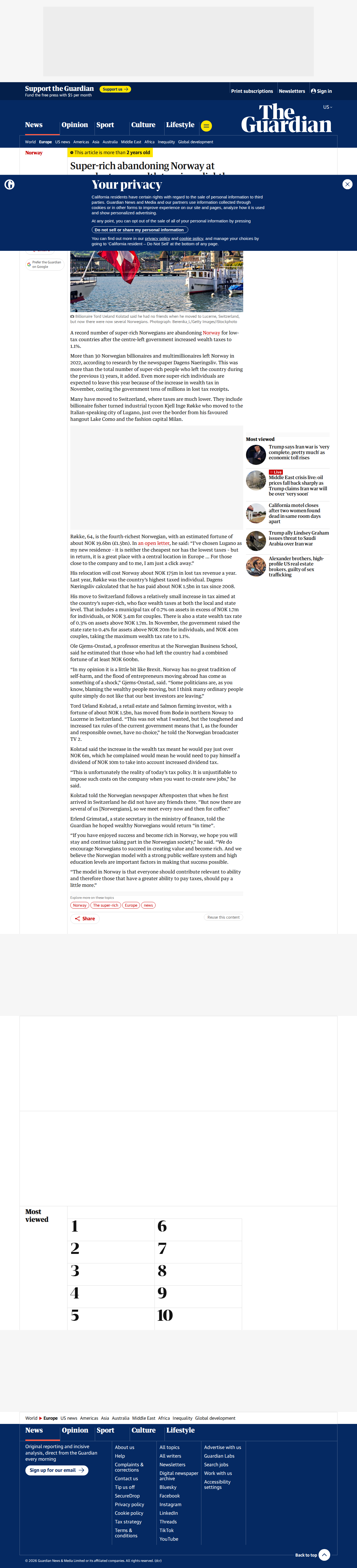
The Guardian (April 2023) reported: “More than 30 Norwegian billionaires and multimillionaires left Norway in 2022… more than the total number of super-rich people who left the country during the previous 13 years.”
It is important to note that Norway’s aggregate wealth tax revenue has still grown (from 18 billion to 32 billion kroner between 2021 and 2024) due to its broad tax base (20% of adults). The 2022 increase was net negative; the overall tax is not currently net negative in Norway. This is a meaningful distinction.
Broader European Pattern
CalMatters (February 2026) reviewed the European experience: “Over the past six decades, 14 European countries have imposed a broad tax on personal wealth. Most repealed them, with officials citing capital flight, disappointing revenue, high administrative costs and revenue losses from other existing taxes.”
The Tax Foundation confirms: “Countries have repealed their wealth taxes for a variety of reasons. They raise little revenue, create high administrative costs, and induce an outflow of wealthy individuals and their money.”
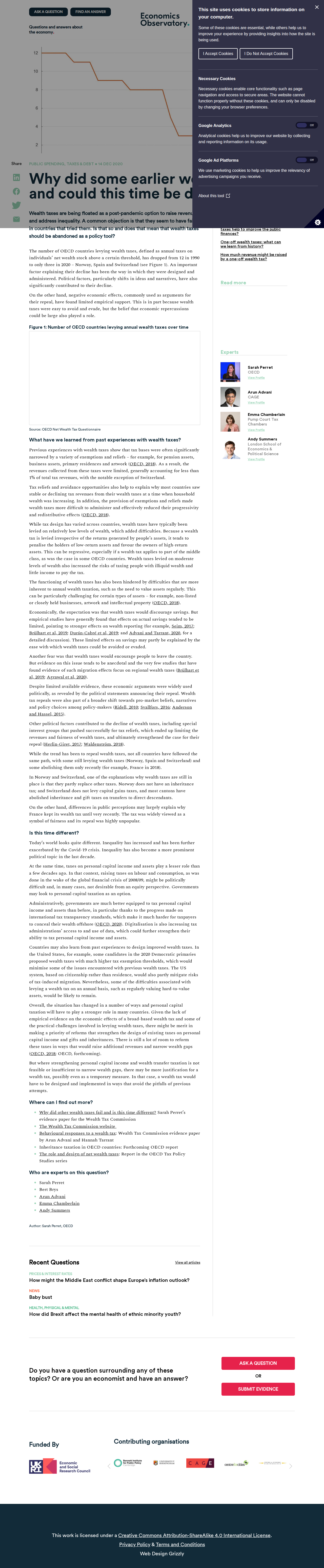
The Economics Observatory (2020) offers a partial counter: “On the other hand, negative economic effects, commonly used as arguments for their repeal, have found limited empirical support.” This is because wealth taxes were often so leaky (through avoidance and exemptions) that the expected macro damage was muted. But this also means the tax failed on its own terms.
Switzerland — The Counter-Example
Switzerland operates a cantonal-level wealth tax that has raised ~1.19% of GDP (2022), representing about 5.6% of total combined federal/cantonal/municipal tax revenue. Switzerland’s case is distinctive: the wealth tax partially substitutes for a capital gains tax (which Switzerland does not have at the individual level), it has low flat rates, and it is embedded in a fiercely decentralised, competition-oriented tax system. It is not straightforwardly applicable to jurisdictions with income tax, capital gains tax, and inheritance tax already in place.
Verdict: ✅ Largely True. The “net negative” outcome is well-documented for France and Norway’s 2022 increase, and the broader pattern of 14 OECD countries abandoning wealth taxes is consistent with this. Switzerland is a genuine counter-example, but operates under unique conditions. The claim is strong but should be understood as a well-evidenced tendency, not an iron law.
2. “Wealth taxes expand beyond the rich”
✅ True — documented through inflation drag on thresholds and very low starting thresholds in practice
France: Bracket Creep Catches the “Income Poor”
France’s ISF threshold was not adjusted in line with property price inflation between 1998 and 2004. This alone created €400 million in windfall revenues for the state in FY 2004, as homeowners with modest incomes were dragged into the tax net as their property values rose.
By 2016, the social profile of ISF taxpayers showed clear scope creep:
| Income bracket | Share of ISF taxpayers |
|---|---|
| Annual income below €49,000 | 20% |
| Annual income below €33,000 | 10% |
As French-property.com noted, this made the ISF “a tax imposed on those who are ‘capital rich’ but ‘income poor’” — particularly hitting retirees who owned their homes outright but lived on modest pensions.
Norway: 20% of Adults Now Pay
Norway’s current wealth tax threshold of ~1.7 million kroner (approximately $150,000–$264,000 in net worth) means the tax now falls on 720,000 citizens — roughly 20% of the adult population. The Guardian (September 2025) confirmed even Norwegian tax reformers acknowledge “the threshold of 1.7m kroner is too low.”
This is explicitly beyond what is normally marketed as targeting “the rich” — a quarter-million dollar net worth encompasses many ordinary homeowners in urban areas.
OECD: Systematic Pattern
The OECD’s analysis confirms this is a structural feature, not an accident. In their review of net wealth taxes:
“Wealth taxes have typically been levied on relatively low levels of wealth… This can be regressive, especially if a wealth tax applies to part of the middle class, as was the case in some OECD countries.”
CalMatters documents that the three currently active European wealth taxes kick in at net wealth of just $200,000 (USD equivalent), a level that in property-expensive cities captures middle-class homeowners.
Verdict: ✅ True. Both the mechanism (thresholds not inflation-adjusted) and the outcome (20% of Norwegian adults, 20% of French ISF payers on below-median incomes) confirm that wealth taxes systematically expand their reach beyond the “ultra-rich” they are sold as targeting.
3. “Wealth taxes produce relatively little revenue due to the small number of individuals”
✅ True — average 0.2% of GDP, less than 1% of total tax revenues across most OECD countries; designed exemptions further erode the base
The Scale Problem: Even 100% of Billionaire Wealth Falls Short
The fundamental constraint on wealth tax revenue is arithmetic: there simply isn’t enough wealth among the super-rich to fund government operations. The UK provides a stark illustration:
| Figure | Value |
|---|---|
| UK government annual spending (2024-25) | ~£1.33 trillion |
| Sunday Times Rich List top 350 combined wealth (2025) | £772.8 billion |
| Coverage | ~58% of annual spending (~7 months) |
Even using the most generous possible benchmark — the combined wealth of the entire Sunday Times Rich List top 350 (which includes all UK billionaires and the richest non-billionaires), totalling £772.8 billion in 2025 — seizing 100% of that wealth would still not fund the UK government for a single year. The Sunday Times Rich List 2025 reported that its 350 wealthiest individuals and families together hold £772.8 billion, while the UK government spends over £1.3 trillion annually. This underscores why wealth taxes consistently raise minimal revenue relative to overall government expenditure: the tax base is simply too small, even at the extreme end of the wealth distribution.
The OECD and independent researchers consistently find that wealth taxes raise remarkably little revenue:
| Country / Scope | Revenue as % of GDP | Revenue as % of total tax |
|---|---|---|
| OECD average (countries with wealth tax) | ~0.2% | <1% (typically) |
| Spain (2022) | 0.19% | 0.51% |
| Norway (2022) | ~0.7% | ~4.5% |
| Switzerland (2022) | 1.19% | 4.35% |
| Germany (pre-1997) | ~0.1% | ~0.3% |
| France ISF (2007) | ~0.16% | ~1.5% |
The Economics Observatory (2020): “Revenues collected from these taxes were limited, generally accounting for less than 1% of total tax revenues, with the notable exception of Switzerland.”
CalMatters: European wealth taxes generate, on average, 0.2% of GDP — “one-fiftieth of what the United States raises in federal income taxes.”
Why Revenue Is Low — Even Before Capital Flight
The small revenue is not solely due to departures. OECD analysis identifies multiple design failures:
- Extensive exemptions: Business assets, pension wealth, primary residences, artwork, and intellectual property are routinely excluded — both for political reasons and because these assets are hard to value.
- Avoidance: Because assets are self-reported and hard to value, avoidance is pervasive. Pichet estimated ISF fraud at 28% of revenues.
- Asset illiquidity: Illiquid assets (privately-held businesses, property) are both hard to value and create cash-flow problems for taxpayers with asset-rich, income-poor profiles.
- Small base: Even without departures, the ultra-wealthy are simply few in number. Warren’s proposed US wealth tax at $50M threshold would apply to only ~10% of total household wealth stock.
The Departure Effect Multiplier
When wealthy individuals leave, the fiscal damage extends beyond the wealth tax itself. They take income tax, VAT, capital gains, and investment multipliers with them. Pichet’s €7 billion annual shortfall estimate included these second-order losses. Norway’s $594 million in lost wealth tax revenue from the 2022 rate increase vastly exceeded the $146 million it was expected to raise.
Verdict: ✅ True. The low-revenue outcome is consistent across countries and studies. The small number of very wealthy individuals creates both the design problem (easy to flee) and the revenue ceiling (there aren’t many of them).
4. “Taking 100% of UK billionaire wealth would not fund UK for a single year”
✅ Supported (using a conservative benchmark)
The Sunday Times Rich List 2025 reports that the UK’s 350 richest individuals/families hold a combined £772.8 billion, with 156 billionaires listed. Note: the Rich List total of £772.8bn is used here as a conservative upper-bound benchmark — it includes very rich non-billionaires alongside billionaires, so the actual billionaire-only figure is lower still, which only strengthens the claim.
The House of Commons Library reports that UK government receipts in 2024/25 were £1.139 trillion.
Using those two totals directly in pounds:
- Rich List total wealth benchmark: £772.8bn
- Annual UK receipts benchmark: £1,139bn
- Ratio: ~67.8% of one year of receipts
So, even confiscating all wealth of the entire Rich List top 350 (a broader and higher benchmark than billionaires alone) still falls short of one year of UK state finances. Since annual public spending exceeds receipts in deficit years, this remains a conservative test that supports the claim. This illustrates the fundamental point that wealth taxes cannot meaningfully substitute for a functioning tax system: the entire stock of billionaire wealth is less than a single year’s tax receipts.
Verdict: ✅ True.
Summary Table
| Sub-claim | Rating | Summary |
|---|---|---|
| Wealth taxes produce net negative returns | ✅ Largely True | France’s ISF cost ~twice what it raised; Norway’s 2022 increase resulted in a $448M net loss; 14 OECD countries abandoned them. Switzerland is a genuine but context-specific counter-example. |
| They expand to cover more than “the rich” | ✅ True | Inflation drag and low thresholds routinely catch middle-class homeowners; Norway’s tax now covers 20% of adults; France’s ISF caught people earning below €49K/year |
| They produce little revenue due to small numbers | ✅ True | Average 0.2% of GDP across European wealth-tax countries; most raise <1% of total tax revenues; compounded by avoidance, exemptions, and capital flight |
| Taking 100% of UK billionaire wealth would not fund UK for a single year | ✅ True | UK billionaire wealth stock (£772.8bn) falls short of one year of government receipts (£1.139tn); even the broader top-350 Rich List total is only ~67.8% of annual state receipts |
Overall: Largely True — The core claims are well-supported by decades of empirical data from multiple European countries. The “net negative” characterisation is most precisely accurate for France and Norway’s 2022 increase, and represents the dominant pattern in the broader international evidence. The scope-expansion and low-revenue claims are robustly evidenced. Minor qualification is needed because (a) Switzerland demonstrates a functioning wealth tax in the right conditions, (b) Norway’s aggregate wealth tax revenue is still rising even as specific rate increases produce net negative returns, and (c) some of the failures are attributable to poor design as much as to the instrument itself.
References
Primary Sources
-
Eric Pichet — “The Economic Consequences of the French Wealth Tax” (SSRN) Published: September 2008 | Accessed: March 2026 URL: https://papers.ssrn.com/sol3/papers.cfm?abstract_id=1268381 Key finding: ISF causes annual fiscal shortfall of ~€7 billion (twice what it yields); total capital flight ~€200 billion since 1988.
-
CitizenX — “Norway’s Wealth Tax Unchains a Capital Exodus” Published: March 2026 | Accessed: March 2026 URL: https://citizenx.com/insights/norway-wealth-exodus/ Key finding: Norway’s 2022 wealth tax increase expected to raise $146M led to $448M net loss as $54B in wealth left.
-
The Guardian — “Super-rich abandoning Norway at record rate as wealth tax rises slightly” Published: April 2023 | Accessed: March 2026 URL: https://www.theguardian.com/world/2023/apr/10/super-rich-abandoning-norway-at-record-rate-as-wealth-tax-rises-slightly Key finding: More than 30 Norwegian billionaires/multimillionaires left in 2022 — more than the previous 13 years combined.
-
CalMatters — “Opinion: California should learn from these European countries that tried wealth taxes” Published: February 2026 | Accessed: March 2026 URL: https://calmatters.org/commentary/2026/02/wealth-taxes-europe-countries-california/ Key finding: 14 European countries tried broad wealth taxes, most repealed them; average revenue 0.2% of GDP; European taxes kick in at $200,000 net worth.
-
Economics Observatory — “Why did some earlier wealth taxes fail and could this time be different?” Published: December 2020 | Accessed: March 2026 URL: https://www.economicsobservatory.com/why-did-some-earlier-wealth-taxes-fail-and-could-time-be-different Key finding: Revenues generally <1% of total tax revenues; OECD countries dropped from 12 to 3 with wealth taxes between 1990 and 2020; middle class frequently caught.
-
Tax Foundation — “Wealth Tax Impact: Details & Analysis” Published: ongoing | Accessed: March 2026 URL: https://taxfoundation.org/research/all/eu/wealth-tax-impact/ Key finding: Countries repeal for low revenue, high admin costs, and capital flight; Norway, Spain, Switzerland, Colombia are only OECD countries with active wealth taxes; Spain 0.19% GDP; Switzerland 1.19% GDP.
-
Fortune — “Before California, France tried a wealth tax. Macron repealed it after rich people fled” Published: January 2026 | Accessed: March 2026 URL: https://fortune.com/2026/01/27/california-france-wealth-tax-inequality/ Key finding: ~60,000 millionaires left France 2000–2017; total capital flight estimated at €200 billion; Macron abolished ISF 2018.
-
Marginal Revolution — “The Economic Consequences of the French Wealth Tax” Published: September 2024 | Accessed: March 2026 URL: https://marginalrevolution.com/marginalrevolution/2024/09/the-economic-consequences-of-the-french-wealth-tax.html Key finding: Summary of Pichet’s findings — ISF threshold not raised for inflation 1998–2004 creating €400M windfall; fiscal shortfall ~twice yield.
-
The Guardian — “People are so angry: how wealth tax became a battleground in Norway’s election” Published: September 2025 | Accessed: March 2026 URL: https://www.theguardian.com/world/2025/sep/07/wealth-tax-norway-election Key finding: 720,000 Norwegians (20% of adults) pay wealth tax; threshold of 1.7M kroner acknowledged as too low even by reformers.
-
Canadian Affairs — “Norway’s wealth tax drove out the rich without breaking the bank” Published: October 2025 | Accessed: March 2026 URL: https://www.canadianaffairs.news/2025/10/24/norways-wealth-tax-drove-out-the-rich-without-breaking-the-bank/ Key finding: Norway’s aggregate revenue rising (27B to 34B kroner 2022–2025) due to broad base, despite high-net-worth departures from 2022 increase.
-
Wikipedia — “Wealth tax” Accessed: March 2026 URL: https://en.wikipedia.org/wiki/Wealth_tax Key finding: Pichet estimate cited; capital flight data; list of countries that abandoned wealth taxes.
-
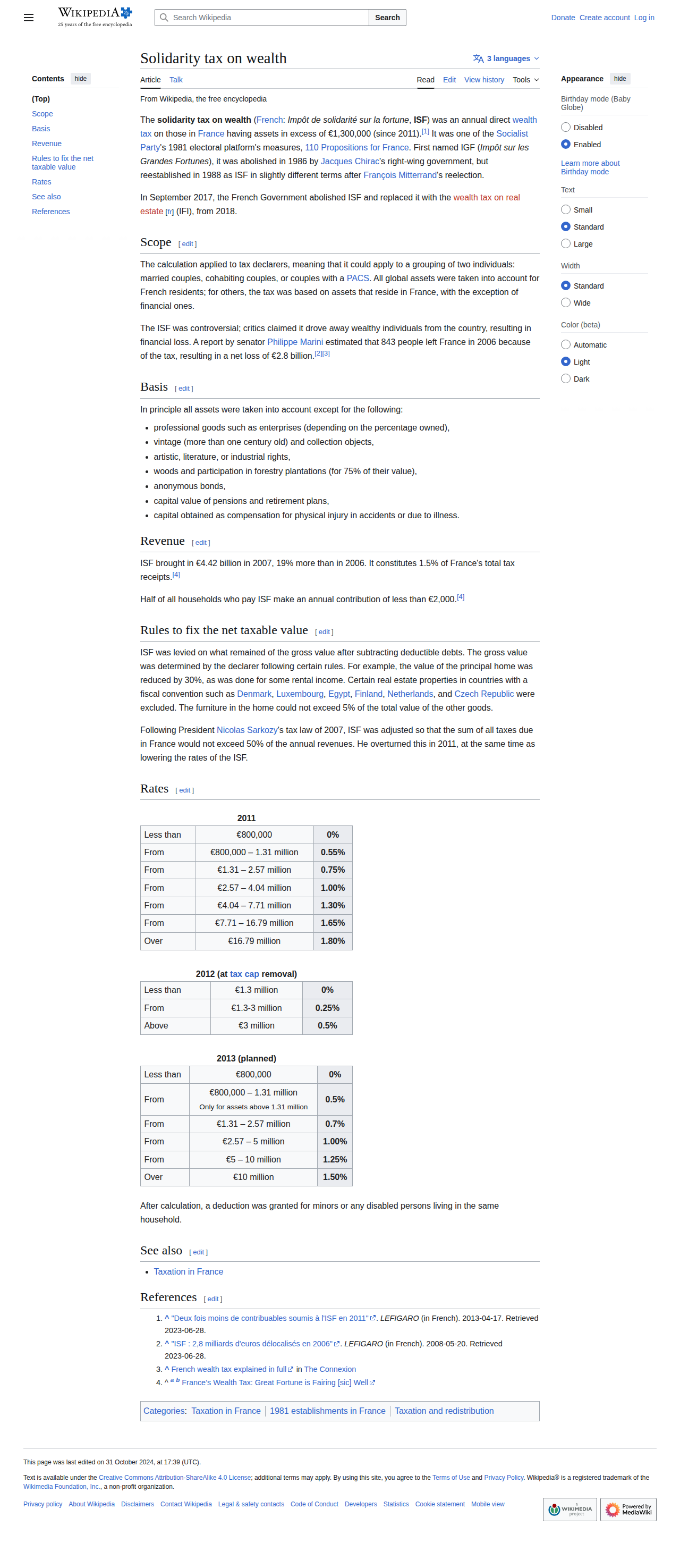
Wikipedia — “Solidarity tax on wealth (ISF)” Accessed: March 2026 URL: https://en.wikipedia.org/wiki/Solidarity_tax_on_wealth Key finding: ISF revenue €4.42 billion (2007); 1.5% of France’s total tax receipts; half of ISF households contributed <€2,000/year.
-
Perret, S. — “Why were most wealth taxes abandoned and is this time different?” (Fiscal Studies, 2021) Published: 2021 | Accessed: March 2026 URL: https://onlinelibrary.wiley.com/doi/10.1111/1475-5890.12278 Key finding: Austria, Denmark, Finland, Germany saw declining net wealth tax revenues; design failures and political factors contributed to repeal.
-
Oxfam GB — “Billionaire wealth surges three times faster in 2024” Published: January 2025 | Accessed: March 2026 URL: https://www.oxfam.org.uk/media/press-releases/billionaire-wealth-surges-three-times-faster-in-2024-world-now-on-track-for-at-least-five-trillionaires-within-a-decade/ Key finding: UK billionaires’ collective wealth was £182 billion in 2024.
-
The Sunday Times Rich List 2025 (UK-focused rich list summary figures) Published: May 2025 | Accessed: 17 March 2026 page.txt | screenshot.png | page.html | metadata.json Key finding: Top 350 combined wealth £772.8bn; 156 billionaires (down from 177 peak in 2022); list wealth down 3% year-on-year. Note: this is an upper-bound benchmark as it includes very rich non-billionaires as well as billionaires.
-
The Sunday Times Rich List 2025 — News UK Published: May 2025 | Accessed: March 2026 URL: https://www.news.co.uk/latest-news/the-sunday-times-rich-list-2025/ Key finding: UK’s top 350 richest individuals and families hold combined wealth of £772.8 billion in 2025, with 156 billionaires listed; this is ~58% of UK annual government spending (~7 months), still falling short of one year.
Evidence Screenshots
Norway Wealth Tax Net Loss — CitizenX

The Guardian — Super-rich abandoning Norway
CalMatters — European wealth taxes repealed

Tax Foundation — Wealth Tax Impact

Economics Observatory — Why earlier wealth taxes failed
Wikipedia — Wealth Tax overview

Marginal Revolution — French Wealth Tax consequences (Pichet abstract)

Fortune — France wealth tax, Macron repeal

Canadian Affairs — Norway wealth tax counterpoint (overall revenues still rising)

The Guardian — Norway wealth tax election battle (threshold too low)

Wikipedia — France ISF Solidarity Tax on Wealth
Pichet SSRN — Economic Consequences of French Wealth Tax

Perret — Fiscal Studies (Wiley), Why were most wealth taxes abandoned

House of Commons Library — Tax statistics overview (UK receipts £1.139tn)

Sunday Times Rich List 2025 — UK billionaire wealth £772.8bn