 New Civil Engineer Civil engineering and construction news and jobs from New Civil Engineer
Regulators have recommended that Thames Water’s proposed large reservoir in the Abingdon area should progress to the next stage of development after finding the project sufficiently mature to warrant further public money.
The Regulators’ Alliance for Progressing Infrastructure Development (Rapid) published a draft decision proposing that the South East Strategic Reservoir Option (Sesro) pass “gate three” of its multi-stage approval process. If confirmed, the decision would release a further £100M to fund detailed design work, environmental assessment and planning preparation ahead of a development consent order (DCO) application expected by November 2026.
Sesro is a joint scheme being developed by Thames Water, Southern Water and Affinity Water. The project would create a fully bunded, non-impounding raw water storage reservoir near Abingdon, Oxfordshire, intended to store Thames water in periods of high flow for use during drought. With a capacity of 150Mm3, developers estimate it could supply about 271M litres a day – enough to serve up to 15M customers across the three companies – and would be one part of a wider response to falling available supplies in the South East.
Rapid, a partnership between Ofwat, the Environment Agency and the Drinking Water Inspectorate that oversees funding and approval of major water infrastructure, said the gate three submission showed “good” evidence in areas including programme planning and procurement and that the £65.44M already spent on gate three development activities had been used efficiently. Rapid recommended gate three approval to allow work on design development, groundwater flood mitigation, drainage solutions and preparation of the Preliminary Environmental Information Report (PEIR) needed for a DCO application. The regulator added these steps are required to keep the scheme on track for construction readiness by 2029 and potential operation from 2040.
But the draft decision also flagged shortcomings. Rapid said the applicant had not demonstrated, within the gate submission, that Sesro remains the best value option in the context of up‑to‑date statutory water resources plans and alternative solutions, given recent cost increases. The submission estimates Sesro’s capital cost at between £5.5bn and £7.5bn, a significant jump from the £2.2bn that was estimated earlier in the process.
Regulators have attached priority actions to address this value question, requiring the three water companies to update their best-value assessment through the statutory water resources planning process by 30 June 2026. This process has been developed by the Environment Agency, Natural Resources Wales and the Office for Water Services and requires project promoters to work through several rigorous procedures including supply and demand forecasts and compiling a best value plan.
Rapid’s draft decision is now subject to public consultation, which closes on 29 January 2026. Rapid will consider responses before issuing its final determination.
NCE recently spoke to Thames Water about the next step to DCO submission, including procuring a contractor.
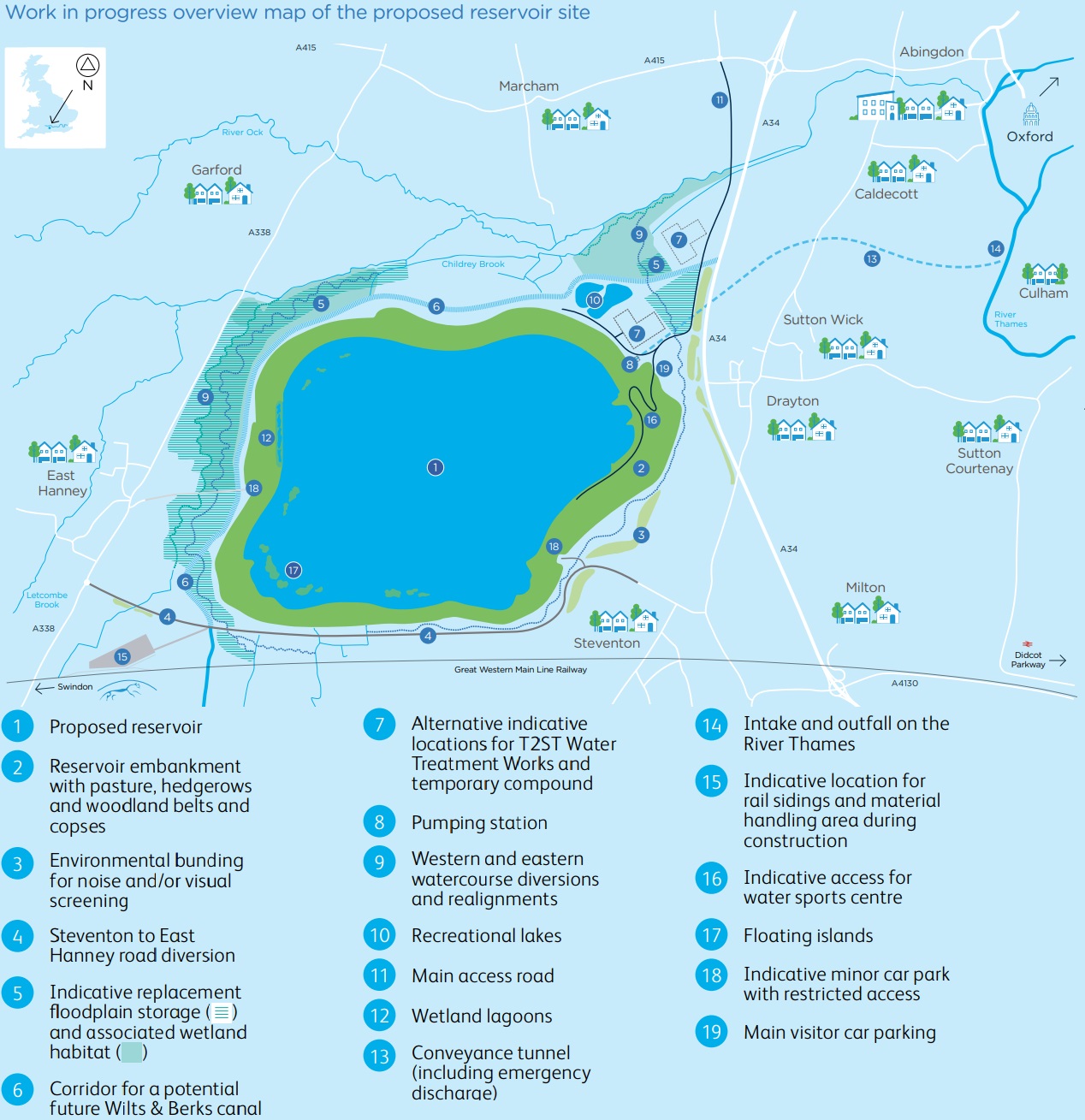
Masterplan for Sesro
Background and wider pressures
The recommendation comes amid growing concern about water scarcity in England and Wales. National projections published by government bodies suggest a potential shortfall of roughly 5bn litres per day by 2055, driven by reduced river abstractions to protect ecosystems, climate change and population growth. The South East faces particularly acute pressure, with forecasts suggesting a local shortfall of more than 2bn litres per day by 2055. Water industry plans rely on a mix of demand reduction, major leakage cuts and new supply projects such as reservoirs, transfers and desalination.
Industry critics and environmental groups have previously questioned large reservoir projects on grounds of cost, landscape and biodiversity impact, and whether alternatives such as accelerated leakage reduction, metering and local transfers could deliver better value. Rapid’s insistence that developers re‑test the project’s best-value case through statutory water resources planning reflects that debate.
If the final Rapid decision maintains gate three approval, developers will receive gate four funding to progress technical design and environmental work ahead of the DCO application. The consultation period offers local communities, environmental bodies and others an opportunity to comment on the draft decision and the case for Sesro. Any DCO application would trigger a separate, statutory planning examination process, where environmental impacts and public representations will be considered in detail.
‘Maintaining momentum is key’
Paul Hickey, Managing Director, Rapid, said: “With a forecast water shortfall of over two billion litres per day in the South East of England by 2055, major infrastructure projects like SESRO will be critical for securing our future water supply.
“Maintaining momentum around this scheme is imperative so it can be construction ready by 2029. Releasing the next round of funding will allow the next phase of development and enabling work to happen without delay.”
“We welcome representations on our draft decision to ensure we are considering all options to mitigate risks and maximise the scheme’s benefits.”
Have your say
or a new account to join the discussion.