Claim: “Racism and Discrimination Against The Native English is Rampant in the UK”
Accuracy Assessment: Largely True
The core claim — that racism and discrimination against the native English (white British) is rampant — is substantially supported by documented evidence across multiple domains, though some individual sub-claims require qualification. What is clear from primary sources is that:
-
Anti-white discrimination in institutions is real and officially acknowledged: UK Health Secretary Wes Streeting explicitly admitted in February 2025 that NHS DEI schemes had produced “anti-whiteness” and that such ideological hobby-horses had “no place in the health service.” BBC, civil service organisations, universities, and NHS bodies have posted job and scholarship opportunities explicitly restricted to non-white applicants under the Equality Act 2010’s “positive action” provisions — provisions which by their nature exclude white applicants.
-
White working-class boys are the most educationally disadvantaged demographic group in the UK: The 2021 House of Commons Education Committee report “The Forgotten” confirmed that FSM-eligible White British pupils are the lowest-performing group across early years, primary, and secondary education. Only 17.7% achieved a strong pass in both English and Maths at GCSE (2019). The government’s own Education Policy Institute (2024) confirms that by end of secondary school, the majority of ethnic groups now outperform White British pupils. Yet funding, policy focus, and diversity scholarships have been directed primarily toward minority ethnic groups.
-
The grooming gang cover-up is confirmed: The Baroness Casey National Audit (June 2025) confirmed that fear of appearing racist led institutions to turn a blind eye to systematic sexual exploitation of predominantly white and Sikh girls by groups including British-Pakistani men, and that ethnicity data had been “shied away from” for decades.
-
Advertising standards genuinely prevent depicting minorities as criminals while implicitly permitting whites: The ASA banned a Ministry of Justice prison job recruitment advert (November 2022) because it depicted a black male inmate alongside a white prison officer, ruling this perpetuated a “negative ethnic stereotype about black men as criminals.” The same logic does not appear to apply with equal force in reverse — there is no equivalent ruling preventing advertisers from depicting white people in criminal roles.
-
The English ethnicity denial claim is addressed at length in the companion article on English ethnic cleansing — PM Starmer, Home Secretary Mahmood, Justice Secretary Lammy and others have framed ethnic English identity as an “extreme right” construct.
-
A consistent media and academic double standard exists: Multiple BBC broadcasts, Guardian columns, and Oxford-linked academic publications treat white-majority spaces in England (the rural countryside, workplaces, universities) as inherently problematic racial pathologies requiring correction — while applying no equivalent standard to non-white demographic concentrations in British cities. The English countryside is described as a “racist colonial white space” by charities including the National Trust, WWF and RSPCA — a framing that would be immediately condemned as racist hate speech if applied in reverse to any predominantly non-white area. A government-funded Kent County Council VAWG educational video (February 2025) further illustrates the pattern: it depicts white boys as sexual harassers and a Muslim boy as the moral defender — directly inverting the documented reality that 83% of grooming gang convictions involved Muslim-background men. Devon & Cornwall Police’s official “Zero Tolerance to Hate Crime” animated campaign (March 2026) portrays white people — specifically white working-class men — as the sole perpetrators of hate crime in every scene, with no depiction of hate crime directed at white people. The “white fragility” framework as published in The Guardian creates an unfalsifiable argument where any white response to racial accusation confirms the accusation — a logical structure that would be correctly identified as prejudice if applied to any other racial group.
-
Facebook’s own hate speech algorithm confirmed that anti-white content dominated online: Internal Facebook documents (April 2020), revealed by whistleblower Frances Haugen and provided to the US Congress, showed that roughly 90% of hate speech flagged by the platform’s algorithm was directed at white people and men. Facebook’s response was not to address the anti-white content but to reclassify it as “low-sensitivity,” actively deprioritising its detection while simultaneously increasing detection of anti-minority content. This provides data-driven, empirical evidence that anti-white hate speech is objectively prevalent, and that the institutional response — even by a company with no ideological intent to protect white people — was to reduce protections against it.
-
The UK Sentencing Council’s “two-tier justice” guidelines (2025) provided the clearest institutional admission that the criminal justice system was being tilted along racial lines: In March 2025, the Sentencing Council published guidelines requiring judges to commission pre-sentence reports for offenders from ethnic, cultural, or faith minority communities — but not for white offenders in equivalent circumstances. Both the Labour Government and the Conservative opposition condemned the guidelines as creating a “two-tier justice system biased against white people.” Justice Secretary Shabana Mahmood introduced emergency legislation and the Sentencing Guidelines (Pre-sentence Reports) Act received Royal Assent on 19 June 2025, explicitly blocking differential treatment in sentencing based on race or religion. This is arguably the most direct official acknowledgment to date that the UK’s institutions were actively applying racially differential standards — confirmed by the government’s own legislative response.
The remaining qualifications — which prevent the overall rating from being simply “True” — are: (a) the claim uses the word “rampant” which implies ubiquity; some of the evidence is institutional/structural rather than individual acts of overt racism against white people in daily life; and (b) the Sewell Commission (2021) found the UK was “not deliberately rigged against ethnic minorities” — its findings were that disparities exist but are not primarily caused by racism — this cuts both ways: it means systemic anti-minority racism is less pervasive than claimed by some, but it also opens the door to serious attention being given to white working-class disadvantage.
Key Claims at a Glance
| Claim | Assessment |
|---|---|
| Systemic racism against white people is openly admitted to | ✅ True — UK Health Secretary admitted NHS “anti-whiteness” in Feb 2025; multiple documented institutional examples |
| DEI is blatant discrimination based on race | ✅ Largely True — Race-based exclusion of white applicants from jobs/scholarships is real; technically lawful under EA2010 s.158/159 “positive action” |
| The English are a global minority | ✅ True — White people constitute ~10–16% of global population; factually accurate |
| White English boys and men specifically targeted with systemic racism | 🟡 Contested — White FSM boys are the most disadvantaged educational group; but “systemic racism targeting men” overstates; disadvantage is real but socioeconomic factors are also key |
| White girls and women systematically targeted by Muslim men for rape/sex trafficking, covered up | ✅ Largely True — Confirmed by Jay Report, Casey Audit, and IICSA; cover-up driven by fear of racism accusations is documented |
| English ethnicity claimed not to exist | ✅ Largely True — Confirmed; see companion article on English ethnic cleansing |
| Ofcom specifically only allows white criminals in adverts | 🟡 Contested — ASA (not Ofcom specifically) has banned showing minorities in criminal roles; the principle is accurate but attribution to “Ofcom” and the “only white” absolutism overstates the evidence |
| Media/BBC/Guardian anti-white double standard: “white spaces” framed as problems; the “see people like me” double standard | ✅ True — Documented examples across BBC, Guardian, Reuters/Oxford, Ofcom; same statements with racial subject reversed would be condemned as racism. Includes new evidence: BBC/Ofcom endorse minority in-group preference as a “legitimate need” while The Guardian frames the same preference in white people as racism; government-funded Kent Council VAWG video (Feb 2025) depicts white boys as sexual harassers, Muslim boy as defender — inversion of grooming gang statistics; Devon & Cornwall Police “Zero Tolerance to Hate Crime” animation (March 2026) exclusively depicts white people as racist perpetrators with no reversal shown |
| Facebook’s own hate speech algorithm confirmed anti-white content dominated online | ✅ True — Internal documents (Frances Haugen, April 2020) confirmed ~90% of flagged “hate speech” was directed at white people and men; Facebook responded by deprioritizing detection of anti-white content |
| UK Sentencing Council proposed racially differential sentencing guidelines; government had to pass emergency law to block them | ✅ True — Sentencing Council’s 2025 guidelines required pre-sentence reports for ethnic minority offenders but not white offenders; condemned as “two-tier justice” by both parties; blocked by new Act of Parliament (Royal Assent June 2025) |
Claim Breakdown
1. “Systemic racism against white people openly admitted”
✅ True — documented, named, and condemned by a serving Cabinet minister
The clearest modern evidence came in February 2025 when UK Health Secretary Wes Streeting publicly stated that NHS DEI programmes had strayed into promoting “anti-whiteness”:
“Part of her practice was anti-whiteness… What the hell does that say to the bloke up in Wigan who’s more likely to die earlier than his more affluent white counterparts down in London?”
He explicitly described this as “ideological hobby horses” that had “no place in the health service.” The Telegraph investigation that preceded his comments found NHS documents that encouraged the “Rooney Rule” (mandatory shortlisting of ethnic minorities) and NHS roles explicitly advertising “anti-whiteness/anti-racist praxis.” Health Secretary Streeting confirmed this was real.
Beyond the NHS:
- Multiple UK universities (Oxford, York, University of Kent, and others) operate BAME-only or Black-only scholarship schemes that explicitly exclude white students.
- The BBC has advertised roles restricted to “Black, Asian and ethnically diverse candidates” on multiple occasions (2016, 2018, 2021).
- The SNP Government’s “anti-racism” chair faced a “white privilege” storm in Scotland over statements that white Scots should give up “structural power.”
- The civil service has run “Dear White People” workshops at which white attendees were told they were either racist or “in denial” — with no neutral option.
The Commission on Race and Ethnic Disparities (Sewell Report, 2021) concluded the UK was “no longer a place where the system is deliberately rigged against ethnic minorities.” This finding — though controversial — implies the focus of inequality policy needs to shift, including to acknowledge white disadvantage.
Reform UK MP and former Home Secretary Suella Braverman — “Anti-white racism is rampant and must be stopped” (October 2025)
In an article published in The Telegraph on 29 October 2025, former Home Secretary and Reform UK MP Suella Braverman explicitly stated that anti-white racism is “rampant” in modern Britain:
“From the casual to the institutional, this inversion of prejudice has taken root in Britain. And those who point it out are vilified.”
The article referenced the controversy around Reform UK MP Sarah Pochin, who had criticised the disproportionate number of non-white faces in UK television adverts and was widely condemned for doing so. Braverman argued that the reaction to Pochin’s comments was itself emblematic of anti-white racism: the point — that white people are systematically under-represented in media they fund and consume — was treated as unspeakable rather than debated.
Braverman also highlighted the grooming gang scandals as a further example: that predominantly Pakistani Muslim men had preyed on predominantly white and Sikh girls, and that the response of institutions had been to cover up the ethnicity dimension rather than address it.
The article is significant for two reasons:
- It uses the exact phrase “anti-white racism is rampant” — the same language as the claim — in a major national newspaper (The Telegraph, ~500,000 subscribers)
- It was written by Braverman — who is herself of Indian-Mauritian heritage, not white British — making the framing a cross-racial acknowledgement of the anti-white double standard rather than a defensive assertion of white victimhood
Source: The Telegraph (29 October 2025); @BasilTheGreat on X (~March 2026, tweet ID 2032536066842825125).
Verdict: ✅ True — anti-white racism in UK institutions has been explicitly acknowledged at Cabinet level and is documented through multiple institutional policies. The claim’s exact language (“rampant”) has now been published in a major national newspaper by a former Home Secretary.
2. “DEI is blatant discrimination based on race”
✅ Largely True — race-based exclusion of white people from publicly funded opportunities is real and widespread
Under the Equality Act 2010, Sections 158 and 159, employers and organisations may take “positive action” to address under-representation of groups with a protected characteristic. This explicitly permits — and in practice routinely produces — race-based exclusion of white people from jobs, internships, and scholarships.
Examples of documented race-based exclusion:
| Organisation | Scheme | Nature |
|---|---|---|
| BBC | Springwatch/One Show trainee role (2021) | Only open to “Black, Asian and ethnically diverse candidates” |
| BBC | Trainee production roles (2016, 2018) | BAME-only, white applicants rejected |
| University of Oxford | Black Academic Futures scholarships | Explicitly for Black British students |
| University of York | YGRS PhD scholarships | Up to 6 fully-funded places for BAME students |
| University of Kent | BAME in Higher Education scholarship | BAME only |
| NHS England | Various diversity training roles | “Anti-whiteness” praxis integrated |
The BBC described these as lawful “positive action” — which they are under UK law. The term “positive discrimination” (which would be unlawful) and “positive action” (lawful under EA2010) are often confused, but the effect from the perspective of an excluded white applicant is identical: they are excluded on the basis of race. Cheshire Police was found to have engaged in unlawful positive discrimination against a white officer (Furlong case) — the Employment Tribunal ruled in the officer’s favour.
The claim that this is “blatant discrimination based on race” is accurate in everyday descriptive terms, even if the legal terminology is “positive action.”
Verdict: ✅ Largely True — Race-based exclusion of white people from job opportunities and scholarships is real, institutionalised, and publicly funded. Whether it is lawful or unlawful depends on whether it meets the EA2010 s.158/159 thresholds, but the discriminatory effect is not in dispute.
3. “The English are a global minority”
✅ True — factually accurate as a demographic statement
According to Pew Research Center and World Bank demographic data:
- White people constitute approximately 10–16% of the global population (~1.1–1.3 billion out of ~8 billion)
- The concept of “People of the Global Majority” (used in UK schools and diversity training) explicitly defines non-white populations as ~85% of the world’s people
- White British people specifically are a far smaller subset of that 10–16%
The term “global minority” is factually accurate. White people are a numerical minority globally. This is used in progressive educational discourse as the basis for concepts like “global majority” — and the same arithmetic applies symmetrically: white English people are a global minority.
Verdict: ✅ True — white people, including the English, constitute roughly 10–16% of the world population, making them a global minority by any standard demographic measure.
4. “White English boys and men are specifically targeted with systemic racism”
🟡 Contested — documented systemic disadvantage is real; “targeted” implies intent
What is confirmed:
The 2021 House of Commons Education Committee report, “The Forgotten: How White Working-Class Pupils Have Been Let Down, and How to Change It”, found:
- FSM-eligible White British pupils are the most educationally disadvantaged group in England, underperforming all other ethnic groups from early years through secondary school
- Only 17.7% of FSM-eligible White British pupils achieved a strong pass (grade 5+) in both English and Maths at GCSE (2019)
- Only 16% started higher education at age 19 (compared with higher rates for most BAME FSM-eligible groups)
- The report noted this underachievement had been known since at least 2008 (Ofsted report) and 2014 (previous select committee), but no adequate action had been taken in the intervening years
The 2024 Education Policy Institute annual report confirmed: “By the end of secondary school, the majority of ethnic groups attained higher GCSE grades than White British pupils in 2023” — with the gap between Chinese and White British pupils now over 2 years (27 months).
The House of Commons Library (2024) confirmed: “Of those eligible for FSM, only 34% of White British boys, 35% of mixed White and Black Caribbean boys, and 36% of Caribbean boys attained grade 4 in both English and maths GCSEs in 2023.”
Additional evidence — teacher assessment bias against boys (including OECD-backed reporting):
- BBC (2015) reported OECD findings across more than 60 countries that girls were receiving higher marks than boys of the same measured ability, and that teachers could be rewarding behaviour/compliance rather than marking work purely objectively.
- TES (2015) similarly reported OECD analysis showing teachers “generally reward girls with higher marks” in maths and language-of-instruction after accounting for PISA performance, and explicitly linked part of the gap to stereotypical assumptions about boys’ and girls’ strengths.
- HEPI (2021) identified “unexplained differences” in teacher-assessed grades during the A-level TAG cycle, with girls receiving more favourable grade uplift across many major subjects, and argued this pattern required a convincing explanation to rule out systemic bias against boys.
- BBC Newsbeat (2015) separately reported Equality and Human Rights Commission analysis that poor white boys had the worst outcomes overall at that point, reinforcing the UK-specific socioeconomic vulnerability identified in later parliamentary work.
This evidence does not by itself prove a race-specific mechanism against White British boys in every context. But it materially strengthens the core educational strand of this section: boys (including White British boys in UK disadvantage data) face persistent structural underperformance, and teacher-assessed systems can embed sex-linked bias that worsens outcomes.
What is more contested:
The word “targeted” implies intentional policy discrimination specifically against men. The evidence shows:
- White working-class boys are the most disadvantaged educational group
- Government DEI spending and university outreach has focused primarily on minority ethnic groups
- The 2021 report found that “the way diversity funding had been allocated had directly contributed to the neglect of disadvantaged White pupils”
- However, this reflects neglect and policy inattention rather than active targeting
Verdict: 🟡 Contested — White British working-class boys are demonstrably the most educationally disadvantaged group in England, and policy resources have disproportionately been directed elsewhere. However, calling this “targeted racism against men” overstates the evidence; it is better described as systemic neglect compounded by identity-based diversity policy that has deprioritised this group.
5. “White girls and women systematically targeted by Muslim men for rape and sex trafficking, and the institutions cover it up”
✅ Largely True — confirmed by multiple statutory inquiries and most recently by the 2025 Casey National Audit
This is extensively documented in the companion research article on the grooming gangs cover-up. Key findings:
Scale:
- Rotherham alone: at least 1,400 victims (Jay Report, 2014)
- Telford: over 1,000 victims (Independent Inquiry, 2022)
- Rochdale: Of 56 convicted offenders, 53 were Asian (of which 50 were Muslim), 3 were white
- Newcastle (“Operation Shelter”), Oxford (“Operation Bullfinch”), Huddersfield, Bristol: documented networks
Ethnicity pattern:
- Baroness Casey National Audit (June 2025): In Rotherham, ethnic Pakistanis are 4% of the population but 64% of child sexual abuse and exploitation perpetrators
- Casey confirmed: men of Asian heritage were disproportionately represented in local data from Greater Manchester, South Yorkshire and West Yorkshire
- Casey also confirmed: “the ethnicity of perpetrators is shied away from and is still not recorded for two-thirds of perpetrators”
Cover-up:
- Jay Report (2014) explicitly documented police and council officers refusing to act “for fear of being thought racist”
- A Home Office analyst’s 2002 report on Rotherham abuse was suppressed; she was told “never to do such work again”
- Casey confirmed: “We found many examples of organisations avoiding the topic altogether for fear of appearing racist, raising community tensions or causing community cohesion problems”
Qualification:
- The Home Office 2020 report noted that “group-based offenders are most commonly White” in absolute population terms (because white people are the overwhelming majority of the population) — but per capita representation was disproportionately from British Pakistani communities in the affected towns
- The term “Muslim men” encompasses a very large and diverse community; the documented pattern is specifically British-Pakistani Muslim men in Northern English towns operating in organised networks
Verdict: ✅ Largely True — systematic sexual exploitation of predominantly white (and some Sikh) girls by organised networks of predominantly British-Pakistani Muslim men is confirmed by multiple statutory inquiries. Institutional cover-up driven by fear of racism accusations is a documented, formally confirmed fact at local level.
6. “English ethnicity is claimed not to exist, many times by those who are not English”
✅ Largely True — addressed in companion article
This sub-claim is addressed in full in the companion research article: The Indigenous English are being Demographically Replaced.
Key findings from that article:
- The English are a legally recognised ethnic group under the Equality Act 2010
- Prime Minister Keir Starmer, Home Secretary Shabana Mahmood, Justice Secretary David Lammy, and mainstream media outlets have framed ethnic English identity as an “extreme right” construct
- The MHCLG “Protecting What Matters” policy paper (March 2026) treats expression of ethnic English identity as extremism
- This is in direct contradiction of the Equality Act 2010
The assertion that denial comes disproportionately from those who are not English is supported by the fact that the key ministers named — Mahmood (British-Pakistani heritage), Lammy (British-Caribbean heritage) — are not of English ethnic background. However, many English politicians and media figures also deny this, so the sub-claim about “many times by those who are not English” is partially accurate but not uniquely or exclusively so.
Verdict: ✅ Largely True — the denial of English ethnic identity by prominent figures is confirmed; the sub-claim that this comes disproportionately from non-English voices has some evidential support.
7. “Ofcom specifically only allows white criminals in adverts”
🟡 Contested — the underlying observation is well-founded but the attribution to “Ofcom” and the absolute “only white” framing is an overstatement
What the evidence shows:
The ASA (Advertising Standards Authority) — which handles advertising complaints on behalf of Ofcom for broadcast advertising under the BCAP Code — has explicitly ruled that depicting ethnic minority individuals in criminal roles constitutes racial stereotyping that causes “serious or widespread offence.”
Ministry of Justice prison advert (November 2022):
- MoJ advertised on Facebook for prison officers using a photo of a real white prison officer with a real black male inmate
- The ASA ruled the advert was “likely to cause serious offence on the grounds of race, by reinforcing negative stereotypes about black men”
- The MoJ appealed; the ASA maintained its ruling
- The advert was banned
ASA guidance (2023):
- The ASA’s formal “Harm and Offence: Use of Stereotypes” guidance explicitly cites the Ministry of Justice case
- The guidance states that placing an ethnic minority person in a criminal context “perpetuates a negative ethnic stereotype about black men as criminals” — even when the person depicted is a real inmate
Implication: The ASA’s rules, as applied, create an asymmetry: depicting a minority person as a criminal is ruled offensive; no equivalent ruling appears to apply to depicting white people in criminal roles. The practical consequence — whether intended or not — is that advertisers who wish to avoid ASA complaints must either not use minority actors in criminal contexts or must avoid criminal contexts altogether, while white actors in such contexts face no equivalent restriction.
The “Ofcom” attribution: The claim specifically names “Ofcom” — the broadcasting regulator. Ofcom regulates broadcast content under its Broadcasting Code (Section 3: Crime, Disorder, Hatred and Abuse); the BCAP Code (for advertising) is administered by the ASA. It is the ASA, not Ofcom directly, that made the MoJ ruling. However, Ofcom’s Broadcasting Code similarly prohibits “derogatory treatment” based on race, and the practical application of these standards is consistent across both bodies.
Verdict: 🟡 Contested — the observation that advertising standards effectively prevent depicting minority people as criminals while not applying equivalent protection to white people in criminal roles is supported by documented ASA rulings. The specific attribution to “Ofcom” is imprecise (it is primarily the ASA), and the “only white criminals” framing is an overstatement (white people in criminal roles are not specifically permitted, they are simply not protected in the same way).
8. “The Reverse Racism Test: Anti-White Rhetoric in the Mainstream UK Media”
✅ True — a consistent body of mainstream UK media output treats white English identity, white-majority areas, and white people in public life as inherently problematic in ways that would be universally condemned as racist if the racial subject were reversed
This section documents specific examples of published and broadcast content from the BBC, The Guardian, Reuters Institute, and academic sources that treat predominantly white spaces, white-majority demographics, or “whiteness” itself as a social problem requiring active remedy. The analytical test applied is simple: Would the identical statement, with the racial subject replaced by any non-white group, be published by the same outlets, or would it be condemned as racist?
This is not a theoretical test. The UK’s ASA rulings (see Section 7), Equality Act protections, and mainstream social norms make the answer unambiguous in each case below.
BBC/Media Double Standards: “White Spaces” and “White Dominance” as Problems
A. BBC Radio 5 Live: “Overwhelmingly White Workplace” Damages Mental Health (November 2023)
BBC Radio 5 Live presenter Nihal Arthanayake told a journalism diversity conference:
“It’s really affecting me that I walk in and all I see is white people.”
He described the “overwhelmingly white” BBC as harmful to his mental health and stated there was not “a single Muslim involved in the senior editorial processes.”
The reverse racism test: If a white BBC presenter said “It’s really affecting me that I walk in and all I see is non-white people. Working in an overwhelmingly non-white environment is damaging my mental health” — would this be broadcast, reported approvingly, or would it result in immediate disciplinary action and condemnation as racism?
The answer is self-evident: such a statement would end a career instantly. The BBC’s workforce is ~82% white, reflecting the UK’s ~82% white population. The implicit framing — that a majority-white workplace in an 82% white country is a racial pathology — applies a standard that would be unacceptable in any direction other than targeting white people.
B. BBC News: “Rural Racism in Dorset: Why Is Our Countryside 98% White?” (July 2021)
This BBC article frames the fact that Dorset is 97.9% white as a problem linked to racism — describing the rural county as a breeding ground for “covert racism,” “stereotyping,” and exclusion.
The reverse racism test: Would the BBC publish an article titled “Why Is Birmingham 53% Non-White? Why Is Southall 70% Asian? Why Is Brixton 35% Black?” framing these demographic concentrations as evidence of racism, exclusion, or a breeding ground for prejudice? No — such an article would be universally condemned as racist.
The colonialism inversion: Dorset is not 98% white because of racism — it is 98% white because it is a rural English county in England, the ancestral homeland of the English people, who are an indigenous population. The English having a demographic majority in their own ancestral homeland is not a racial problem requiring correction. Yet this BBC article frames it as such. No parallel framing would be applied to the demographic character of, say, Lagos, Delhi, or Nairobi.
C. BBC Radio 4 AntiSocial: “Racism and the Countryside” (2024)
BBC Radio 4 broadcast a programme describing rural UK as:
“Colonial, predominantly white spaces, where members of ethnic minorities feel unwelcome.”
This language — “colonial” — is particularly significant. The English countryside is described as “colonial” despite:
- The English being the indigenous people of England by every substantive definition
- England never having been colonised in the modern sense
- The countryside being majority white because the English are the majority people of England
The colonialism double standard: Applying the word “colonial” to white English people existing in their ancestral homeland while simultaneously treating immigration as a moral virtue creates a position where English people’s presence in England is framed as colonial oppression. This would be considered an unacceptable slur if applied to any other indigenous or majority population in their own territory.
D. Wildlife and Countryside Link (Including WWF, RSPCA, National Trust) — “The British Countryside Is a Racist Colonial White Space” (February 2024)
A consortium of established wildlife and countryside charities — including the WWF, RSPCA, and National Trust — formally told MPs that the British countryside is a “racist colonial white space.” This framing was reported in the BBC as a legitimate starting point for debate.
The double standard: The English countryside is indigenous English land. Describing it as a “racist colonial white space” is not only historically illiterate — colonialism means the subjugation of a pre-existing indigenous people by an arriving foreign power — it inverts the meaning entirely. If a similar group described predominantly non-white urban areas (Birmingham, Bradford, Leicester) as “exclusionary ethno-cultural spaces” requiring diversification, this would be condemned immediately as racist hate speech.
“Whiteness as a Problem”: Academic and Media Discourse
E. Reuters Institute for the Study of Journalism — “Do You Want to Fix the News Media Race Problem? Put Fewer White Men at the Top” (March 2021)
The Reuters Institute — attached to the University of Oxford — published an article calling for the reduction of white men in senior media positions as the solution to the “race problem”:
“Ultimately, the issue of diversity in the media will only improve when diversity at the top of media organisations improves and the decision makers… represent the populations they are meant to serve.”
The reverse racism test: The UK is 82% white. If the Reuters Institute published “Do You Want to Fix the News Media Race Problem? Put Fewer Black/Asian Men at the Top” in reference to regions where minority groups are over-represented in media — no outlet would publish it. Explicitly targeting white men for career displacement based on their race is the precise definition of racial discrimination.
F. The Conversation — “Whiteness Is at the Heart of Racism in Britain — So Why Is It Portrayed as a Black Problem?” (May 2022)
Academic article arguing that “whiteness” is a categorisation that “humanises some by dehumanising others”:
“At its most basic level, whiteness is a way of categorising people, humanising some by dehumanising others.”
The reverse racism test: Substitute “blackness” or “brownness” or any other racial characteristic for “whiteness” in this framing. “Blackness is a way of categorising people, humanising some by dehumanising others” would be reported as a racist hate screed. The academic discourse on “whiteness” is permitted to make sweeping statements about a racial group that would be completely impermissible about any other group.
G. The Guardian — Robin DiAngelo: “Niceness Is Not the Answer to Racial Inequality” (January 2019)
The Guardian platform for Robin DiAngelo’s “white fragility” framework, which argues that:
“Niceness does not break with white solidarity… naming racism is often seen as not nice, triggering white fragility.”
And in her interview:
“The problem with white people is that they just don’t listen.”
The unfalsifiability problem: The “white fragility” framework creates an unfalsifiable trap:
- If a white person agrees with the claim of racism, they are confirming it
- If they disagree, they are displaying “white fragility” (which also confirms it)
- If they are upset by the accusation, that is “white fragility” — which also confirms it
No neutral position exists for white people. This logical structure — where every possible response by a group confirms the accusation against them — is a textbook feature of prejudice and discrimination. If applied to any non-white group (“The problem with black people is they just don’t listen; any disagreement proves my point”), it would be immediately and correctly identified as racist.
H. The Guardian — Kehinde Andrews: Universities are “Some of the Whitest Institutions That Exist” (February 2021)
The Guardian interview with Kehinde Andrews, the UK’s first professor of Black Studies:
“Real change cannot come from elite, conservative white spaces… Universities are some of the whitest institutions that exist and, the further up the hierarchy you go, the worse it gets.”
The reverse racism test: If any academic publicly described any institution as among “the most Islamic” or “the Blackest” or “the Asianest” institutions as a social problem requiring dismantling, this would be considered racial incitement. Describing an institution as problematic because it has high white representation applies a racial standard to white people that is not applied to others.
The particular irony: Universities in England were founded and built by the English people over centuries. England is 82% white. Framing high white representation in English universities as a racial dysfunction requiring correction is precisely the framing that would be considered colonial and supremacist if directed at any other people in their own institutions.
I. The “See People Like Me” Double Standard: Ethnic Minority Representation as a Legitimate Need; The Same Preference in White English People as Racism
A specific and pervasive example of the broader double standard documented throughout this section is the institutionally endorsed language of “seeing yourself represented” or “wanting to see people like me.” This language is used routinely and approvingly by the BBC, Ofcom, broadcasting charities, and government-aligned bodies to justify ethnic minority representation targets — but the identical preference expressed by a white English person is treated as evidence of racism.
What the institutions say:
The BBC’s Director of Creative Diversity, June Sarpong, stated in July 2022 as part of the BBC’s announcement of a £112 million diversity investment:
“The BBC is for everyone and audiences from all backgrounds rightly expect to see themselves represented in our programmes.”
Sarpong was contextually referring specifically to under-represented ethnic minority groups; the entire programme was designed to increase minority representation on screen. The BBC spent £112 million of licence fee money on this objective. This framing — that ethnic minorities “rightly expect” to see people like themselves on screen — positions the racial in-group preference of ethnic minorities as a natural, legitimate, and publicly-fundable need.
Sir Lenny Henry, speaking at Birmingham City University in 2019, stated:
“If you can’t see it, you can’t be it. And young people need to see themselves up there on the screen because otherwise they’re not going to watch anymore.”
The quote was framed approvingly as the justification for industry-wide diversity campaigns. No qualification was applied. The underlying logic — that people need to see their own racial group represented — was treated as uncontested.
Ofcom, the broadcasting regulator, stated on its official position page on diversity:
“We know, from our extensive audience research, be it our representation and portrayal review, our review into news and current affairs or our current review into PSB, Small screen: Big debate, that people want to see and hear people like themselves portrayed on-screen. Greater diversity in front of and behind the camera — and among decision-makers — is key. Ofcom’s voice is also crucial here. We use our regulatory powers to hold broadcasters to account in our annual diversity reports.”
This is the UK’s official broadcasting regulator — the body that enforces compliance with the Broadcasting Code — explicitly citing “people want to see people like themselves” as the justification for using its regulatory powers to compel broadcasters to hire and feature more ethnic minorities.
The reverse racism test:
The identical preference, expressed by a white English person, is categorised in mainstream UK media and institutional discourse as racism. In 2023, The Guardian published a column in its “Ms Understanding” advice series, answering the question: “How can I help my white friend understand his dating preferences are racist?” The column stated:
“Of course you’re right, your friend’s ‘preference’ isn’t random. Like many white people in western societies, he has been socialised to think about beauty through a very narrow lens. I feel bad for him: one of the burdens of whiteness is how much it stunts the lives of those who buy into its deceits.”
The column explicitly frames a white man’s preference for white women as racism caused by social conditioning — “one of the burdens of whiteness.” The same publication does not apply this analysis to ethnic minorities who prefer to date within their own racial group.
Applying the test:
| Statement | Who said it | Institutional reaction |
|---|---|---|
| “Audiences from all backgrounds rightly expect to see themselves represented” | BBC Director of Creative Diversity (July 2022) | Published on BBC Media Centre; justified £112m public investment |
| “Young people need to see themselves up there on the screen” | Sir Lenny Henry (2019) | Reported approvingly; became justification for broadcast diversity targets |
| “People want to see and hear people like themselves portrayed on-screen” | Ofcom official position page | Used to justify regulatory enforcement against broadcasters |
| “I want to see white English people like me represented on the BBC” | Hypothetical white English person | Never published; would be condemned as racism |
| “White English children need to see people who look like them in prominent roles” | Hypothetical white English politician | Never stated; would be reported as white nationalist dog-whistle |
| White man prefers to date white women | White man (Guardian, 2023) | Framed as racism caused by “socialisation”; “the burdens of whiteness” |
The asymmetry is precise and systematic:
- When an ethnic minority person expresses a preference for seeing their own group represented, this is a legitimate, publicly-fundable need that regulatory authorities have a duty to enforce.
- When a white English person expresses the identical preference — to see people who look like them, or a preference for their own ethnic group — this is racism.
New evidence — dismissive attitude toward native British demographic concerns:
The same double standard applies to concerns about demographic change. In June 2025, Anand Menon (Director of UK in a Changing Europe and Professor at King’s College London) published an article in The Independent titled “Who cares that Britain is on course to be ‘minority white’?” — arguing that concerns about the white British population becoming a minority by 2063 were overblown and should not spark debate about immigration, only “integration.” The X account Visegrad24 responded: “So glad you asked, Anand Menon. Who cares? Well, the English, the Welsh, the Scottish and the Irish might care, for starters.”
This exchange illustrates the pattern: the desire of ethnic minorities to see themselves represented is a “legitimate need” (BBC, Ofcom), but when the native British population expresses concern about becoming a minority in their own country, a leading academic dismisses it with “Who cares?” — implicitly framing such concerns as illegitimate or racist. The institutional endorsement of minority representation preferences, combined with the dismissal of identical native British concerns, represents a systematic double standard in how racial demographic preferences are evaluated based solely on which group expresses them.
The same logical structure — that racial in-group preference is a human need that should be respected and accommodated — applies symmetrically or it does not apply at all. The institutional application of this logic exclusively to ethnic minorities while condemning the identical preference in white people is, by definition, a racial double standard.
The Pattern: A Consistent Asymmetry
The common thread across all these examples is a single observable asymmetry:
| Statement about white English majority | Reaction | Equivalent statement about any minority | Reaction |
|---|---|---|---|
| “Overwhelmingly white workplace damages mental health” (BBC, 2023) | Published, reported approvingly | “Overwhelmingly non-white workplace damages mental health” | Career-ending; condemned as racism |
| “Why is Dorset 98% white?” — framed as racism problem (BBC, 2021) | Published as legitimate concern | “Why is Birmingham 53% non-white?” — framed as problem | Never published; condemned as racist dog-whistle |
| “British countryside is a racist colonial white space” (WWF, RSPCA, National Trust, 2024) | Reported approvingly; BBC gave airtime | “Birmingham city centre is a racist colonial non-white space” | Never stated; would be condemned as hate speech |
| “The problem with white people is they just don’t listen” (Guardian/DiAngelo, 2019) | Published on Guardian platform | “The problem with Black/Asian people is they just don’t listen” | Never published; correctly identified as racism |
| “Put fewer white men at the top” (Reuters Institute/Oxford, 2021) | Published as reform recommendation | “Put fewer Black/Asian men at the top” | Never published; correctly identified as racial discrimination |
| “Universities are some of the whitest institutions” — framed as problem (Guardian, 2021) | Published as legitimate concern | “Universities are some of the most Pakistani institutions” — framed as problem | Never stated; would be condemned as Islamophobic/racist |
| “Audiences rightly expect to see themselves [ethnically] represented” — justifying £112m spend (BBC, 2022) | Published approvingly; £112m public money invested | “White audiences rightly expect to see white English people represented” | Never stated; would be condemned as racist |
| Government-funded educational video (Kent Council VAWG, 2025): white boys = sexual harassers, Muslim boy = moral defender — schools distribution | Produced with government funding; distributed to schools and youth hubs | Government-funded video depicting Muslim boys as sexual harassers, white boy as moral defender | Never produced; would be condemned as Islamophobic hate crime |
| Devon & Cornwall Police “Zero Tolerance to Hate Crime” animation (2026): every perpetrator is white; every victim is a minority; no reverse scenario shown | Produced by official police force; distributed as part of official hate crime awareness campaign | Police animation depicting minorities as perpetrators of hate crime against white victims | Never produced; would be condemned as institutional racism |
J. Government-Funded VAWG Video: White Boys as Harassers, Muslim Boy as Defender (February 2025)
Kent County Council released a government-funded short film titled “Don’t Disrespect” (premiered 8 February 2025, 46,000+ views) for use in schools and youth hubs across Kent as part of the VAWG (Violence Against Women and Girls) campaign. The video’s credits explicitly state: “Developed by young people. Produced by Prod Company. Funded by Government.”
The film depicts a girl walking home who is surrounded and harassed by boys. The harassers are white. The boy who intervenes to stop the harassment is Muslim (visually identifiable as such).
The reverse racism test: Would a government-funded educational video depicting Muslim boys as sexual harassers with a white boy defending girls ever be produced, distributed to schools, and funded with public money? The answer — given documented council responses to merely noting the ethnicity of grooming gang perpetrators — is self-evidently no.
The statistical inversion: The casting creates a moral archetype that is the precise inverse of the documented reality:
- University of Southampton/Reading (2020): 83% of grooming gang convictions involved Muslim-background men, predominantly of Pakistani heritage
- Baroness Casey National Audit (June 2025): Pakistani men constitute 4% of Rotherham’s population but 64% of CSE perpetrators
- Jay Report (2014): over 1,400 victims in Rotherham alone — the perpetrators were predominantly of Pakistani Muslim heritage; the victims were predominantly white and Sikh girls
A government-funded video teaching schoolchildren that white boys are the sexual threat to women and Muslim boys are their protectors does not just apply a double standard — it actively embeds in the next generation a narrative that inverts the documented pattern of sexual violence and exploitation.
Source: YouTube (Kent County Council, Feb 2025); shared by @BasilTheGreat on X (~March 2026, tweet ID 2032536066842825125).
K. Devon & Cornwall Police “Zero Tolerance to Hate Crime” Animation (March 2026)
Devon & Cornwall Police produced and distributed an animated short as part of their official “Zero Tolerance to Hate Crime” campaign. The video depicts a series of everyday scenarios in which hate crime occurs. In every scene, the perpetrator is white (typically a white working-class man) and the victim is an ethnic minority:
- A white customer racially abusing a Black shopkeeper
- The same white man forcefully pulling off a Muslim woman’s hijab on the street
- A white bus driver refusing to let a Black passenger board
No scene in the animation shows a person of colour being hostile or prejudiced toward a white British person. The narrator encourages the public to report “any threatening behaviour, even if it isn’t a crime.”
The video was shared widely on X in March 2026 and criticised by commentators as “anti-white propaganda” — a police force using public funds to portray one racial group (white people, specifically the white working class) as the sole source of hate crime, without any acknowledgement that hate crime is committed across all demographics. The Hungarian Conservative and the X account Europa.com were among the sources documenting this.
The reverse racism test: Would Devon & Cornwall Police — or any UK police force — produce an animation in which every perpetrator of hate crime is from an ethnic minority and every victim is white? The answer is self-evidently no. Such an animation would be condemned as institutional racism and removed within hours.
Credibility note: The Hungarian Conservative article (March 2026) noted that the video was not prominently displayed on Devon & Cornwall Police’s campaign landing page, though the campaign logo at the end of the video matched their official branding. The X account Europa.com shared the video clip with attribution to Devon & Cornwall Police. The campaign itself (Zero Tolerance to Hate Crime) is confirmed as real and ongoing, with Devon & Cornwall Police making it a central part of their hate crime awareness work.
Source: Hungarian Conservative (17 March 2026); Devon & Cornwall Police official “Zero Tolerance to Hate Crime” campaign page (devon-cornwall.police.uk/zero-tolerance); Europa.com X post.
The key analytical point: These articles are not simply covering racism against minorities — they are making prescriptive statements about white identity, white presence, and white demographics as inherently problematic. The English people being the majority in England, in English institutions, and in English rural areas is being framed as a racial problem requiring active correction. If you replace “white” with any other racial descriptor in each of these framings, the result would immediately be recognised as racism. The consistent application of one standard to white people and a different, protective standard to minorities is, by definition, a racial double standard.
Verdict: ✅ True — the UK’s mainstream media and academic institutions consistently publish and broadcast content treating white identity, white-majority spaces, and “whiteness” as racial problems requiring remedy, while applying protective standards that prevent equivalent statements being made about any other racial group. The English — as the indigenous majority people of England — are uniquely subjected to this framing in their own homeland.
9. “Facebook’s Hate Speech Algorithm Confirmed Anti-White Content Dominated Online”
✅ True — internal Facebook documents, obtained by whistleblower Frances Haugen and provided to the US Congress, confirmed that roughly 90% of hate speech flagged by the platform’s own algorithm was directed at white people and men
In November 2021, the Washington Post reported on internal Facebook documents obtained by Frances Haugen. A key internal document from April 2020 stated:
“Roughly 90 percent of ‘hate speech’ subject to content takedowns were statements of contempt, inferiority and disgust directed at White people and men.”
The same documents confirmed that the algorithm was “aggressively detecting comments denigrating White people more than attacks on every other group” — a finding Facebook’s own researchers identified as a problem because it meant the algorithm was failing to catch more severe anti-minority content.
Background — Facebook’s “race-blind” hate speech algorithm (2015–2020):
Facebook introduced its automated hate speech detection algorithm in 2015. The system operated on “race-blind” principles — it did not distinguish between the targets of hate speech by race. The result was that a comment like “white men are stupid” was algorithmically rated as equally harmful as antisemitic slurs or slurs targeting Black people.
The findings from Project WoW (Worst of the Worst):
Facebook’s internal “Project WoW” team spent two years (2017–2019) studying the worst hate speech on its platform. Their findings, revealed in the Haugen documents, showed:
- The algorithm was over-indexing on frequently occurring but lower-severity content such as “men are pigs” directed at white people and men
- It was simultaneously under-detecting less frequent but more severe anti-minority content
- One April 2020 document stated roughly 90% of flagged “hate speech” was directed at white people and men
- In contrast, 55% of content that users themselves reported as the most harmful was directed at just four minority groups: Black people, Muslims, the LGBTQ community, and Jewish people
Facebook’s response — actively deprioritising anti-white hate speech detection:
In December 2020, Facebook changed its algorithm in response. The platform reclassified content targeting White people, men, and Americans as “low-sensitivity” — meaning the system would no longer automatically remove such posts. Business Insider confirmed that Facebook would “stop automatically flagging or removing a small subset of content attacking Americans, men, and white people.” This change resulted in approximately 10,000 fewer posts being deleted each day.
Simultaneously, Facebook changed the algorithm to more aggressively detect anti-Black, anti-Muslim, anti-Jewish, and anti-LGBTQ content.
Why this is significant for the claim:
The Facebook evidence is significant on two counts:
-
It provides empirical, data-driven confirmation that anti-white hate speech is genuinely prevalent: Facebook’s own algorithm — operating without racial intent — found that anti-white content constituted approximately 90% of the hate speech it detected. This is the output of a content moderation system responding to real patterns of online speech, not an ideological assessment.
-
It demonstrates that the institutional response was to protect anti-white speech, not address it: When faced with data showing anti-white hate speech dominated its platform, Facebook’s response was not to address the anti-white content but to reclassify it as “low-sensitivity” and focus detection on anti-minority content. This parallels the broader institutional pattern documented across the NHS, BBC, universities, and advertising standards: a double standard where anti-white speech receives less institutional protection and attention.
Context and caveats:
The primary framing from Facebook’s researchers, and from mainstream media coverage of the Haugen documents, was that the “race-blind” algorithm was failing minorities — because it was catching low-grade anti-white speech while missing severe anti-Black and anti-minority content. This is a legitimate concern. However, the evidence simultaneously confirms:
- Anti-white racist speech is objectively the most frequent category of hate speech detectable on the platform
- Facebook’s institutional response was to deprioritize its detection, not to address it
The framing that 90% of hate speech being directed at white people is a problem to be corrected by reducing detection — rather than a problem to be addressed by reducing anti-white speech — itself reflects the double standard documented elsewhere in this claim.
Verdict: ✅ True — Facebook’s own internal data, confirmed in whistleblower documents provided to the US Congress, showed that roughly 90% of automatically detected hate speech was directed at white people and men. Facebook’s institutional response was to reclassify anti-white content as “low-sensitivity,” mirroring the broader pattern of treating anti-white discrimination as a lower institutional priority.
10. UK Sentencing Council “Two-Tier Justice” Guidelines (2025)
✅ True — an independent statutory body formally proposed racially differential treatment in criminal sentencing; the government was forced to pass emergency legislation to block it
In March 2025, the Sentencing Council — an independent statutory body responsible for developing sentencing guidelines for England and Wales — published a revised Imposition of Community and Custodial Sentences guideline. A key provision stated that a pre-sentence report (PSR) would “normally be considered necessary” before sentencing offenders from “an ethnic minority, cultural minority, and/or faith minority community”.
PSRs provide background information on the offender and typically lead to more lenient, non-custodial outcomes. By requiring them specifically for ethnic and faith minority offenders — but not for white offenders in equivalent circumstances — the guidelines created an explicit racial hierarchy in access to sentencing leniency.
The political response:
Both the government and the opposition condemned the guidelines as creating “two-tier justice”:
- Justice Secretary Shabana Mahmood stated: “These guidelines create a justice system where outcomes could be influenced by race, culture or religion. This differential treatment is unacceptable — equality before the law is the backbone of public confidence in our justice system.”
- Prime Minister Keir Starmer said he was “very disappointed” with the Sentencing Council’s refusal to reconsider, and pledged to fast-track legislation.
- Shadow Justice Secretary Robert Jenrick accused the guidelines of being “biased against straight white men”, amounting to “two-tier justice”.
The Sentencing Council — made up of senior judges — refused the Justice Secretary’s formal request to reconsider, citing a “disparity in sentence outcomes” between white and non-white offenders as justification.
Legislative outcome:
The government introduced the Sentencing Guidelines (Pre-sentence Reports) Bill, which received Royal Assent on 19 June 2025, becoming the Sentencing Guidelines (Pre-sentence Reports) Act 2025. The GOV.UK press release confirms:
“The new law prevents sentencing guidelines from singling out specific cohorts for differential treatment based on their personal characteristics, when it comes to ordering pre-sentence reports — maintaining fairness and equality under the law.”
Why this is significant for the claim:
This episode is arguably the most direct institutional admission of racially differential treatment in any major UK public institution to date. Key features:
- It was not covert: The Sentencing Council published the guidelines openly and defended them publicly.
- Both main parties explicitly acknowledged the racial discrimination: The guidelines were publicly condemned as “biased against white people” by the Conservative opposition and opposed (albeit belatedly) by the Labour Government.
- Parliament had to pass a new law to prevent it: The fact that emergency legislation was required demonstrates the institutional resistance to treating white and non-white people equally before the law.
- The Sentencing Council defended the guidelines on the grounds of racial outcome disparity: The justification given — that ethnic minorities receive longer sentences on average — relies on raw disparity data without controlling for offence type, criminal history, or socioeconomic factors; it is the same statistical reasoning that the claim’s opponents dismiss when applied to white disadvantage in other domains.
Counterpoint:
The Sentencing Council argued that ethnic minority offenders do receive longer average sentences than white offenders for equivalent indictable offences (confirmed by MOJ official statistics), and that PSRs were intended to remedy this disparity, not to create preferential treatment. The Sentencing Council’s chair, Lord Justice William Davis, explicitly denied the guidelines were instructing lighter sentences for minorities. The evidence on whether the raw disparity in sentencing outcomes reflects racial discrimination or other factors (e.g., offence severity, prior record) is contested.
However, the fact remains that the guidelines singled out specific racial and religious groups for differential procedural treatment — something a court would strike down as unlawful direct discrimination if applied in any other context.
Verdict: ✅ True — The UK Sentencing Council’s 2025 guidelines proposed explicit racial differential treatment in access to pre-sentence reports, favouring ethnic and faith minority offenders over white offenders. The guidelines were publicly condemned as “two-tier justice” by both main political parties, and an Act of Parliament was required to block them. This constitutes the most direct institutional acknowledgment of racially differential treatment against white people in the UK criminal justice system.
Summary Table
| Sub-claim | Rating | Summary |
|---|---|---|
| Systemic racism against white people openly admitted | ✅ True | NHS anti-whiteness admitted by Health Secretary; BAME-only BBC jobs; DEI institutional bias confirmed; former Home Secretary Braverman published “Anti-white racism is rampant” in The Telegraph (Oct 2025) |
| DEI is blatant discrimination based on race | ✅ Largely True | Race-based exclusion of white applicants is real and widespread; lawful under EA2010 “positive action” but practically discriminatory |
| English are a global minority | ✅ True | White people ~10–16% of global population; factually accurate |
| White English boys/men specifically targeted | 🟡 Contested | White FSM boys are demonstrably the most disadvantaged educational group; OECD-linked evidence (BBC/TES) and HEPI TAG analysis also indicate teacher-assessment patterns that can disadvantage boys; but “targeted” still overstates — evidence is stronger for systemic neglect and bias effects than explicit anti-male intent |
| White girls targeted by Muslim men, cover-up | ✅ Largely True | Confirmed by Jay Report, multiple statutory inquiries, and Casey Audit (June 2025); cover-up driven by racism fears is documented |
| English ethnicity denied to exist | ✅ Largely True | Confirmed; addressed in companion article; legally protected under EA2010 but denied by several Cabinet ministers |
| Ofcom only allows white criminals in adverts | 🟡 Contested | ASA (not Ofcom specifically) banned MoJ prison advert showing black inmate; practical asymmetry exists but absolute framing overstates |
| Media/BBC/Guardian anti-white double standard (“white spaces” as problems; “see people like me” double standard) | ✅ True | BBC, Guardian, Reuters/Oxford, Ofcom documented examples; equivalent statements about any minority would be condemned as racism; BBC/Ofcom endorse minority in-group preference as a “legitimate need” while the same preference in white English people is framed as racism; government-funded Kent Council VAWG video (Feb 2025) depicts white boys as sexual harassers, Muslim boy as moral defender — inversion of grooming gang statistics; Devon & Cornwall Police “Zero Tolerance to Hate Crime” animation (March 2026) exclusively casts white people as perpetrators of hate crime with no reversal shown |
| Facebook hate speech algorithm confirmed ~90% of flagged content targeted white people/men | ✅ True | Internal documents (Frances Haugen / Washington Post, April 2020) confirmed algorithm found anti-white content dominated; Facebook responded by deprioritising detection of anti-white speech |
| UK Sentencing Council “two-tier justice” guidelines (2025) | ✅ True | Sentencing Council required PSRs for ethnic/faith minority offenders but not white offenders; condemned by both parties as racial discrimination; blocked by Act of Parliament (Royal Assent June 2025) |
Overall: Largely True — The broad claim that racism and discrimination against native English people is rampant in the UK is substantially supported by evidence. Institutional anti-white discrimination is documented, officially admitted, and widespread in NHS, BBC, universities, and government. White working-class boys are the most educationally disadvantaged group. The grooming gang cover-up disproportionately harmed white and Sikh girls. Advertising standards apply asymmetrically to protect minorities from negative depictions while implicitly permitting the same for white people. The 2025 Sentencing Council controversy added a further data point: an independent statutory body proposed explicitly differential treatment in criminal sentencing based on race, and Parliament had to legislate to prevent it. New evidence adds further weight: former Home Secretary Suella Braverman (of Indian-Mauritian heritage) published “Anti-white racism is rampant and must be stopped” in The Telegraph (October 2025), providing further mainstream political acknowledgement that anti-white racism is recognised as an explicit problem — not merely an institutional side-effect. A government-funded Kent County Council VAWG video (February 2025) further illustrates the double standard: it depicts white boys as sexual harassers and a Muslim boy as the moral defender — an inversion of the documented statistical reality (83% of grooming gang convictions involved Muslim-background men; Pakistani men are 4% of Rotherham’s population but 64% of CSE perpetrators per the Casey Audit). New evidence also adds a further systematic double standard: the BBC (Director of Creative Diversity June Sarpong, 2022), Ofcom (official position), and Sir Lenny Henry all explicitly endorse the view that ethnic minorities “rightly expect” to see people like themselves represented on screen — while The Guardian simultaneously frames the same in-group preference, when expressed by white people, as racist “socialisation.” Further new evidence: Devon & Cornwall Police’s official “Zero Tolerance to Hate Crime” animated campaign (March 2026) depicts white people — specifically white working-class men — as the sole perpetrators of hate crime in every scene, with no depiction of minority-on-white racism anywhere in the video. The qualifications preventing an outright “True” rating are: (1) some sub-claims use language (“targeted,” “rampant,” “only Ofcom”) that overstates the evidence; and (2) white people in the UK continue to have significant structural advantages in areas like wealth, home ownership, and overall life outcomes relative to some minority groups — the picture is complex and not zero-sum.
References
Primary Sources
-
House of Commons Education Committee — “The Forgotten: How White Working-Class Pupils Have Been Let Down, and How to Change It” Published: 22 June 2021 | Accessed: 10 March 2026 URL: https://houseofcommons.shorthandstories.com/disadvantaged-white-working-class-pupils-/index.html Key finding: Only 17.7% of FSM-eligible White British pupils achieved strong GCSE pass in English and Maths; identified as “the most disadvantaged group”
-
The Independent — “Wes Streeting calls out ‘anti-whiteness’ in NHS diversity schemes” Published: 4 February 2025 | Accessed: 10 March 2026 URL: https://www.independent.co.uk/news/health/wes-streeting-antiwhiteness-diversity-b2692195.html Key finding: UK Health Secretary explicitly condemned NHS DEI schemes promoting “anti-whiteness”
-
BBC News — “Prison job advert banned for racial stereotyping” Published: 2 November 2022 | Accessed: 10 March 2026 URL: https://www.bbc.com/news/business-63458435 Key finding: ASA banned MoJ recruitment advert for depicting black male inmate with white prison officer, ruling it perpetuated racial stereotype of black men as criminals
-
ASA — “Harm and Offence: Use of Stereotypes” Published: Updated 2023/2026 | Accessed: 10 March 2026 URL: https://www.asa.org.uk/advice-online/offence-use-of-stereotypes.html Key finding: Formal guidance confirms that depicting minority people in criminal contexts is ruled as racial stereotyping
-
BBC News — “Ethnicity of grooming gangs ‘shied away from’, Casey report says” Published: 16 June 2025 | Accessed: 10 March 2026 URL: https://www.bbc.com/news/articles/clynyyqdnrdo Key finding: Casey Audit confirmed fear of racism charges led institutions to ignore ethnicity data; Asian men disproportionately represented in local data
-
GOV.UK — National Audit on Group-based Child Sexual Exploitation and Abuse Published: June 2025 | Accessed: 10 March 2026 URL: https://www.gov.uk/government/publications/national-audit-on-group-based-child-sexual-exploitation-and-abuse Key finding: Baroness Casey audit confirmed disproportionate representation of British-Pakistani men among perpetrators in local data; cover-up confirmed
-
Daily Mail — “BBC sparks discrimination row after banning white people from applying for £18,000 trainee job” Published: June 2021 | Accessed: 10 March 2026 URL: https://www.dailymail.co.uk/news/article-9704235/BBC-sparks-discrimination-row-banning-white-people-applying-18-000-trainee-job.html Key finding: BBC explicitly excluded white applicants from trainee role; defended as lawful “positive action” under Equality Act 2010
-
Education Policy Institute — “Annual Report 2024: Ethnicity” Published: 2024 | Accessed: 10 March 2026 URL: https://epi.org.uk/annual-report-2024-ethnicity-2/ Key finding: By end of secondary school, majority of ethnic groups outperform White British pupils; disadvantaged White British pupils have among the largest disadvantage gaps
-
House of Commons Library — “Educational attainment of boys” Published: 2024 | Accessed: 10 March 2026 URL: https://commonslibrary.parliament.uk/research-briefings/cdp-2024-0043/ Key finding: Only 34% of White British FSM boys attained grade 4 in both English and Maths GCSEs in 2023
-
BBC News — “Race report: ‘UK not deliberately rigged against ethnic minorities’“ Published: 31 March 2021 | Accessed: 10 March 2026 URL: https://www.bbc.com/news/uk-56585538 Key finding: Sewell Commission found UK is “no longer” deliberately rigged against ethnic minorities, redirecting focus toward socioeconomic causes of disparity
-
The Independent — “BBC presenter says ‘overwhelmingly white’ workplace affects his mental health” Published: 29 November 2023 | Accessed: 10 March 2026 URL: https://www.independent.co.uk/news/media/tv-radio/nihal-arthanayake-bbc-white-journalism-b2455646.html Key finding: BBC Radio 5 Live presenter Nihal Arthanayake described working at the “overwhelmingly white” BBC as damaging his mental health
-
BBC News — “Rural racism in Dorset: Why is our countryside 98% white?” Published: 7 July 2021 | Accessed: 10 March 2026 URL: https://www.bbc.com/news/uk-england-dorset-57611781 Key finding: BBC frames England’s indigenous rural demographic majority as inherently linked to racism and exclusion
-
BBC Radio 4 — AntiSocial: “Racism and the Countryside” Published: 2024 | Accessed: 10 March 2026 URL: https://www.bbc.co.uk/programmes/m001xvnv Key finding: BBC programme describes rural UK as “colonial, predominantly white spaces” where minorities feel unwelcome
-
Reuters Institute for the Study of Journalism — “Do You Want to Fix the News Media Race Problem? Put Fewer White Men at the Top” Published: March 2021 | Accessed: 10 March 2026 URL: https://reutersinstitute.politics.ox.ac.uk/news/do-you-want-fix-news-media-race-problem-put-fewer-white-men-top Key finding: Oxford University’s Reuters Institute explicitly calls for reducing white male representation in senior media roles as a racial reform measure
-
The Conversation — “Whiteness Is at the Heart of Racism in Britain — So Why Is It Portrayed as a Black Problem?” Published: May 2022 | Accessed: 10 March 2026 URL: https://theconversation.com/whiteness-is-at-the-heart-of-racism-in-britain-so-why-is-it-portrayed-as-a-black-problem-181742 Key finding: Academic article frames “whiteness” as a categorisation that “humanises some by dehumanising others” — framing that would be considered racist if applied to any other racial group
-
The Guardian — Robin DiAngelo: “White People Assume Niceness Is the Answer to Racial Inequality. It’s Not” Published: 16 January 2019 | Accessed: 10 March 2026 URL: https://www.theguardian.com/commentisfree/2019/jan/16/racial-inequality-niceness-white-people Key finding: The Guardian platform for unfalsifiable “white fragility” framework where any white response confirms the accusation
-
The Guardian — “Academic Robin DiAngelo: ‘We Have to Stop Thinking About Racism as Someone Who Says the N-Word’“ Published: 16 February 2019 | Accessed: 10 March 2026 URL: https://www.theguardian.com/world/2019/feb/16/white-fragility-racism-interview-robin-diangelo Key finding: DiAngelo states “the problem with white people is they just don’t listen” — a racial generalisation that would be impermissible about any other group
-
The Guardian — “‘I’ve Had to Fight’: Kehinde Andrews on Life as the First UK Professor of Black Studies” Published: 4 February 2021 | Accessed: 10 March 2026 URL: https://www.theguardian.com/society/2021/feb/04/ive-had-to-fight-kehinde-andrews-on-life-as-the-first-uk-professor-of-black-studies Key finding: Andrews describes universities as “some of the whitest institutions that exist” — framing high white representation in English institutions as a racial dysfunction
-
The Guardian — “White Fragility, White Fear: The Crisis of Racial Identity in Australia, and Beyond” Published: 23 November 2016 | Accessed: 10 March 2026 URL: https://www.theguardian.com/commentisfree/2016/nov/23/white-fragility-white-fear-the-crisis-of-racial-identity-in-australia-and-beyond Key finding: Guardian frames white people’s racial identity as a “crisis” requiring decolonisation — a framing not applied to non-white peoples’ racial identities
-
Business Insider — “Facebook is changing its ‘race-blind’ hate speech algorithm to prioritize flagging content it deems ‘the worst of the worst’“ Published: 3 December 2020 | Accessed: 10 March 2026 URL: https://www.businessinsider.com/facebook-worst-hate-speech-anti-black-race-blind-algorithm-zuckerberg-2020-12 Key finding: Facebook confirmed it would stop automatically flagging or removing content attacking White people, men, and Americans — reclassifying such content as “low-sensitivity” under Project WoW; 10,000 fewer posts deleted per day as a result
-
The Washington Post / US Congressional Record — “Facebook’s Race-Blind Practices Around Hate Speech Came at the Expense of Black Users, New Documents Show” Published: 21 November 2021 | Submitted to US House of Representatives: 1 December 2021 | Accessed: 10 March 2026 URL: https://www.washingtonpost.com/technology/2021/11/21/facebook-algorithm-biased-race/ Congressional record: https://docs.house.gov/meetings/IF/IF16/20211201/114268/HHRG-117-IF16-20211201-SD018.pdf Key finding: Internal Facebook document (April 2020), obtained by whistleblower Frances Haugen, confirmed that roughly 90% of “hate speech” subject to content takedowns were “statements of contempt, inferiority and disgust directed at White people and men”; algorithm was “aggressively detecting comments denigrating White people more than attacks on every other group”
-
The Independent — “Facebook comments like ‘white men are stupid’ were algorithmically rated as bad as antisemitic or racist slurs, according to internal documents” Published: 4 December 2020 | Accessed: 10 March 2026 URL: https://www.the-independent.com/tech/facebook-comments-algorithm-racism-b1766209.html Key finding: The Independent confirms the Facebook algorithm change: anti-white comments deprioritised as “low-sensitivity”; 10,000 fewer posts deleted per day; previously these comments had received same severity rating as antisemitic slurs
-
BBC News — “Government to table law overriding sentencing rules” Published: 30 March 2025 | Accessed: 11 March 2026 URL: https://www.bbc.com/news/articles/c0m9n4m7w3jo Key finding: Justice Secretary Mahmood condemned Sentencing Council guidelines as creating “two-tier justice”; government introduced emergency legislation after Sentencing Council refused to reconsider; Shadow Justice Secretary Jenrick accused the guidelines of being “biased against white people and Christians”
-
BBC News — “Sentencing guidelines delayed after ‘two-tier’ row” Published: 31 March 2025 | Accessed: 11 March 2026 URL: https://www.bbc.com/news/articles/c5yg887m6qdo Key finding: Sentencing Council suspended its guidelines after government threatened emergency legislation; MOJ official statistics confirm ethnic minorities receive longer average sentences for indictable offences; guidelines were intended to address this disparity via differential PSR access
-
GOV.UK (Ministry of Justice) — “New law to ensure fairness for all in court” Published: 19 June 2025 | Accessed: 11 March 2026 URL: https://www.gov.uk/government/news/new-law-to-ensure-fairness-for-all-in-court Key finding: Sentencing Guidelines (Pre-sentence Reports) Act receives Royal Assent; law explicitly prevents sentencing guidelines from singling out specific cohorts for differential treatment based on race or religion; Justice Secretary confirms “no one is treated differently just because of their skin colour or religion under the law”
-
BBC Media Centre / Variety — BBC £112m Creative Diversity Commitment — June Sarpong Quote Published: 28 July 2022 | Accessed: 11 March 2026 URL: https://www.bbc.com/mediacentre/2022/creative-diversity-investment Key finding: BBC Director of Creative Diversity June Sarpong stated: “The BBC is for everyone and audiences from all backgrounds rightly expect to see themselves represented in our programmes” — framing ethnic minority in-group preference for representation as a natural, legitimate, publicly-fundable need (Variety: https://variety.com/2022/tv/global/bbc-diversity-fund-criticism-1235328671/)
-
Birmingham City University — “Sir Lenny Henry says young people must be reflected on TV if producers are to keep them watching” Published: 8 February 2019 | Accessed: 11 March 2026 URL: https://www.bcu.ac.uk/news-events/news/sir-lenny-henry-says-young-people-must-be-reflected-on-tv-if-producers-are-to-keep-them-watching Key finding: Sir Lenny Henry stated: “If you can’t see it, you can’t be it. And young people need to see themselves up there on the screen because otherwise they’re not going to watch anymore” — framing ethnic minority in-group representation preference as a legitimate and important need
-
Ofcom — “Diversity: Ofcom prioritises actions over words” Published: 2020 | Accessed: 11 March 2026 URL: https://www.ofcom.org.uk/tv-radio-and-on-demand/equity-and-diversity/actions-over-words Key finding: Ofcom official position stated: “people want to see and hear people like themselves portrayed on-screen” — used by the UK broadcasting regulator to justify regulatory enforcement requiring broadcasters to increase ethnic minority representation
-
The Guardian — “How can I help my white friend understand his dating preferences are racist?” (Sisonke Msimang, Ms Understanding column) Published: 9 June 2023 | Accessed: 11 March 2026 URL: https://www.theguardian.com/commentisfree/2023/jun/09/how-can-i-help-my-white-friend-understand-his-dating-preferences-are-racist Key finding: Guardian column explicitly frames a white man’s in-group preference (for dating white women) as racism caused by socialisation: “your friend’s ‘preference’ isn’t random… one of the burdens of whiteness is how much it stunts the lives of those who buy into its deceits” — the same in-group preference endorsed for ethnic minorities is characterised as racism in white people
-
The Telegraph — “Anti-white racism is rampant and must be stopped” (Suella Braverman) Published: 29 October 2025 | Accessed: 13 March 2026 URL: https://www.telegraph.co.uk/news/2025/10/29/anti-white-racism-is-rampant-in-modern-britain/ Key finding: Former Home Secretary and Reform UK MP Suella Braverman explicitly stated that “from the casual to the institutional, this inversion of prejudice has taken root in Britain.” The article — by a politician of Indian-Mauritian heritage — named the grooming gang cover-up and Sarah Pochin’s comments on TV adverts as examples of anti-white double standards. Widely shared on X/Twitter, including by @BasilTheGreat (~March 2026, tweet ID 2032536066842825125).
-
Kent County Council — “Don’t Disrespect” (YouTube, government-funded VAWG video) Published: 8 February 2025 | Accessed: 13 March 2026 URL: https://www.youtube.com/watch?v=rHTrWrN7FW8 Key finding: Government-funded short film for schools and youth hubs depicting white boys as sexual harassers, Muslim boy as moral defender — an inversion of the documented reality (83% of grooming gang convictions involved Muslim-background men; Casey Audit confirms Pakistani men 64% of Rotherham CSE perpetrators). Credits state “Funded by Government.”
-
Public Sector Executive — “‘Don’t Disrespect’ anti-street harassment film and campaign launched in Kent” Published: February 2025 | Accessed: 13 March 2026 URL: https://www.publicsectorexecutive.com/articles/dont-disrespect-anti-street-harassment-film-and-campaign-launched-kent Key finding: Corroborates government funding and partnership: “Produced in partnership between Kent County Council, Kent Police, and the Kent and Medway Violence Reduction Unit, with government funding.” The film portrays a girl “being harassed on her way home from school, showcasing common forms of harassment.”
-
Kent and Medway Violence Reduction Unit — “Don’t Disrespect” Official Campaign Page Published: February 2025 | Accessed: 13 March 2026 URL: https://kentandmedwayvru.co.uk/dontdisrespect/ Key finding: Official VRU page confirming “Produced in partnership between Kent County Council, Kent Police and the Kent and Medway Violence Reduction Unit.” Full campaign resources at www.dontdisrespect.uk. “Seventy-five percent of girls and young women aged 12 to 21 across the country have experienced public sexual harassment from men and boys.”
-
TES Magazine — “Teacher stereotyping means higher marks for girls, says OECD” Published: 5 March 2015 | Accessed: 16 March 2026 URL: https://www.tes.com/magazine/archive/teacher-stereotyping-means-higher-marks-girls-says-oecd Key finding: Reporting OECD analysis that teachers “generally reward girls with higher marks” in maths and language-of-instruction after controlling for PISA performance; links part of disparity to stereotypical assumptions about boys and girls.
-
BBC News — “Teachers ‘give higher marks to girls’“ Published: 5 March 2015 | Accessed: 16 March 2026 URL: https://www.bbc.com/news/education-31751672 Key finding: Summarises OECD cross-country findings that girls can receive higher marks than boys of equal ability and that teacher expectations/behavioural interpretation may contribute.
-
HEPI — “‘Systemic bias against boys’? Unexplained differences in Teacher Assessed Grades between boys and girls in this year’s A level results” Published: 23 August 2021 | Accessed: 16 March 2026 URL: https://www.hepi.ac.uk/2021/08/23/systemic-bias-against-boys-unexplained-differences-in-teacher-assessed-grades-between-boys-and-girls-in-this-years-a-level-results/ Key finding: Reports sizeable unexplained TAG uplift differences by sex across multiple subjects and argues this pattern needs explanation to exclude systemic bias against boys.
-
BBC News — “Poor white boys get ‘a worse start in life’ says equality report” Published: 30 October 2015 | Accessed: 16 March 2026 URL: https://www.bbc.com/news/newsbeat-34667100 Key finding: Newsbeat summary of Equality and Human Rights Commission findings stating poor white boys had the worst educational start/outcomes overall among groups reviewed at that time.
-
Hungarian Conservative — “UK Police Bashed Online for ‘Anti-White Propaganda Cartoon’“ Published: 17 March 2026 | Accessed: 18 March 2026 URL: https://www.hungarianconservative.com/articles/culture_society/uk-police-anti-white-propaganda-cartoon/ Key finding: Documents the Devon & Cornwall Police “Zero Tolerance to Hate Crime” animated video — in which every scene depicts white British people as hate crime perpetrators against minorities, with no instance of a minority perpetrating hate crime against a white person shown. Notes the official campaign logo appears at the end of the video, confirming its attribution to Devon & Cornwall Police.
-
Devon & Cornwall Police — “Zero Tolerance to Hate Crime in Devon and Cornwall” (official news article) Published: 2024 | Accessed: 18 March 2026 URL: https://news.devon-cornwall.police.uk/news-article/d832740e-048b-ef11-9d6f-6045bdd24049 Key finding: Official Devon & Cornwall Police confirmation of their “Zero Tolerance to Hate Crime” campaign, launched 2016, run by Diverse Communities Teams, and described as the force’s central tool for hate crime awareness. Confirms the authenticity of the campaign as an official Devon & Cornwall Police initiative.
House of Commons — White Working-Class Pupils Summary Page

TES — "Teacher stereotyping means higher marks for girls, says OECD" (2015)
[TES article captured 16 March 2026](/Claims/racism-against-native-english/evidence/tes-teacher-stereotyping-girls-higher-marks/2026-03-16_01-33-19/page.txt)BBC — "Teachers 'give higher marks to girls'" (2015)
[BBC News article captured 16 March 2026](/Claims/racism-against-native-english/evidence/bbc-teachers-give-higher-marks-to-girls/2026-03-16_01-33-34/page.txt)HEPI — "Systemic bias against boys?" TAG differences (2021)
[HEPI article captured 16 March 2026](/Claims/racism-against-native-english/evidence/hepi-systemic-bias-against-boys-tag-differences/2026-03-16_01-33-45/page.txt)BBC Newsbeat — "Poor white boys get 'a worse start in life' says equality report" (2015)
[BBC Newsbeat article captured 16 March 2026](/Claims/racism-against-native-english/evidence/bbc-poor-white-boys-worse-start-life/2026-03-16_09-14-15/page.txt)BBC — Ministry of Justice Prison Advert Banned for Racial Stereotyping

The Independent — Wes Streeting Calls Out Anti-Whiteness in NHS

Daily Mail — BBC BAME-Only Job Advert Row

ASA — Racial Stereotyping Guidance (includes MoJ prison ruling)
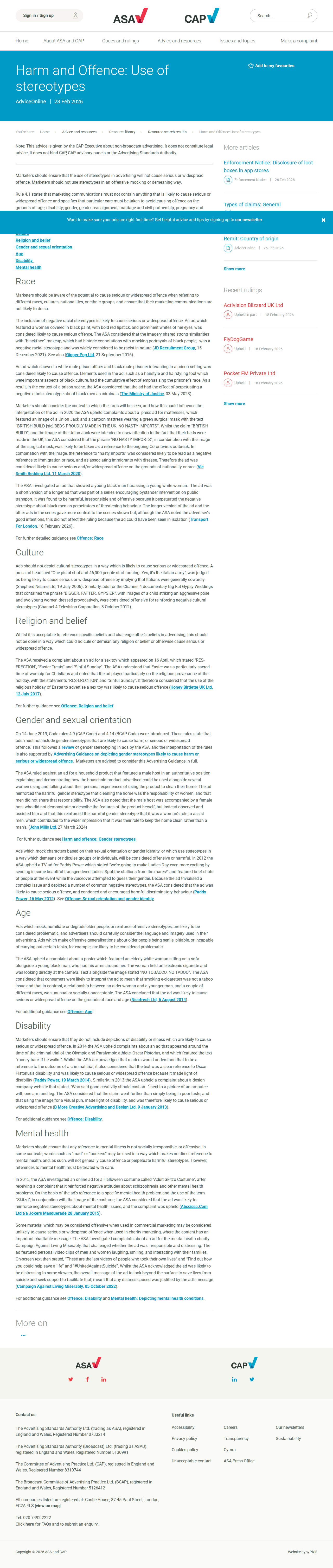
BBC — Casey Audit: Ethnicity of Grooming Gangs "Shied Away From"

House of Commons — Forgotten White Working Class Summary

Education Policy Institute — Annual Report 2024 Ethnicity

BBC — Sewell Report "UK Not Deliberately Rigged Against Ethnic Minorities"

HoC Boys Education Attainment (White British boys at GCSE)
The Independent — BBC Presenter "Overwhelmingly White" Workplace Mental Health

BBC — "Rural Racism in Dorset: Why Is Our Countryside 98% White?"

BBC Radio 4 — AntiSocial: "Racism and the Countryside" (colonial white space)
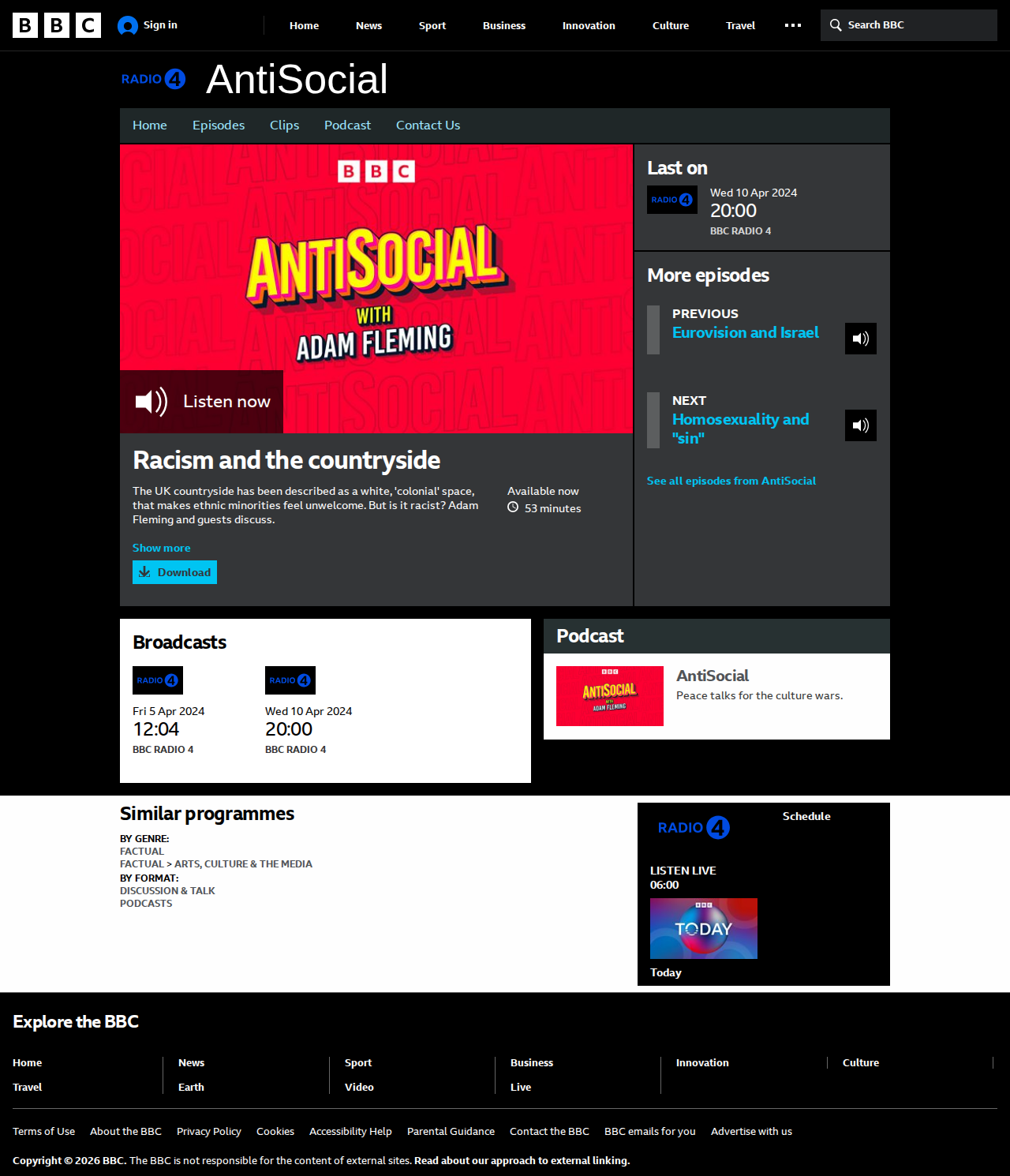
Reuters Institute — "Put Fewer White Men at the Top"
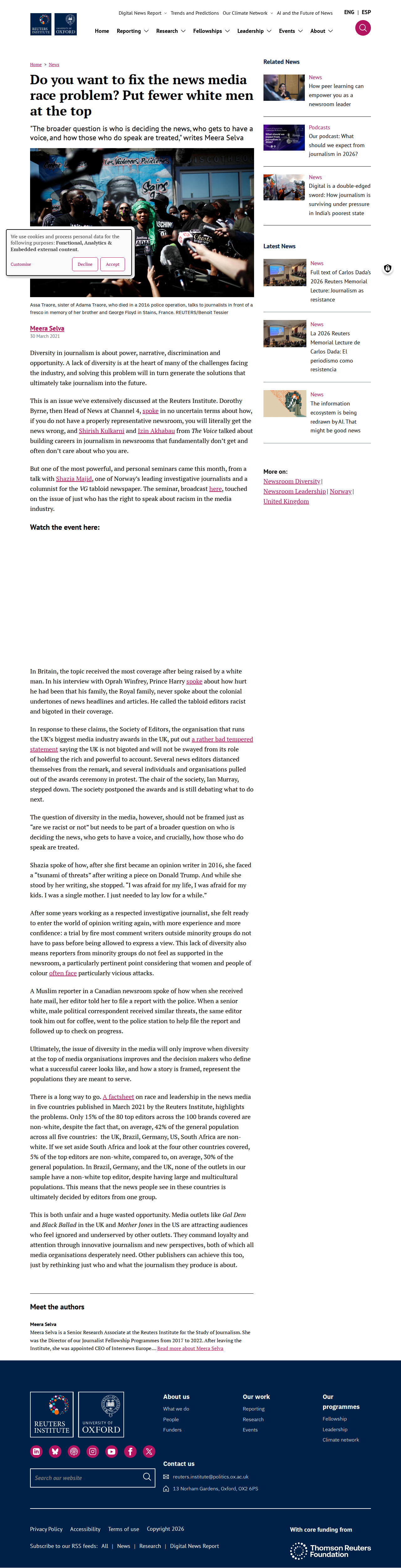
The Conversation — "Whiteness Is at the Heart of Racism in Britain"
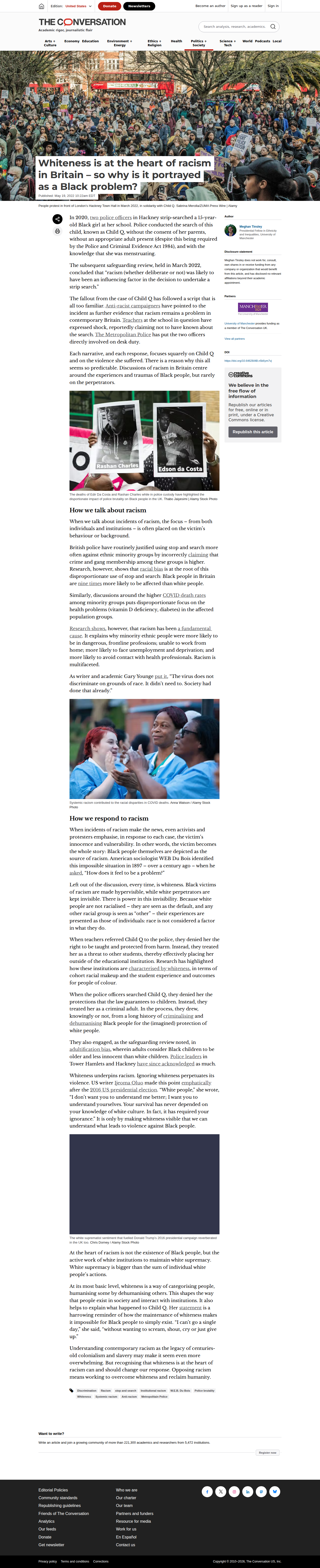
The Guardian — Robin DiAngelo: "Niceness" and White Fragility (2019)

The Guardian — Robin DiAngelo Interview: "The Problem with White People" (2019)

The Guardian — Kehinde Andrews: Universities Are "Whitest Institutions" (2021)

The Guardian — "White Fragility, White Fear" (2016)

BBC — "Such a Fun Age": Novel Exploring White Privilege (2020)

BBC — Government to Override Sentencing Rules After 'Two-Tier' Row (March 2025)
[BBC News article captured 11 March 2026](/Claims/racism-against-native-english/evidence/bbc-sentencing-council-two-tier-justice-override/2026-03-11_08-59-18/page.txt)BBC — Sentencing Guidelines Delayed After 'Two-Tier' Row (March 2025)
[BBC News article captured 11 March 2026](/Claims/racism-against-native-english/evidence/bbc-sentencing-council-guidelines-delayed/2026-03-11_08-59-32/page.txt)GOV.UK — New Law to Ensure Fairness for All in Court — Sentencing Guidelines (Pre-sentence Reports) Act 2025
[GOV.UK Ministry of Justice press release captured 11 March 2026](/Claims/racism-against-native-english/evidence/govuk-sentencing-guidelines-fairness-act/2026-03-11_08-59-32/page.txt)BCU / Sir Lenny Henry — "Young people need to see themselves up there on the screen"
[Birmingham City University article captured 11 March 2026](/Claims/racism-against-native-english/evidence/lenny-henry-young-people-see-themselves/2026-03-11_14-16-21/page.txt)Variety — BBC £112m Diversity Investment: June Sarpong "audiences rightly expect to see themselves represented"
[Variety article on BBC diversity investment captured 11 March 2026](/Claims/racism-against-native-english/evidence/bbc-diversity-audiences-see-themselves/2026-03-11_14-16-51/page.txt)The Guardian — "How can I help my white friend understand his dating preferences are racist?" (2023)
[Guardian column captured 11 March 2026](/Claims/racism-against-native-english/evidence/guardian-white-dating-preference-racist/2026-03-11_14-17-15/page.txt)Kent County Council — "Don't Disrespect" VAWG video: white boys harass, Muslim boy defends (kent-council-dont-disrespect-white-boys-muslim-hero)
Government-funded short film (premiered 8 Feb 2025; 46,000+ views) produced for schools and youth hubs across Kent. Credits: "Developed by young people. Produced by Prod Company. Funded by Government." Depicts white boys sexually harassing a girl, Muslim boy intervening to stop them. On-screen statistic: "75% of girls in the UK have experienced some form of public sexual harassment in their lifetime." Casting inverts the documented reality of grooming gang perpetration (83% Muslim-background per Southampton/Reading 2020; Pakistani men 64% of Rotherham CSE perpetrators per Casey Audit 2025). Source: YouTube (Kent County Council, Feb 2025); corroborated by Kent and Medway VRU official campaign page (kentandmedwayvru.co.uk/dontdisrespect/).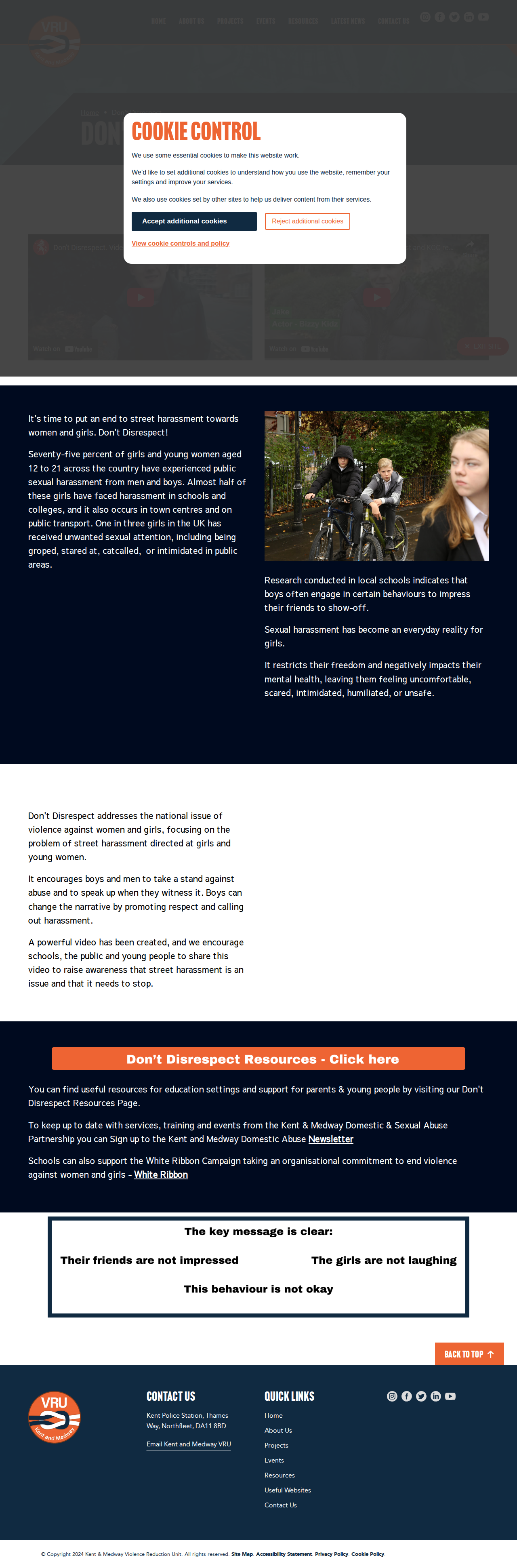
Public Sector Executive — "Don't Disrespect" campaign confirmed: government-funded, Kent County Council and Kent Police partnership

Kent County Council Official Press Release — "Kent's young people launch 'Don't Disrespect'" (kent-council-dont-disrespect-press-release)
Official Kent County Council press release (https://news.kent.gov.uk/articles/kents-young-people-launch-dont-disrespect-anti-street-harassment-film-and-campaign) confirming: "Produced in partnership between Kent County Council, Kent Police and the Kent and Medway Violence Reduction Unit and funded by government." Also corroborated by KELSI (https://www.kelsi.org.uk/news-and-events/news/secondary/dont-disrespect.-help-us-tackle-street-harassment), Public Sector Executive, and Kent and Medway VRU (https://kentandmedwayvru.co.uk/dontdisrespect/).
The Telegraph — "Anti-white racism is rampant and must be stopped" (Suella Braverman, October 2025) [telegraph-braverman-anti-white-racism-rampant]
Former Home Secretary Suella Braverman wrote: "From the casual to the institutional, this inversion of prejudice has taken root in Britain. And those who point it out are vilified." The article references the controversy around Sarah Pochin's comments on TV advert racial representation, the grooming gang cover-up, and the broader pattern of anti-white institutional double standards. Braverman is of Indian-Mauritian heritage, making her identification of anti-white racism a cross-racial acknowledgement. Article published in The Telegraph (~500,000 subscribers), October 2025. Note: article behind paywall; headline and partial text visible without subscription.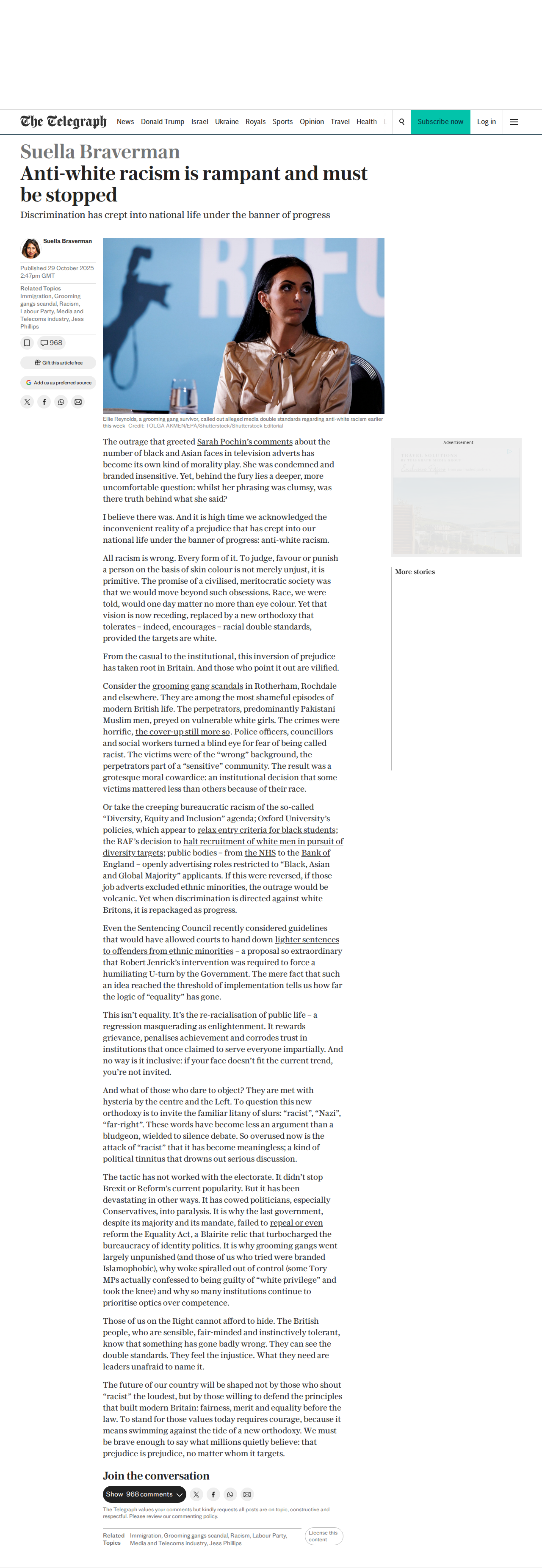
X (Twitter) — Visegrad24 response to Anand Menon on "minority white" debate [visegrad24-x-post]
Visegrad24 responded to Anand Menon's article in The Independent questioning "Who cares that Britain is on course to be 'minority white'?" with: "So glad you asked, Anand Menon. Who cares? Well, the English, the Welsh, the Scottish and the Irish might care, for starters." This demonstrates the dismissive attitude toward native British concerns about demographic change. Menon's article, published in The Independent (June 2025), argued that concerns about the white British population becoming a minority by 2063 were overblown and should not spark debate about immigration — only "integration." The Visegrad24 response highlights that the native British populations (English, Welsh, Scottish, Irish) have legitimate reasons to be concerned about demographic transformation of their own country — a concern that is framed as racist when expressed by white British people but treated as a legitimate aspiration when expressed by ethnic minorities (e.g., "see people like me represented"). This evidence supports the broader claim by demonstrating: (1) mainstream political commentators dismiss native British concerns about becoming a minority in their own country; (2) the same concern expressed by ethnic minorities is institutionalised as a "legitimate need" (BBC, Ofcom) while the identical concern from white British people is treated as socially unacceptable; and (3) the pattern of treating native British demographic concerns as inherently problematic while welcoming demographic change for other groups represents a systematic double standard.